Article Highlights | April 7, 2026
image:
image
view more
Credit: Higher Education Press
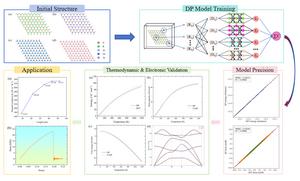
Two-dimensional group III nitrides (h-BN, h-AlN, h-GaN, and h-InN) show great promise in electronic and optoelectronic applications due to their hexagonal structure, thermal stability, and wide bandgap. However, exploring their structure and performance on a large scale faces significant challenges. Traditional density functional theory (DFT) is limited by prohibitive computational costs for large systems, whereas classical molecular dynamics (MD) relies on empirical potentials and therefore often lacks sufficient precision to describe complex interactions.
Here, this study uses a deep potential (DP) method to construct a machine learning potential (MLP) that combines the accuracy of DFT and the efficiency of MD simulation. The developed DP model achieved DFT-level accuracy in energy and force prediction and accurately reproduced the phonon dispersion and thermodynamic functions (free energy, heat capacity, and entropy) over the temperature range from 0 to 1200 K. Extensive MD simulations revealed unique mechanical behavior. h-BN exhibits high strength but brittleness, while h-AlN and h-GaN exhibit a good balance between strength and ductility. Furthermore, nonequilibrium MD simulations revealed that the thermal conductivity of h-BN and h-AlN due to the long phonon mean free path is strongly length dependent, in contrast to the low scattering-dominated thermal conductivity of h-GaN and h-InN.
The study, titled “Possibilities of machine learning for predicting properties of two-dimensional Group III nitrides,” Acta Physico-Chimica Sinica (Published November 24, 2025).