

Dinosaur footprints have always been a bit of a mystery. Now, an artificial intelligence app called DinoTracker is converting these ancient footprints into data that scientists can finally read in detail, and the results could push the origins of birds back tens of millions of years further than anyone expected.
The system, developed by researchers from Berlin’s Helmholtzzentrum and the University of Edinburgh, allows users to upload photos or simple outlines of fossil footprints. This app suggests in seconds what kind of dinosaur likely made it, with accuracy comparable to professional paleontologists in most tests.
So what is the app actually looking for when it studies three-toed footprints in stone?
How DinoTracker reads stone footprints
Behind the simple interface is an unsupervised neural network trained on 1,974 dinosaur and bird footprints spanning over 200 million years of evolution. Instead of being told in advance which tracks belong to which groups, the network was left to classify the shapes on its own and find the pattern that best separates the shapes.
The model has learned eight main ways in which footprints differ. These include how wide your toes spread, how your toes attach to the rest of your foot, the position of your heel, the area of your foot that actually touches the ground, and how your weight is distributed from side to side.
In testing, the classification matched human experts’ judgments approximately 80 to 93 percent of the time, depending on the type of truck.
Physicist Gregor Hartmann, who led the study, explains that the method is an objective way to recognize subtle changes in footprints that people often overlook. Doing so, he points out, reduces the risk of long-held assumptions being baked into new digital tools.
The oldest bird hidden in plain sight
After the network mapped this footprint “landscape,” the team added labels based on previous expert work, including the footprints of carnivorous theropods, plant-eating ornithopods, large tetrapods, and both fossil and modern birds. Next, they provided some of the most controversial prints in dinosaur research.
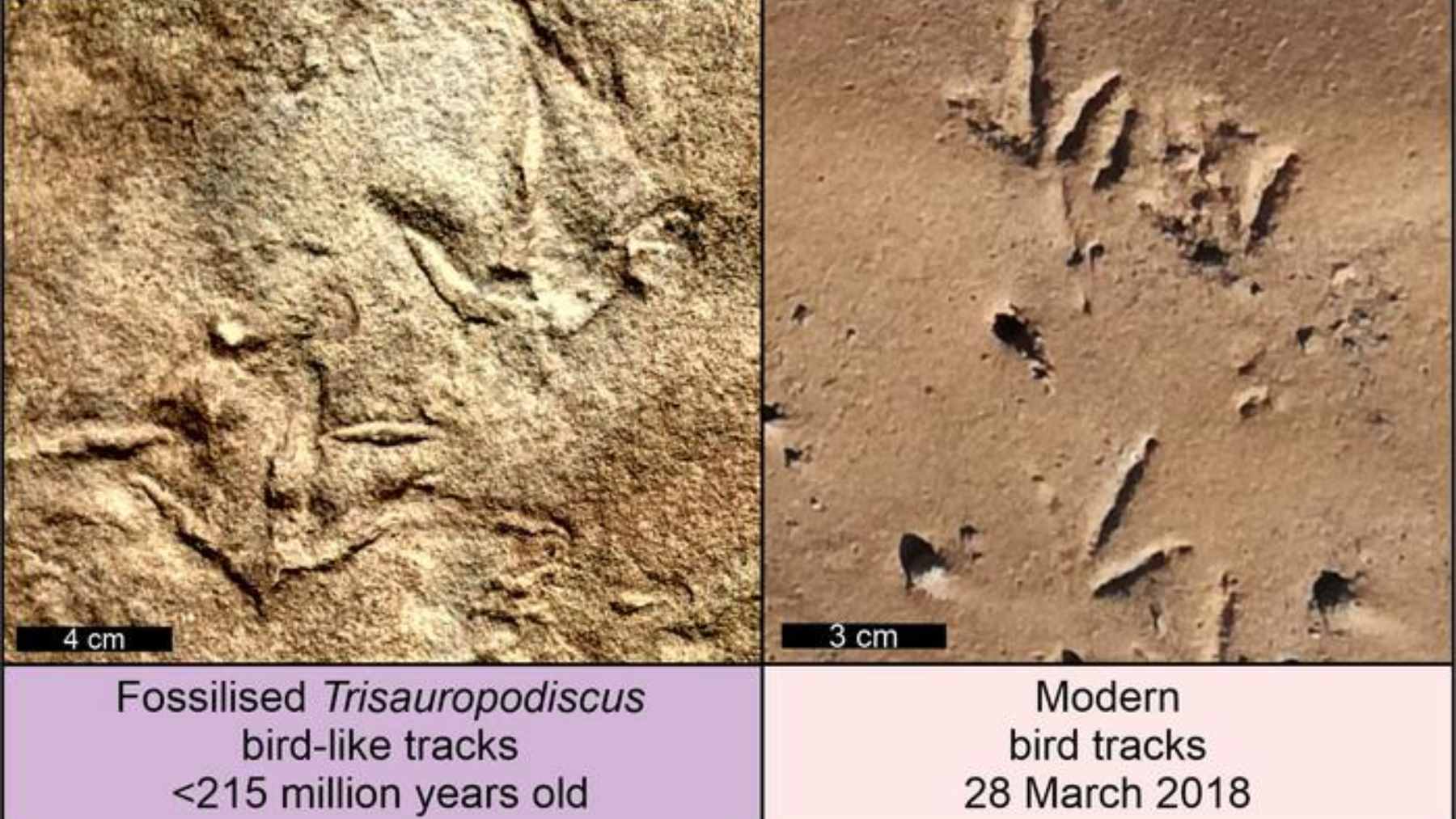
Several small three-toed footprints from the late Triassic to early Jurassic period, including one discovered in what is now South Africa, have long looked like creepy birds. DinoTracker placed most of them directly in the footprints of birds, rather than non-avian theropods.
The footprints are about 210 million years old, which is about 60 million years older than the oldest known bird skeleton.
Does that mean real birds were already roaming around that early? Researchers are cautious. This footprint could represent a real, early bird whose bones have yet to be found, but it could also come from a small dinosaur that happened to have very bird-like feet, or that left bird-like tracks in the soft, moist sediment.
Paleontologist Steve Brusatte, one of the study’s senior authors, said the similarities are so strong that scientists need to take this possibility seriously and look for explanations that fit both the bones and footprints.
The app has also revisited mysterious mid-Jurassic footprints found on the shores of a long-vanished lagoon on the Isle of Skye.
Many of these footprints match early relatives of duck-billed dinosaurs, suggesting that some of the group’s earliest known members were already roaming what is now Scotland, although some footprints are still closer to classic theropods.
From ancient mud to questions about modern climate
At first glance, this may seem like a very technical discussion. But dinosaur footprints are more than just curiosities pressed against boards in museum hallways.
These are formed in real environments, such as riverbanks, floodplains, and tidal flats, and often preserve how animals migrate, what paths they take, and what habitats they prefer. As such, they provide powerful clues to the structure of ancient ecosystems and how life responded to changes in climate and sea level in the distant past.
By classifying thousands of footprints in a more consistent way, AI tools like DinoTracker can help scientists better map when different dinosaur groups appeared, where they lived, and how their communities changed during mass extinctions.
These long-term patterns are important when considering how modern species will respond to rapid warming and habitat loss. The rock record becomes a kind of stress test for planetary change.
New tools, not crystal balls
The team is clear that DinoTracker is not meant to replace human fieldwork. The shape of a footprint depends on what the animal was doing, how wet the ground was, and how much the footprint was eroded or distorted during fossilization.
Because the app focuses only on shape, researchers must verify the age and geology of each site before making bold claims about the origins of birds or the behavior of dinosaurs.
The good news is that this software is free and aimed at both professionals and the curious public.
A paleontologist working in a remote desert, a student on a school trip, or a hiker who stumbles upon suspicious three-toed tracks can all use the same tool to make the first standardized comparison with known footprints.
That first pass may be wrong in some cases, but it gives experts a common starting point rather than a pile of competing intuitions.
After all, DinoTracker is less like an oracle and more like an extra colleague at the table, observing patterns in the stone that are easily missed by the human eye.
This research Proceedings of the National Academy of Sciences.

