Biomimetic trabecular architecture with thermodynamically adaptive interfaces
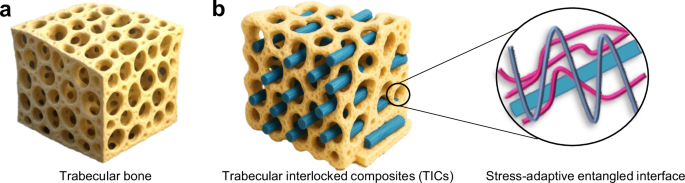
Inspired by the hierarchical porosity and mechanical efficiency of natural trabecular bone1,2, we establish a biomimetic composite design paradigm governed by thermodynamic principles (ΔG = ΔH − TΔS)25,26. Central to this strategy is the reduction of interfacial enthalpy (ΔH) during the thermal blending, which lowers the energetic barrier for polymer chain interdiffusion and promotes the formation of stable physical interlocks at soft–hard interfaces. This concept is realized in the trabecular interlocked composites (TICs), characterized by aligned reinforcing phases embedded within a robust three-dimensional porous skeleton (Fig. 1b). The stress-adaptive interfaces in these composites rely on dynamic diffusion and entanglement of polymer chains with rigid constituents under thermal activation, thus transitioning from traditional static bonding toward a thermodynamically governed entanglement strategy.

a Hierarchical porous architecture of natural trabecular bone serving as the biological prototype. b Proposed composite strategy: a continuous 3D trabecular scaffold interlocks aligned reinforcements through thermodynamically driven soft-hard interfaces, enabling stress-adaptive entanglement.
The effectiveness of this approach is experimentally validated in a ternary system, where thermoplastic polyurethane (TPU) functions as the entanglement promoter, poly(phenylene ether ketone) (POK) serves as the rigid matrix, and aligned basalt fibers (BF) provide structural reinforcement. Analogous to natural bone structures, TPU forms collagen-like entangled networks, while the POK phase provides structural rigidity, and the shear-aligned BF creates the trabecular scaffold. The hierarchical porous architecture is fabricated via gas-assisted pore formation under controlled thermo-shear conditions. Upon thermal activation, TPU chains become highly mobile and gradually diffuse into the POK matrix and along the BF interfaces. This interdiffusion lowers the interfacial enthalpy (ΔH), thereby reducing the energetic barrier for physical entanglement formation. The resulting dynamic, entangled interfaces enhance compatibility and mechanical integrity. These phenomena are substantiated by thermal analyses, structural characterizations (Figure S5), and molecular dynamics simulations (Fig. S6 and Supplementary Note 2).
Machine learning (ML) driven multi-objective optimization
While the feasibility of the trabecular interlock architecture and thermodynamically driven interfacial strategy has been established, the compositional design space for these polymer composites remains extensive and intrinsically high-dimensional. Traditionally, optimized polymer composite formulations are developed through empirical trial-and-error methods27,28, which involve adjusting one variable at a time (e.g., x1 in Fig. 2a) while keeping others constant. Performance metrics such as f(x1) improve gradually through repeated cycles of formulation, testing, and adjustment. However, conventional approaches become inefficient when addressing multiple mechanical objectives with competing trade-offs.

a Conventional trial-and-error approaches iteratively vary a single formulation component (e.g., x1) while fixing other variables, establishing empirical relationships (e.g., x1 ~ f(x1)) through repeated testing and adjustments. This method is time-consuming and ineffective for addressing high-dimensional, multi-objective problems. b The ML-guided framework incorporates Pareto Set Learning (PSL), Gaussian Process (GP) modeling, and Active Learning (AL) to concurrently explore and optimize multiple mechanical objectives. Formulations derived from preference-based models are evaluated via GP predictors and validated experimentally through mechanical property measurements (strength, fracture toughness, and impact energy dissipation). This integrated strategy enables rapid identification of high-performance formulations that conventional methods struggle to discover.
To address the intrinsic trade-offs among strength, toughness, and impact resistance, we introduce a machine learning (ML)–assisted multi-objective optimization framework (Fig. 2b). This data-driven approach systematically explores the composition–performance landscape, identifies approximate Pareto-optimal solutions, and resolves competing performance objectives. Consequently, the framework significantly accelerates the discovery and refinement of high-performance composite formulations.
Pareto set learning (PSL)
An initial baseline dataset is established using a design-of-experiments (DoE) strategy by selecting 50 representative composite formulations spanning the feasible composition space. Each formulation is experimentally fabricated and mechanically characterized to measure tensile strength, fracture toughness, and impact energy dissipation. These data are used to train three independent Gaussian process regression (GPR) surrogate models.
As the training set size increases from 30 to 50, cross-validated predictive performance improves systematically for all three targets, as evidenced by increasing coefficients of determination (R2), decreasing mean absolute errors (MAE), and decreasing mean squared errors (MSE), together with a concurrent reduction in predictive uncertainty quantified by the standard deviation across validation folds (Supplementary Note 3.1 and Fig. S7). Although toughness-related properties exhibit comparatively higher uncertainty at smaller sample sizes, all surrogate models attain statistically reliable accuracy at 50 samples, thereby establishing a robust foundation for subsequent multi-objective optimization.
Building on the validated GPR surrogates, multi-objective optimization is performed using Pareto set learning (PSL). PSL learns a mapping from preference vectors λ, which encode user-defined trade-offs among competing objectives, to optimized formulations x by scalarizing the multi-objective problem into a tractable single-objective form29. By sampling 1000 preference vectors, the trained PSL model generates a diverse and structured set of Pareto-consistent candidate solutions spanning a broad range of engineering priorities (Supplementary Note 3.2 and Fig. S8).
Active learning (AL)-guided optimization
To further improve optimization efficiency and solution quality, we integrate active learning (AL) with multi-objective Bayesian optimization to iteratively refine the learned Pareto set and guide exploration of the trabecular interlocked composites (TICs) design space30,31. Specifically, we adopt an acquisition strategy that combines a lower confidence bound (LCB) criterion with hypervolume improvement (HVI) to select small batches of informative and non-dominated candidates from the PSL-generated solution pool for experimental validation (Supplementary Note 3.3). This uncertainty-aware strategy balances exploitation of high-performing regions with exploration of poorly sampled areas, enabling targeted expansion of the experimentally validated performance envelope under a fixed experimental budget.
Starting from the baseline dataset (Fig. 3a), the experimentally sampled formulations in the strength–fracture toughness space follow an approximately monotonic trend, with impact energy dissipation co-varying with the high-performance region. However, the initial data are concentrated around intermediate strength (≈220–235 MPa) and fracture toughness (≈12–13.5 MPa·m1/2), leaving the extreme high-performance boundary sparsely sampled. With successive AL iterations (Figs. 3b and S9), newly selected formulations progressively populate the upper-right region of the design space, corresponding to tensile strengths exceeding ~245 MPa and fracture toughness values above ~14.5 MPa m1/2, while maintaining high impact energy dissipation (>4.6 J). Furthermore, the selected candidates are not clustered in regions of high sample density but are preferentially drawn toward areas associated with elevated predictive uncertainty and potential Pareto-front expansion, consistent with the intended uncertainty-aware acquisition strategy.

a Initial experimental dataset (n = 50) projected in the strength–fracture toughness space, with impact energy dissipation encoded by color. Marginal density profiles summarize the univariate distributions of strength and fracture toughness. b The same property space after successive active learning (AL) iterations, highlighting previously selected AL formulations and the current AL batch. Newly selected points preferentially populate the high-strength/high-toughness boundary while maintaining high impact energy dissipation. c Normalized hypervolume (HV) of the non-dominated set as a function of the number of experiments (left axis), together with the incremental hypervolume gain (ΔHV) per AL update (right axis). The HV exhibits a pronounced early increase followed by saturation, indicating diminishing marginal gains after rapid Pareto-front expansion. d–f Pareto set obtained by retraining the PSL model after completion of five AL iterations (25 additional experiments, total n = 75). d Approximate Pareto set in the TPU–BF–POK composition space. Green points denote PSL-generated Pareto-consistent solutions; semi-transparent connections indicate preference-guided associations between neighboring solutions (shown as a guide to the eye). The solutions are confined to a relatively narrow compositional basin. e Three-dimensional representation of the Pareto-consistent solutions in the strength–fracture toughness–impact energy dissipation space, revealing a smooth, manifold-like trade-off structure. f Projection of the Pareto set onto the strength–fracture toughness plane with impact energy dissipation encoded by color. Highlighted markers indicate representative solutions extracted for balanced, strength-prioritized, fracture-toughness–prioritized, and impact-energy–prioritized design preferences. The inset ternary diagram compares prescribed preference vectors (stars) with the corresponding matched preference vectors (circles), demonstrating close alignment between intended design priorities and realized PSL solutions.
The efficiency of this frontier expansion is quantified by hypervolume (HV) analysis. More than 90% of the total normalized HV gain is achieved within the first ten additional experiments, driven by a dominant early HV increase (ΔHV ≈ 0.012), followed by rapid saturation with marginal gains below 0.001 per iteration. Across five AL iterations, learning-curve analysis further reveals systematic improvements in cross-validated predictive accuracy and progressive stabilization of the surrogate models, particularly for fracture toughness and impact energy dissipation (Fig. S10). Independent hold-out testing confirms robust out-of-sample generalization for all three properties, with no evidence of systematic prediction bias (Fig. S11).
Finally, benchmarking against a classical response surface method (RSM) under identical experimental budgets (50 initial formulations plus 25 additional trials) demonstrates that the combined PSL + AL framework consistently drives the Pareto front toward higher-performance regimes and achieves over 90% of its terminal normalized hypervolume improvement within the first ten additional experiments. In contrast, RSM yields only marginal performance gains even after exhausting the full experimental budget (Fig. S12). These results establish that uncertainty-aware, iterative learning enables substantially higher sample efficiency and reliability than conventional quadratic design-of-experiments baselines.
Preference-guided solution extraction
After completion of five active learning iterations (25 additional experiments), the PSL model is retrained using the expanded dataset, yielding the optimized Pareto set shown in Fig. 3d–f. The resulting Pareto-consistent solutions exhibit a pronounced and organized structure across both composition and performance spaces. In the TPU–BF–POK composition space (Fig. 3d), the solutions are confined to a relatively narrow compositional window rather than being dispersed across the full admissible domain, revealing a well-defined high-performance basin.
A consistent structural organization is observed in the three-dimensional performance space (Fig. 3e), where the Pareto-consistent solutions form a smooth, manifold-like trajectory instead of a diffuse cloud. This behavior indicates that the achievable multi-objective trade-offs are constrained by a common structural regime, within which improvements in tensile strength are accompanied by predictable and coupled variations in fracture toughness and impact energy dissipation, rather than arbitrary performance fluctuations.
This structured Pareto manifold enables preference-guided engineering decision making (Fig. 3f and Table S2). By specifying target preference vectors, representative solutions corresponding to balanced, strength-prioritized, fracture-toughness–prioritized, and impact-energy–prioritized design modes can be directly extracted along the learned manifold. The close agreement between the prescribed preference vectors and their matched counterparts confirms that PSL preserves preference information during solution generation, allowing explicit design priorities to be translated into concrete compositions and predicted performance outcomes.
These results demonstrate that the combined AL–PSL framework not only accelerates the discovery of high-performance Pareto fronts but also constructs a mechanistically admissible and queryable design manifold, enabling practical and transparent composite formulation design under competing performance objectives.
Experimental validation of preference-guided Pareto solutions
To validate the machine-learning–selected Pareto solutions experimentally, we fabricated four representative formulations corresponding to distinct design preferences (balanced, strength-first, fracture-first, and impact-first). Across tensile, notched tensile, and impact loading, the macroscopic response curves remain highly consistent (Fig. 4a–c), with comparable yielding, strain hardening, and terminal failure behavior. This similarity indicates that preference-guided selection operates within a narrowly defined high-performance basin, rather than shifting the material into qualitatively different deformation regimes.

a Tensile stress–strain curves of four representative designs (balanced, strength-first, fracture-first, and impact-first; compositions indicated in the legend). b Force–displacement responses from notched tensile (fracture) tests, with the inset schematically illustrating the loading configuration. c Impact force–displacement curves showing the energy-dissipation process. d–f Summary of experimentally measured tensile strength, fracture toughness, and impact energy dissipation (mean ± s.d., n = 5 independent specimens per design). The shaded region denotes the ±1 s.d. envelope of the balanced formulation. g–i Relative differences (Δ) of the three mechanical metrics with respect to the balanced design. Dashed lines indicate zero difference. The small Δ values compared with experimental scatter highlight that preference selection reorders trade-offs within a tightly clustered high-performance region rather than inducing large absolute shifts in mechanical performance. j–l Ashby-type benchmarking of experimentally validated formulations. j Specific fracture toughness versus specific strength, showing that the optimized composites occupy a high-performance composite regime beyond conventional polymers and ceramics. k Fracture toughness as a function of density, highlighting the lightweight yet damage-tolerant nature of the optimized designs. l Specific impact energy dissipation versus specific impact force, demonstrating simultaneous enhancement of impact resistance and energy absorption. Red markers denote formulations selected from the optimized Pareto set. Data for j-l are adapted from CES Selector™ and referenced literature (Tables S3 and S4).
Quantitatively, the absolute properties cluster tightly. Tensile strength spans approximately 248–250 MPa (maximum deviation ~1.2 MPa relative to the balanced formulation, <0.5%, Fig. 4d, g), and fracture toughness remains near 14.8–14.9 MPa m1/2 (differences ~0.02 MPa m1/2, Fig. 4e, h), both within experimental scatter. Impact energy dissipation is similarly concentrated (~ 4.65–4.71 J, Fig. 4f, i), with the impact-first design exhibiting a small but reproducible increase (~ 0.06 J, ~1%) relative to the balanced reference. Expressed as relative differences with respect to the balanced formulation, the shifts remain modest yet directionally consistent with the prescribed preferences, supporting that preference guidance primarily refines trade-off ordering within an already optimized performance envelope.
To contextualize these validated formulations within a broader materials landscape, we benchmark their mass-normalized performance against representative natural and engineered materials using Ashby-type maps (Fig. 4j–l; Tables S3 and S4). All four designs occupy a narrow yet high-performance region across the examined property spaces, consistent with convergence toward a Pareto-optimal plateau governed by a shared deformation and energy-dissipation mechanism. In the specific strength–specific fracture toughness map (Fig. 4j), the optimized TICs fall within the advanced composite and bone-like regime, positioned well above conventional polymers and non-technical ceramics. When density is explicitly considered (Fig. 4k), all formulations remain in a lightweight regime (<1000 kg/m3) while maintaining fracture toughness on the order of 10–20 MPa m1/2, highlighting a rare combination of low mass and damage tolerance. A similar clustering is observed in the specific impact force–specific energy dissipation map (Fig. 4l), where the TICs exhibit concurrent enhancement of impact resistance and energy absorption, comparable to or exceeding reported Bouligand and gradient composite architectures.
The close grouping of the four designs across these Ashby maps therefore reflects convergence toward a Pareto-optimal performance plateau governed by a shared deformation and energy-dissipation mechanism, rather than experimental scatter. This convergence underscores the robustness of the preference-guided optimization and provides a reliable basis for Ashby-map–guided materials comparison and selection.