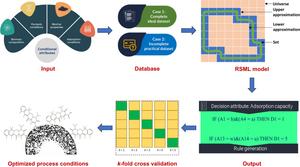
New research published in journal carbon research We are deploying advanced machine learning models that can predict the most effective way to create biochar to remove antibiotics from water. A collaborative team of scientists from National Institute of Technology Rourkela, University of Aucklandand Tarim University demonstrated that their model can generate reliable and scientifically consistent rules even when dealing with incomplete “real world” datasets, a common challenge in scientific research. This approach avoids the need for potentially biasing data entry techniques and provides a more robust tool for environmental remediation.
Decoding data with “rough sets”
The persistent organic pollutant tetracycline poses a serious threat to water sources and human health. Biochar, a charcoal-like substance made from biomass, shows promise as a purification adsorbent, but its effectiveness varies greatly depending on how it is produced and used. To overcome this complexity, a research team led by: Paramasivan Balasubramanian and mukhir raj prabhakarWe employed an explainable AI technique known as . Rough set-based machine learning (RSML). Unlike “black box” AI models, RSML generates clear “if-then” rules that are easy for scientists to interpret and test. This technique is designed to identify core attributes and hidden patterns in complex and messy data.
The researchers compiled a database of 295 experimental results from previously published literature. Next, we created two different scenarios for our model. The first used an “ideal” dataset containing 94 complete data entries with no missing values. In the second, more difficult scenario, we used a “practical” dataset containing all 295 entries, including entries that were missing information on key parameters. These two approaches allowed us to directly evaluate the unique ability of RSML models to handle the types of incomplete data often encountered in real-world applications.
From messy data to clear predictions
The analysis shows the extraordinary capabilities of the RSML framework. The model trained on the incomplete “working” dataset not only produced valid prediction rules, but also demonstrated higher overall accuracy in classifying the most effective biochars compared to the model trained on the “ideal” dataset. This finding is important because it suggests that valuable but incomplete datasets can be used effectively without resorting to imputation, a process of inferring missing values that can skew results. The model was successful in identifying the key elements needed for maximization. Tetracycline adsorption capacity.
Corresponding author of this study, Dr. Chung Liu from University of Aucklandcommented on the findings. “Real-world scientific data is rarely perfect and often has gaps. Our study shows that there is no need to discard this valuable information or rely on potentially biased data entry techniques. A coarse-grained approach By using it, we can build robust, interpretable models that provide clear, actionable rules for creating highly effective materials for environmental remediation. This brings us closer to a data-driven approach to designing solutions to complex pollution problems.”
Optimize decontamination with AI-driven recipes
This study provides a concrete guide for producing high-performance biochar. The “if-then” rules generated by the model serve as a set of recipes for success. For example, in a model trained on a practical dataset, producing biochar at a pyrolysis temperature of 300 °C and using it at a specific initial ratio of tetracycline to biochar (1–2) was found to be a key condition to achieve an adsorption capacity of more than 200 mg/g. These specific data-driven guidelines will help streamline biochar production and utilization and make water treatment efforts more efficient and effective.
Although preliminary results show great promise, the authors say: Zhang Pengyan and Hwayoung Leemaintain a positive perspective. They acknowledge that when using incomplete datasets, the model performs poorly on certain metrics such as recall and F1 score, indicating room for improvement. The research team suggests that the model requires additional refinement and testing before it can be widely implemented in real-world settings. Future efforts may focus on increasing the model’s predictive power and applying it to other environmental problems.
Corresponding author: Chung Liu
Original source: https://doi.org/10.1007/s44246-024-00129-w
contribution: Paramasivan Balasubramanian wrote the original manuscript, designed the methodology, and performed the formal analysis. Muhil Raj Prabhakar contributed to methodology, formal analysis, software, and manuscript review and editing. Chong Liu obtained resources and performed project management, supervision, and validation. Pengyan Zhang wrote the original draft and obtained the resources. Fayong Li contributed to the review and editing process and formal analysis.
Disclaimer: AAAS and EurekAlert! We are not responsible for the accuracy of news releases posted on EurekAlert! Use of Information by Contributing Institutions or via the EurekAlert System.