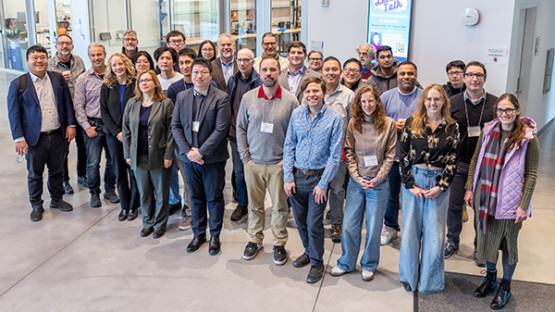
The Assessing and Imagining the Impact of Generative AI on Science symposium, held March 3-5 on Cornell University’s campus, brought together experts from academia, industry, and funding agencies to discuss how generative artificial intelligence (GenAI) is transforming science: the good, the bad, and the unknown.
In a series of panel discussions, participants considered both the incredible boom in scientific productivity enabled by this technology and issues related to AI governance, equity, access, and public trust.
This was a positive event that brought together a diverse range of scholars, including computer scientists, biologists, philosophers, and social scientists from both inside and outside of Cornell University, to address the implications of GenAI across scientific research, said co-organizer Ian Yin, assistant professor of information science in Cornell’s College of Computing and Information Sciences.
“Typically, we’re in a tiny piece of the universe,” said co-sponsor AJ Alvero, assistant professor at Cornell University’s Center for Data Science for Enterprise and Society. “But this week we were all in the same room and able to talk about this important issue and how it is changing perspectives in our field.”
Torsten Joachims, Vice Provost for Artificial Intelligence Strategy and Jacob Gould Schulman Professor in the School of Computer Science and School of Information Science, opened the symposium.
“We are witnessing a fundamental shift in the way science is conducted and communicated,” Joachims said. “While these changes are interesting, there are important implications that must be considered to ensure that the use of generative AI is rigorous, respects disciplinary norms, and does not undermine public trust in research.”
GenAI is accelerating the rate of scientific discovery and giving scientists access to more scientific publications. Large-scale language models like those that power ChatGPT are a great asset when writing papers, especially for scientists whose native language is not English. AI tools can also assist with troubleshooting, create websites, and assist with coding. We expect these tools to be further improved in the future.
But while AI tools are beneficial to individual scientists, the glut of AI-authored papers poses new challenges in how to evaluate each publication and determine its contribution to the field, Yin said. With GenAI, substandard science can be hidden by well-written papers and grant applications, complicating decisions about whether to accept papers into journals, which projects to fund, and even who should receive tenure. At the symposium, university leaders and representatives from funding agencies discussed this ongoing challenge.
“Many nuances and new challenges have emerged in efficient and fair evaluation,” Yin said. “Everyone agrees that it is urgently needed and we need to do more work on that and think more carefully about it.”
Another issue the panel discussed was scientific fraud. Plagiarism and data falsification have always been a problem, but GenAI tools make fraud easier than ever. “The barrier to entry for bad science is much lower,” Albero said. “Conversely, these same tools may make it easier to identify malicious actors.”
A common thread in the discussion was the need for stronger regulation in this era of the “Wild West” of AI. There is currently little regulation or guidance regarding its appropriate use for GenAI, often leaving researchers and universities to determine their own policies. As AI becomes more powerful, the need for regulation will only increase.
“We hope this is a contribution to the larger conversation as we continue to unravel this new territory,” Alvero said.
The Cornell AI Initiative, Cornell Bowers, Research & Innovation, the College of Arts and Sciences, and the Center for Data Science for Business and Society co-sponsored the symposium.
Patricia Waldron is a writer in the Cornell Ann S. Bowers College of Computing and Information Sciences.