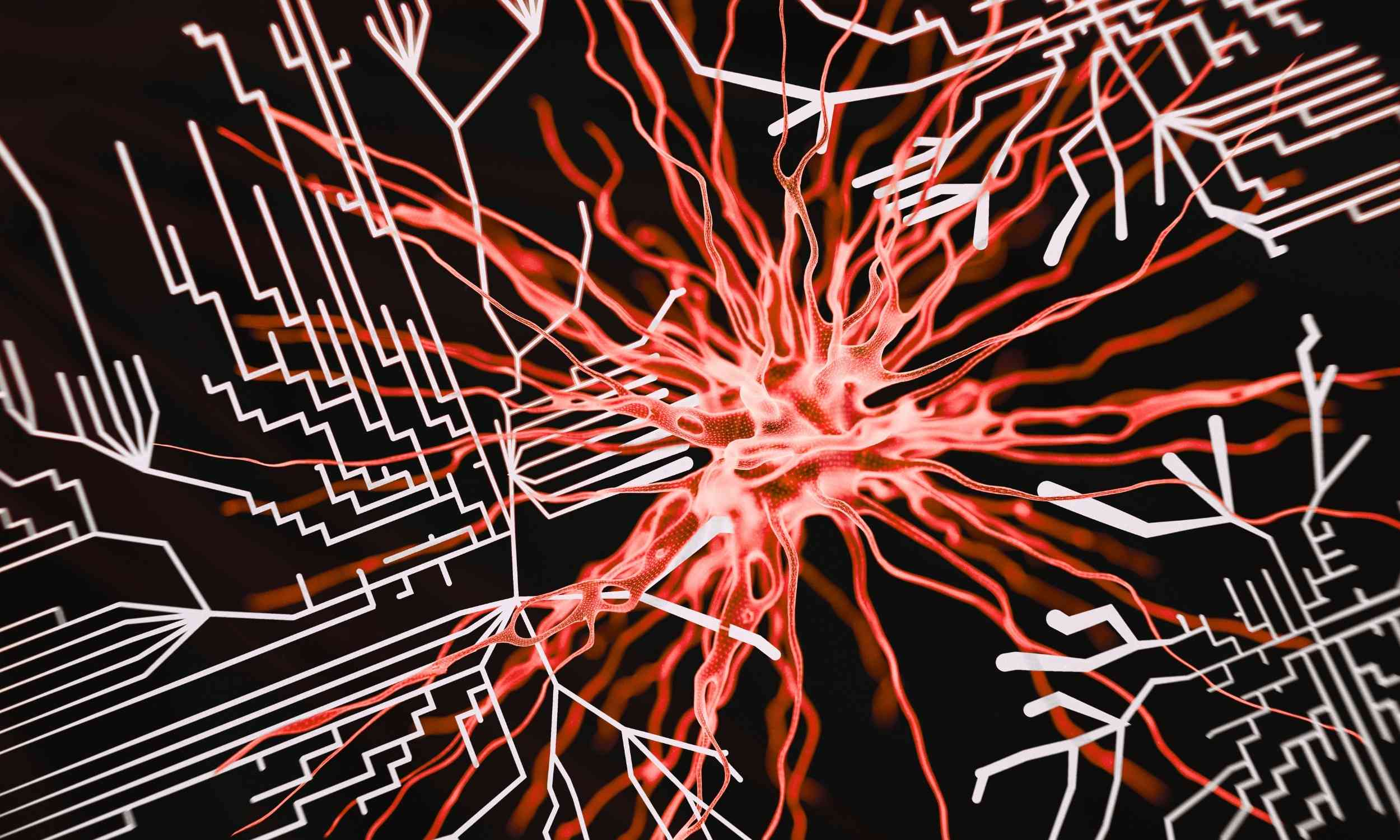
Researchers have discovered that artificial memory can switch with less than 10 nanoamperes of current while maintaining hundreds of stable states. This combination could help AI hardware learn and store information using much less power.
AI and artificial memory
Inside the test device, made of a thin oxide film, the resistance changed smoothly in many small steps instead of abruptly.

Dr. Babak Bakhit of the University of Cambridge has shown that a small 1-volt spike is sufficient to generate a controlled response.
Rather than disappearing after short periods of activity or collapsing into erratic behavior, these changes persisted over repeated use.
Such stability indicates that the device is more than a laboratory curiosity and raises deeper questions about why it consumes so little power.
Why is electricity consumed?
The main reason AI hardware consumes power is because today’s chips keep shuttling data between memory and processing blocks.
Brain-inspired hardware that stores and processes signals in one place could reduce energy usage by up to 70%.
Memristors, electrical components that store resistance, are made for just such local tasks.
Cambridge’s version operates with switching currents about a million times lower than some traditional oxide devices.
more stable switch
Older oxide memories typically rely on tiny conductive threads that repeatedly form and break, making their behavior difficult to predict.
Here, the device resistance was changed by nudging the interfacial barrier, so the device did not require any harsh formation steps.
As the charge moves and some oxygen and nitrogen ions drift away, that barrier rises and falls in controlled increments.
Smooth tuning allows the device to use intermediate levels instead of a single binary flip. This is important for learning tasks.
the nation that followed
Laboratory tests have shown that the components can continue to operate through more than 50,000 switching cycles and maintain their programmed state for approximately one day.
These states remained stable because many trapped charges shared the load, rather than all being carried along one fragile pathway.
Across 50 devices, the resistive gap remained wide enough to cleanly separate the stored values, even after repeated use.
Such reliable behavior is essential if engineers want to train models on large arrays without continuous modification.
learn from spikes
When the researchers repeatedly pulsed one volt to the device, its electrical weight increased and decreased in small, reproducible steps.
For hardware like the brain, learning relies on many small adjustments rather than one big rewrite, so incremental updates are important.
The response remained stable after about 40,000 spikes, and the device also followed the timing rules used in unsupervised learning.
These characteristics make this component more useful for adaptive hardware than memory, which can only be switched on and off.
What moved inside
Microscopy and spectroscopy pointed to the same cause: a boundary where one layer supplies positive carriers and the next provides negative carriers.
The boundary acts like a p-n junction, an electronic barrier between opposite charge types, and is initially strongly depleted.
Positive pulses push down the barrier by displacing charge and oxygen-rich defects, while negative pulses raise the barrier.
Because the entire interface is involved, the effect remains uniform across the device rather than wandering around a single weak point.
Why is chemistry important?
Strontium did more than just decorate the film, as the hafnium oxide helped carry the positive charge, rather than acting purely as an insulator.
Titanium narrowed the material’s energy gap, making it easier to maintain positively charged behavior under oxygen-rich growth.
Its chemical recipe produced a very high resistance at rest and opened the tuning range to more than 50 when the pulse arrived.
It may sound counterintuitive to have a large resistance, but that’s exactly what it does to keep the current low and energy usage low.
hottest issues
There is still one problem between this result and mass production. That means the film now needs to be grown at around 1,292 degrees Fahrenheit.
That heat is beyond the comfort zone of standard chip manufacturing, so the devices can’t just go straight into existing manufacturing lines.
“This is currently the main challenge in our device manufacturing process,” said Dr. Bakhit.
Solving this limitation could be as important as physics, as manufacturing often determines which smart devices survive.
The next step in artificial memory
If engineers can lower the growth temperature, these memories could fit into dense arrays that train and run models in the right places.
This reduces one of the biggest costs of AI hardware: the cost of communicating information before the actual computation begins.
“If you want hardware that can learn and adapt, not just store bits, you need these characteristics,” Bakhit says.
The team hasn’t shown a complete chip or a complete network yet, so the promise still rests on the next engineering phase.
This study describes an unusual combination of low current, stable multistep tuning, and brain-like learning within one material system.
The only question with this combination is whether it survives chip manufacturing, but it does point to AI hardware that spends far less energy on memory.
This research scientific progress.
—–
Like what you read? Subscribe to our newsletter for fascinating articles, exclusive content and the latest updates.
Check out EarthSnap, a free app from Eric Ralls and Earth.com.
—–