
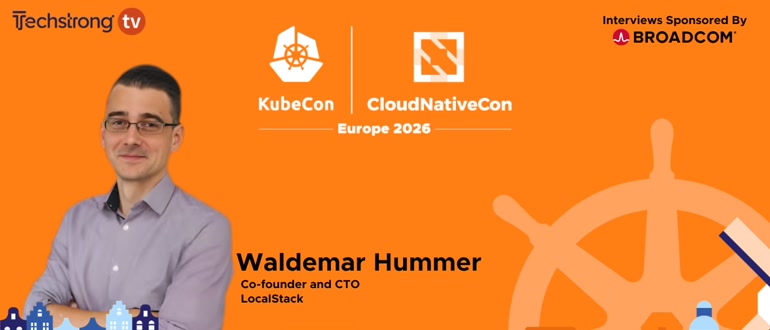
Testing AI agents against real cloud infrastructure is expensive, time-consuming, and often unreliable. In this interview from KubeCon Europe, Mike Vizard speaks with Waldemar Hummer, CEO of LocalStack, about how high-fidelity sandboxes are helping development teams bridge the gap between creating AI-driven applications and validating that they actually work as intended.
Mr. Hammer explains the core issue. AI agents that interact with cloud services need to be tested in a believable environment, but spinning up real AWS or cloud resources for every test cycle creates waste, increases costs, and introduces unpredictable delays. LocalStack addresses this issue by providing a local emulation layer that closely replicates the behavior of cloud services so that developers and AI agents can run meaningful tests without ever touching production.

In our conversation, we explore how this approach fits into modern platform engineering workflows. As teams deploy AI agents to autonomously provision infrastructure, create deployment configurations, and manage cloud resources, the need for safe and reproducible testing environments becomes critical. Without a sandbox that accurately reflects how cloud services respond, teams are essentially acting blind, discovering failures only after the code reaches staging or production.
Hammer also discusses how the rise of agent AI is changing the economics of cloud development. The cost of testing against real-world cloud APIs quickly increases when agents can repeat hundreds of test cycles within minutes. High-fidelity local sandboxes turn financial problems into solved problems and allow teams to test aggressively without worrying about cloud bills. For organizations building AI-powered applications on cloud-native infrastructure, this is a real-world consideration of an increasingly urgent question.
related


