The ‘TinyML UK Network’ brings together experts in AI, electronics, hardware design and embedded systems to establish collaboration and shape future research priorities in areas that enable AI to run directly on small, low-power devices, rather than relying on large data centres.
The new network is co-led by the University of Southampton and Imperial College London, and is funded by UK Research and Innovation through the Engineering and Physical Sciences Research Council.
Today’s AI systems rely on large-scale models, centralized cloud infrastructure, and continuous data transfer.
They are costly, energy-intensive, and increasingly difficult to maintain sustainably, as well as concerns about privacy, resilience, and digital sovereignty.
Distributed AI and TinyML run machine learning directly on sensors, wearables, and embedded systems that can operate locally, respond in real-time, and continue to function even when connectivity is limited. Store data close to where it is generated, reducing latency and energy usage while improving privacy and reliability.
However, this change requires new approaches to how models are trained, deployed, updated, and tuned across networks of hardware.
Aiman Kanjo, professor of pervasive sensing and TinyML and network leader at Nottingham Trent University’s School of Science and Technology, explained that the wider adoption of TinyML faces a combination of technical and commercial hurdles.
One of the most important technical constraints is memory, due to the limited capacity of microcontrollers, which limits model size and forces developers to rely on advanced optimization and compression, he said.
System-level chip design also presents challenges, as effective solutions must integrate sensing, communication, control, and AI processing.
“AI models and control tasks often require separate processors, which adds complexity,” said Professor Kanjo, who is also Honorary Visiting Professor at Imperial College London. “Furthermore, the lack of large-scale testbeds for distributed systems makes it difficult to verify performance under real-world conditions.”
Beyond technical issues, regulatory and structural barriers further slow progress. Excessive regulation can hinder adoption, especially in sensitive or highly controlled areas. Access to key industries is also limited, as policy frameworks and government support do not always provide a clear path to implementing new engineering solutions in real-world environments.
Resource constraints also remain a major hurdle, with a lack of talent with expertise across AI and hardware, as well as insufficient and fragmented funding.
Further utilization of artificial intelligence
“The TinyML UK Network is positioned to address these gaps by focusing on coordination rather than direct commercialization,” Professor Kanjo said. “Its primary role is to integrate fragmented ecosystems.”
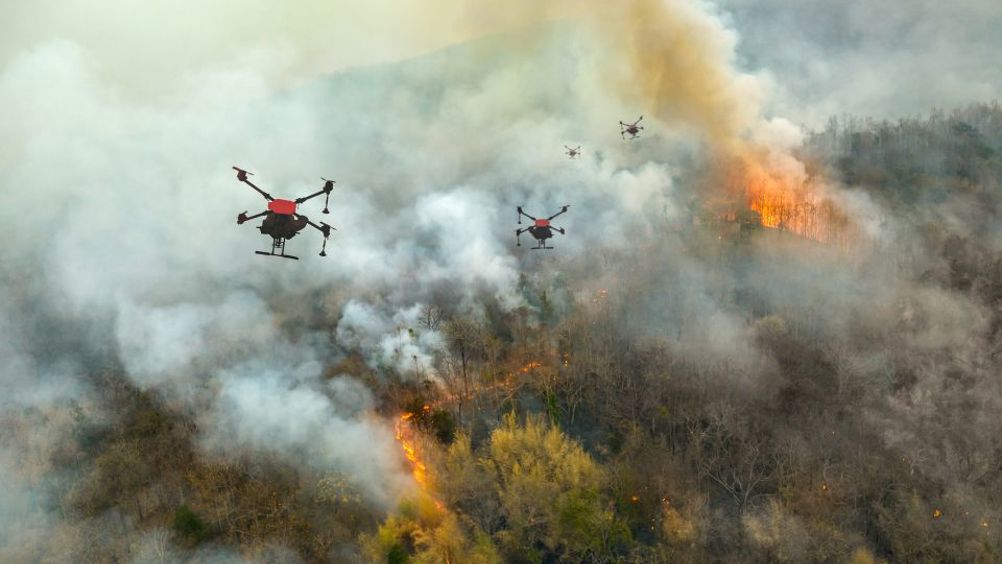
TinyML is already making real-world changes across a variety of applications, including defense and disaster management.
“Drones, robots, and wearables can run collaborative AI to detect hazards, support disaster management, and search for survivors without relying on central infrastructure,” said Professor Kamishiro. “These systems can operate even when connectivity is unavailable, increasing reliability in critical situations.”
He added that agriculture is also one of the early adopters.
“Devices can be attached to livestock or deployed across fields. [can] Monitor behavior, mating, feeding, interactions, health, ecology and environmental conditions. Local inference avoids continuous data transmission. This reduces energy usage and infrastructure costs while enabling large-scale deployment. ”
For industry, non-destructive testing and predictive maintenance are clear use cases, as sensors in machines detect vibration, temperature or acoustic anomalies and localize failures.
“Rather than streaming raw data to the cloud, only relevant events are reported,” says Professor Kanjo. “This reduces latency from network-level delays down to milliseconds, which is important for real-time control.
“Energy usage is reduced because communication is minimized. The main economic benefits come from reduced downtime and reduced maintenance interventions,” she continued.
Professor Kanjo added that TinyML is not a commercial vehicle.
“Their value lies in creating the conditions for adoption: shared knowledge, validated approaches, and a coordinated research and innovation pipeline.”