
When NASA’s Mars rover Perseverance needs to get from point A to point B, it’s not as simple as connecting GPS directions. The rover must avoid alien rocky areas, sand dunes, and steep slopes.
To chart a course for Perseverance, NASA enlisted the help of AI and digital twins. Kevin Murphy, NASA’s acting chief artificial intelligence officer, said digital twins are particularly useful for the agency, which “operates in some of the harshest environments imaginable.” This technology creates virtual replicas of real-world environments and conditions, helping NASA scientists understand real-time conditions in space and places like Mars.
Like NASA, the broader aerospace industry is also embracing the use of AI-powered digital twins. Karen Wilcox, director of the Auden Institute for Computational Engineering Sciences and professor of aerospace engineering and engineering mechanics at the University of Texas at Austin, said human oversight and verification is essential for aircraft and weapons that can put human lives at risk.
“Many of the AI deployments we’ve seen in other environments allow companies to act more quickly because the risk of getting it wrong isn’t a matter of life or death,” Wilcox said.
“AI is very powerful,” she added. “But AI alone will never be enough.”
Inside NASA’s digital twin
Digital twins aren’t entirely new to NASA. The space agency pioneered the concept during the Apollo program in the 1960s.
Since then, the technology and its use cases have advanced. Murphy said that by layering AI, digital twins can go beyond virtual clones to make predictions, diagnose problems, and recommend actions in real time. He added that AI can provide more insight than a digital twin alone, classifying sensor data coming into a digital twin faster than humans and finding anomalies and risks that might have been missed.
When NASA developed Perseverance’s path, the two technologies were used in parallel. Murphy told Business Insider that engineers at NASA’s Jet Propulsion Laboratory in California fed the AI model with information, the same kind of data that would be given to humans devising a path for a Mars rover. The AI generated a route that avoided dangerous terrain. NASA engineers reviewed, refined, and cross-checked a virtual replica of Perseverance’s surroundings before sending commands to the spacecraft.
An animation of the Perseverance rover with AI helping it plan its route. NASA/JPL-California Institute of Technology
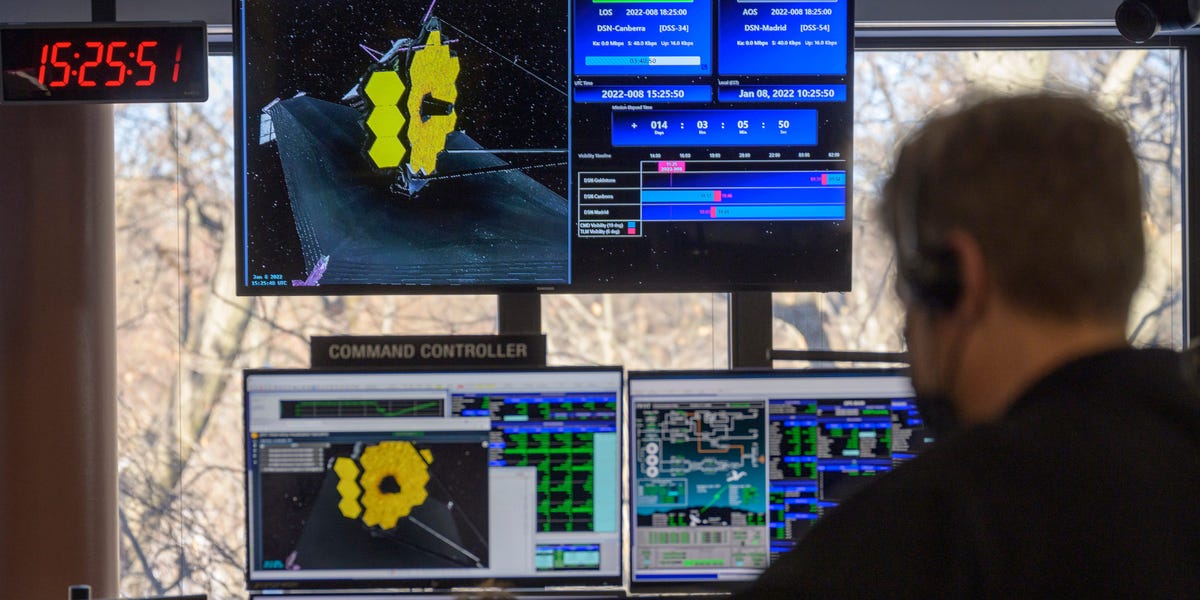
NASA also used a series of digital twins to test and monitor the James Webb Space Telescope. The telescope is a gigantic device, four stories tall and as long as a tennis court.
“It was too large to test in a thermal vacuum chamber,” Murphy said.
One of the twins was a 3D video-based model that allowed scientists to track the deployment of the telescope’s sunshade. This is a “complex operation with 344 potential failure points,” Murphy said.
The other twin modeled the telescope’s core to track its temperature. Murphy explained that overheating could cause the telescope to become invisible, making it impossible to observe galaxies.
Julie Van Kampen, NASA’s Webb Telescope mission systems engineer, said she began developing the twins in the early 2000s, before AI as we know it today existed. But the modelers who created the twins are now applying their expertise to the next generation of NASA projects, including AI tools, she said.
NASA is now using AI to analyze the vast amounts of data that the James Webb Space Telescope collects every day. With the help of AI, NASA can connect datasets from different observatories to gain a broader view of the universe.
Van Kampen compared datasets to gold mines. AI will help you unearth the nuggets and treasures buried within.
Endless possibilities, very high stakes
Giant telescopes and Mars rovers may seem niche for NASA, but Murphy sees potential far beyond space exploration. AI is not a single technology or a “one-size-fits-all solution,” he said.
“The downstream applications for the broader aerospace industry are endless,” he said.
Willcox said predictive maintenance is one of the most common applications in the aerospace industry. Sensors stream real-time data from the aircraft or engine to the digital twin, the AI updates the status of the replica in real-time, and the twin can generate predictions that humans can evaluate.
This moves maintenance from a set schedule to replacing parts only when a model exhibits wear or performance issues, allowing manufacturers to plan for downtime in advance. Airbus is one of the companies using digital twins and AI for predictive maintenance as well as product development and manufacturing.
Meanwhile, Boeing is deploying both AI and digital twin technology to simulate test conditions for its aircraft.
Wilcox said aerospace companies and agencies are keen to use digital twins during time-consuming and costly testing and evaluation. For example, in the development of military fighter jets, a quarter of the budget goes toward testing and evaluation, she said. The Defense Advanced Research Projects Agency is running research programs on AI and digital twins to accelerate testing of combat systems while maintaining safety.
But Wilcox said the risks are higher in the aerospace industry and AI output needs to be more rigorously verified and validated than other industries.
“If you don’t have to worry about making mistakes, you can go much faster,” Wilcox says. “That’s not how we operate in aerospace.”
She believes that AI and digital twins will complement humans, allowing technology to provide a two-way flow of information between physical and virtual environments, allowing experts to interact with technology in natural language and make decisions in real time.
Murphy said the NASA team conducted “extensive testing” before launching the AI technology on the Mars rover. He added that they checked over 500,000 variables before sending commands to Perseverance. Then, continually validate and update your digital twin against real-world performance.
It all comes back to the core mission of considering options, making decisions and identifying problems “without putting people or hardware at risk,” Murphy said.