
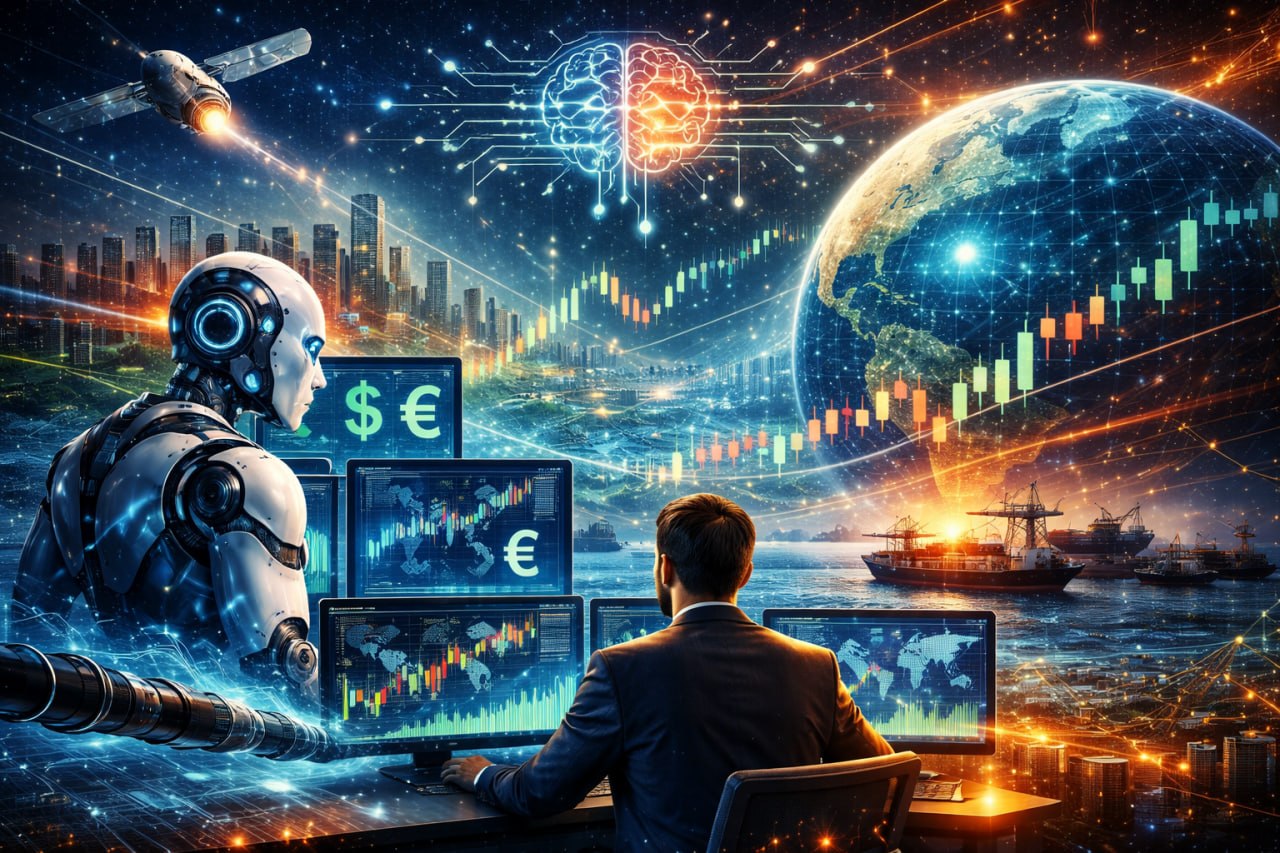
The most successful participants in trading are those who react immediately to even the smallest changes. This is especially important when implementing day trading strategies, but it also affects trading styles designed for the long term. That’s exactly…
The most successful participants in trading are those who react immediately to even the smallest changes. This is especially important when implementing day trading strategies, but it also affects trading styles designed for the long term. Historically, this is exactly why telegraph cables were laid across oceans to quickly receive and respond to information. Today, you can achieve the same effect by using the top-rated Forex EA, which is software that operates based on algorithms, user-defined rules, and machine learning.
The role of ML in institutional decision-making
The main purpose of using ML-based trading bots is to stay competitive. Not surprisingly, the largest investment funds and corporations were the first to adopt these solutions. Following this, retail traders also started using ML-based expert advisors.
- Trading bots perform multiple strategic tasks simultaneously. They analyze unstructured data sets. Not all data required for analysis is available in numerical form. Regarding global currency markets, much depends on statements by world leaders, central bank announcements, reports from regulatory authorities, and other documents. The natural language processing that modern trading bots have allows them to extract important aspects from all the news and even identify bearish or bullish sentiment within statements.
- EAs are essential for implementing HFT, as it is impossible to manually predict short-term price movements with the required speed and accuracy. It is equally difficult to manually split a position into many smaller trades and close them once the optimal pricing level is reached.
- Bots based on ML models are effective at predicting macroeconomic trends and often perform better than other tools. For example, different institutions predict the level of GDP and inflation for different countries. Still, EA can also incorporate satellite imagery of ports and credit card usage data into the analysis. You’ll get a more complete and accurate picture.
Evolution of ML and Expert Advisors
Until recently, Expert Advisors relied solely on technical analysis: trend indicators and oscillators. ML integration has turned software that simply executes instructions such as “if situation A occurs, do B” into a full-fledged trading assistant.
Changes that have occurred in recent years:
ML-infused EAs are learning to build layered strategies. Rules for entry and exit are becoming increasingly complex.
The first advanced EAs were already able to analyze historical data. Modern software can also predict whether past patterns are likely to work in today’s market conditions.
Bots have learned to detect things that humans might miss. For example, you can analyze correlations between different currency pairs, not just major currency pairs. As a result, you can identify patterns and turn that information into real trading profits.
Risk management revolution
Risk management has become more effective and is no longer limited to setting stop loss and take profit points. In trading software, these points are now dynamic and can react to market “noise”. For example, a trader sets a stop loss at 20 pips.
At the same time, there are signs of capital accumulating ahead of important news announcements. The system automatically places additional protective stops. Prevents loss of the entire asset value in the event of an adverse outcome. Therefore, while major market participants set traps, trading robots with embedded ML models guard against them.
Challenges and ethical considerations
Modern EAs solve many problems, but they also have pitfalls. The main one is the black box problem. Even with the best software, unexpected failures can occur. Even developers are not prepared for these problems. Such errors during the execution of large contracts can result in financial losses.
Another issue is that the system learns from historical data. Only the best trading robots can adapt this learning to current market conditions. Although most programs have strong backtesting results, they are not well-positioned for the future.
Finally, it is important to understand that lone traders do not use trading software, whereas the majority of the market does. In some situations, many EAs react in the same way to a market event, causing a chain effect that causes an instant price crash.
conclusion
When choosing an EA for Forex trading, it is important not only to choose a proven solution, but also to consider its flexibility and how effectively it can process analytical data. Additionally, it is important to provide high-quality data that you can trust and learn from. Only in this way can traders protect their capital managed through ML-embedded trading robots.


