
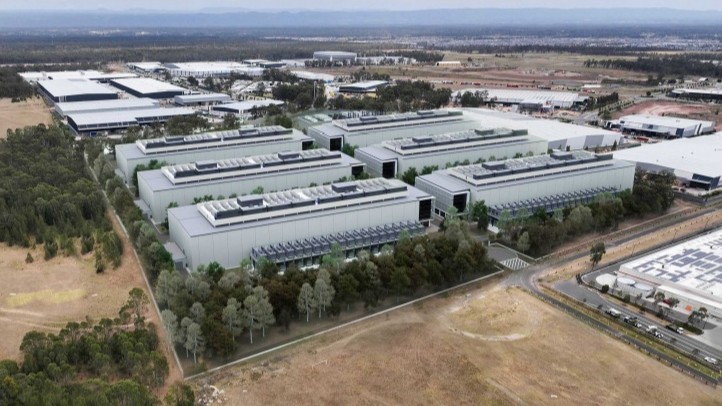
Increasing the supply of clean energy and minimizing water use will be the public expectation of new data centers being built on Australian soil.
Businesses that invest more in employee training and provide affordable computing power to local startups and researchers can also expect preferential treatment.
Although the coveted National Principles for Data Centers are not legal requirements, development proposals that meet expectations will receive priority under federal regulatory evaluation.
Australia has the second-largest data center construction pipeline in the world after the United States, and investment to address artificial intelligence computing needs is surging globally.
While the federal government has hailed the economic boost and job creation, the facilities require large amounts of energy and water, giving policymakers pause.
Trade unions, environmental groups and clean energy industry groups came together in February to call for an energy and water self-sufficient sector that works to upskill workers.
Energy is a particular focus as countries struggle to deploy renewable resources fast enough to meet climate goals and feed emerging green export industries.
Energy demand triples
Data centers consume approximately 2% of the electricity provided by the grid, and that proportion is expected to triple by 2030 due to the proliferation of AI.
In addition to deploying their own clean energy and storage to offset demand on the grid, operators are expected to cover the full cost of electricity connections and support network stability.
Energy Minister Chris Bowen said getting investment settings right was critical to keeping the electricity system safe and affordable.
“Data centers have great potential to support our power grid and expand investment in new renewable energy,” he said.
Sustainable water use is viewed favorably to protect local drinking water, with the use of recycled and non-potable water encouraged where possible.
Assistant Secretary of State Andrew Charlton said the country’s expectations would maintain community confidence in the fast-growing sector.
“We will do what it takes to ensure that the growth of AI is sustainable and supported by a strong social license,” he said.
Work is underway to implement the principles in collaboration with state and territory governments and industry.
The federal opposition has criticized the government’s response to the AI infrastructure boom, arguing that without faster planning processes and easier access to affordable, reliable energy, Australia risks losing investment to competitors.
Opposition industry spokesman Andrew Hastie supports using Australia’s abundant fossil fuels and uranium to power data centers and high-tech manufacturing.
AAP


