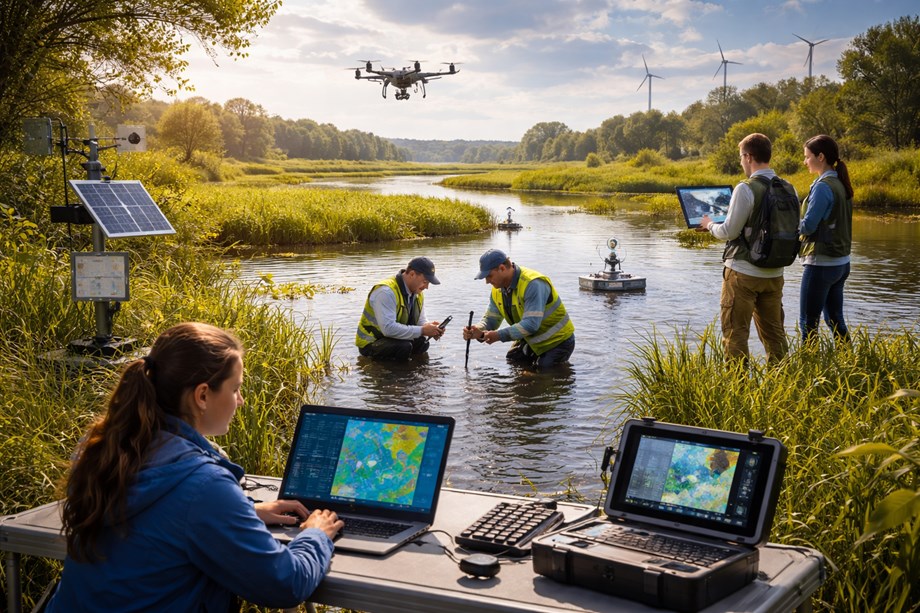
A quiet shift is taking shape in the way governments evaluate their decisions. A recent study by researchers at the National Bureau of Economic Research, the University of California, Berkeley, and Yale University shows that artificial intelligence can help predict the impact of regulations before they are implemented. Their research focuses on the American Clean Water Act, one of the most important and controversial environmental laws in the United States, and demonstrates how deep learning can provide clearer and more reliable predictions than traditional methods.
Uncertain regulatory issues
Policymakers have long struggled with the fundamental challenge of how to evaluate rules before they actually exist. The Clean Water Act is a prime example. Although the law regulates pollution of “waters of the United States,” the law does not specifically define which waters qualify. As a result, courts and governments have repeatedly changed their interpretations. Important decisions such as Lapanos, the Clean Water Rule, the Navigable Waters Protection Rule, and the recent Sackett decision have expanded and contracted federal authority.
This constant back and forth is causing confusion. Developers don’t know which land is protected, environmental groups can’t easily assess risks, and regulators have to enforce rules that can change again at a moment’s notice. Traditionally, experts have relied on maps of wetlands and rivers to estimate impacts, but these models are often incomplete and inconsistent.
Teach AI to read the landscape
The new study takes a different approach. The researchers primarily use real-world data rather than relying on expert judgment. They analyze about 200,000 official decisions made by the U.S. Army Corps of Engineers that determine whether a particular location is protected by law. These decisions provide a detailed picture of how the rules work in practice.
Researchers use this data to train deep learning models that recognize patterns. The key innovation is how the model handles new rules. Because there is no data on policies that have not yet been implemented, researchers adjust past decisions to reflect how policies would be classified under the new rules. This process allows models to simulate future outcomes, effectively predicting the impact of regulations before they are implemented.
Clear advantages over older models
The results show a significant improvement over traditional methods. Standard geophysical models that rely on maps of water systems perform only slightly better than the simple assumption that water is unprotected. In contrast, deep learning models are much more accurate and identify regulatory areas more effectively.
Of particular note is that the model performs well even without real-world data due to the new rules. This means that policy makers can obtain reliable forecasts before making decisions, reducing uncertainty at key stages. When compared to models trained after the rules have been implemented, the difference in performance is surprisingly small, indicating that the early predictions can still be very useful.
What the Sackett decision really changed
The study also provides one of the clearest pictures yet of how the Sackett decision reshaped water protection in the United States. According to the analysis, only about 11.5% of the country is under federal water regulation. Approximately one-quarter of streams and wetlands are still protected, but this represents a significant reduction compared to the previous rule.
The rollback is significant. About one-third of previously protected waters have lost federal jurisdiction, including hundreds of thousands of miles of streams and millions of acres of wetlands. The impact is not spread evenly. Coastal wetlands, floodplains, and seasonal rivers in dry regions are most affected. These areas are important for flood control, water quality, and wildlife habitat, and there are concerns about long-term environmental impacts.
Why this matters beyond water policy
The implications of this research go far beyond environmental law. If deep learning can accurately predict the impact of regulations, it could change the way governments make decisions. Policy makers can test different proposals before choosing one. By understanding regulatory risk, companies can better plan their investments. Courts could use data-driven insights to more effectively interpret the law.
At the same time, researchers note that technology cannot replace human judgment. The quality of predictions depends on the available data and how well legal rules can be translated into measurable categories. Still, this study shows that combining data with advanced algorithms can significantly improve how policies are evaluated.
In a world where regulatory decisions have high economic and environmental stakes, the ability to see their consequences in advance can be a powerful tool. Deep learning doesn’t just improve predictions. It opens up new ways of thinking about policy itself.