
I didn’t pay much attention to how to handle video files for a long time.
They were just… there.
Things I downloaded, watched once, and left them in a folder. Sometimes I would come back to them, but more often than not.
If you need anything from the video, just watch it again.
I felt that was normal.
But lately, I’ve started noticing some inefficiencies about that habit.
It’s not immediately clear. Just a small thing.
I wanted to review it again, but I didn’t have time to sit down again.
A long interview with only the main points.
A recording I liked listening to more than watching.
None of these were major problems in and of themselves.
But they added up together.
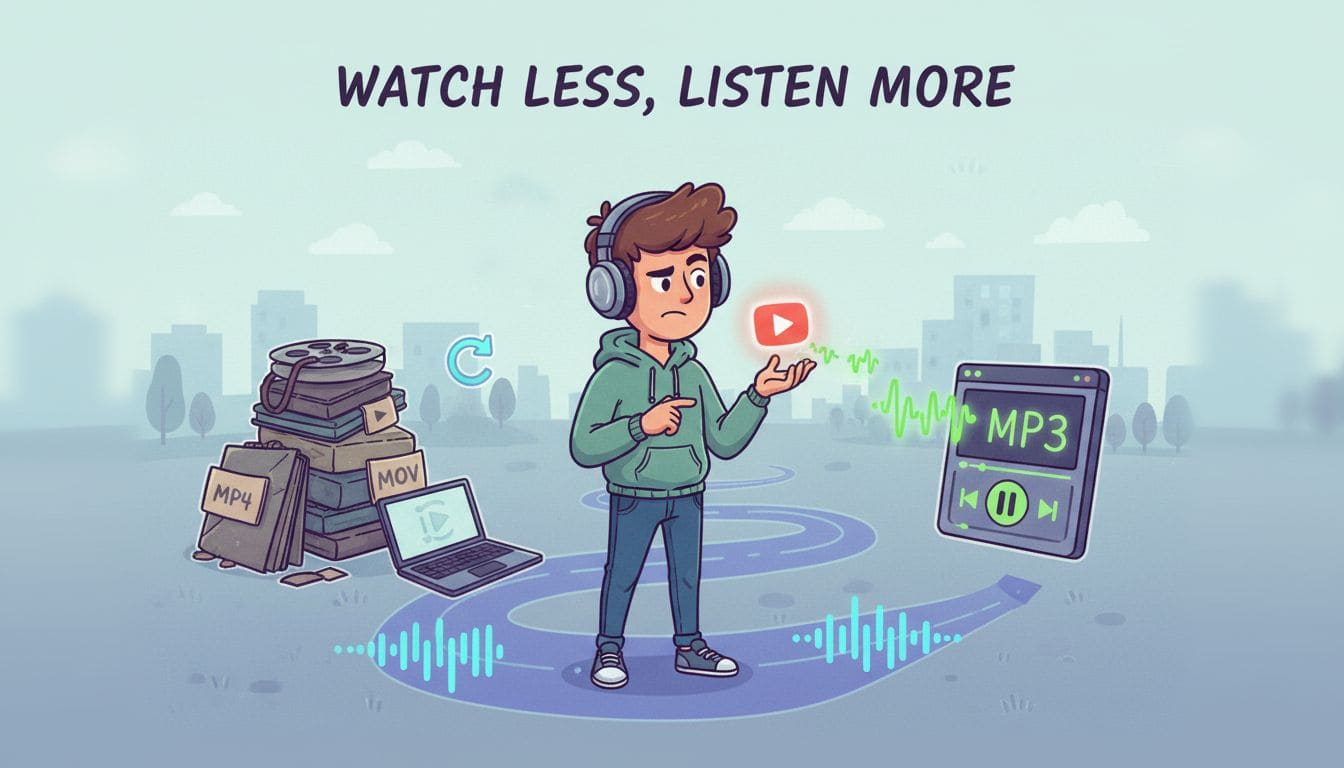
At some point I realized that in many cases I wasn’t using the “video” part at all.
What we actually needed was audio.
That thought lingered in the back of my mind for a while.
I didn’t act right away.
However, the more I realized that I didn’t need to save everything in video format.
So I tried something simple.
Instead of watching it again, I took some files and converted them to audio.
Just see what happens.
The first file I tested was a 35MB MP4 recording.
The process took approximately 7 seconds.
The second one was even larger, about 110MB. It took almost 22 seconds.
There were no surprises, but there were also no interruptions or failures.
Everything worked on the first try.
I repeated this several times with different files.
Short tutorial.
A longer lecture.
Recorded discussion with multiple speakers.
The results were fairly consistent.
Processing time varies depending on file size, and output is ready almost immediately.
But it wasn’t the speed that I found more interesting.
This was a change in the way we interacted with content.
Hearing is different from seeing.
It’s neither good nor bad. It’s just different.
When I played back the converted audio while I was out for a walk, I noticed something.
Without visuals, I paid more attention to the structure.
The transitions between ideas felt clearer. The pauses became more noticeable.
In some cases, I even found it easier to follow.
Of course, it wasn’t perfect.
I tested a file with background noise and the output reflected that.
Music-centered content has lost a bit of depth.
Also, there were no options to adjust the bitrate or tweak the quality.
Therefore, do not use it for detailed audio work.
However, I felt it was sufficient for daily use.
There was also a practical aspect.
The audio file is now smaller. Storage becomes easier. It’s now easier to revisit.
There was no need to scroll through timelines or load large video files to find specific moments.
From some point on, I started using this approach more often.
This applies to certain types of content, but not all.
lecture. Interview. Long form discussion.
Something where visuals aren’t important.
The process itself remained simple.
Upload.
hang on.
download.
I didn’t spend much time thinking about the tools themselves.
Even more important was the change in workflow.
I think that’s the part that stuck with me.
It’s not the conversion speed.
It was helpful, but not even convenient.
Just the idea that reducing something, like removing visual layers or simplifying the format, can make it easier to use is enough.
It’s a small adjustment.
There’s no dramatic difference.
However, after a few tries, I started to feel that going back to my old ways was a bit inefficient.
Maybe I’m not wrong.
However…it’s heavier than necessary.
And now when you watch a video file, it may ask you a simple question first.
Do you really need to see this?
Or is listening enough?
Often the answer is already obvious.
Even if you didn’t think about it before.
If I had to explain it, it’s less about using specific tools and more about noticing small changes in the way you use content.
And once you notice it, it’s hard to ignore.
Especially when the simple step of converting a video to MP3 is enough to change that procedure.


