
Dartmouth College is launching and expanding across the school a series of programs to help students harness the power of artificial intelligence while learning how to use it critically and ethically.
Building on the university’s tradition as the birthplace of AI and its long-standing strength in combining technical rigor with human insight, new offerings in fields ranging from engineering to business to healthcare focus on the thoughtful use of powerful technologies to enhance uniquely human capabilities.
“AI is changing the way knowledge is accessed, communicated, and applied, but universities have a responsibility to be equally clear about what AI can and cannot do. At Dartmouth, we are not just talking about adopting new tools; we are making sure those tools augment human judgment, rather than replacing it,” said President Santiago Schnell.
“Our new courses and degree programs are designed to train future leaders who understand that what machines cannot provide—the ability to navigate true uncertainty, create new knowledge, and take responsibility for truth—is precisely what a Dartmouth education requires.”
Students interested in artificial intelligence can find new opportunities across Dartmouth schools, including:
Thayer’s Two Track
Dartmouth School of Engineering students can now choose an AI track within the Master of Engineering program and a new department focused on AI within the Bachelor of Engineering degree.
In both programs, students gain hands-on experience through hands-on, project-based courses while tackling topics such as machine learning, high-dimensional sensing, optimization, and reinforcement learning. The new program builds on recent initiatives such as the online MEng in Computer Engineering and the Practical Machine Learning Certificate, which focus on the hardware side of intelligent systems.
quotation
At Dartmouth, the conversation isn’t just about adopting new tools. It’s about ensuring that these tools augment human judgment, rather than replacing it.
“We are excited to introduce new opportunities for students to gain expertise and take on leadership roles in AI and related fields,” said Douglas Van Sitters ’99, Thayer ’03, ’06, interim dean of the Thayer School of Engineering. “We are doing this the Dartmouth way: teaching our students to ask important questions and consider human impacts so that AI can contribute to society in responsible and meaningful ways.”
At the Guarini Graduate School of Advanced Studies, graduate students and postdoctoral fellows are also working on artificial intelligence through Guarini’s growing role in advanced research. Labs and research groups across campus routinely use machine learning approaches to model protein folding, interpret large experimental data sets, and uncover patterns that cannot be detected using traditional methods alone.
Tuck electives and bridges
AI is integrated throughout Tuck’s MBA curriculum, and the school is currently adding a number of new AI-focused electives, including AI-Driven Analytics and Society, AI for Managers, NLP/Machine Learning in Finance, AI for Executives, AI and Ethics, and Digital Operations.
“We are empowering our students, faculty, and staff to use AI with confidence, agility, and judgment,” said Tuck Dean Matthew Slaughter. “As the world continues to evolve, we expect AI to increase the demand for the leadership skills that Tuck excels in.”
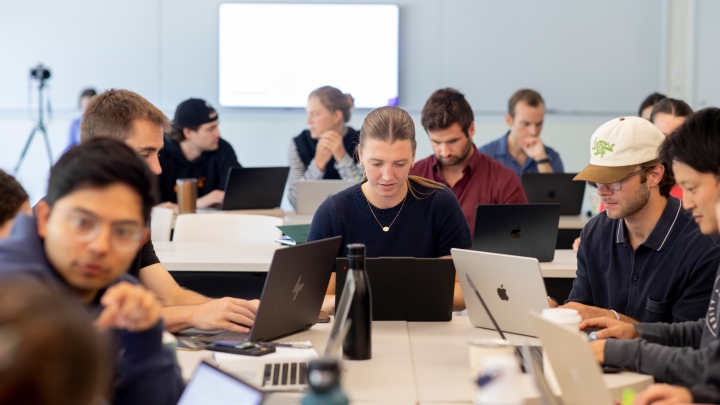
Artificial intelligence is integrated throughout Tuck’s MBA curriculum, including this recent Vibe coding session. (Photo provided by Laura DeCapua)
The Tuck Business Bridge program for undergraduates at Dartmouth and elsewhere also integrates AI training to help students think critically about technology and use it effectively in real-world situations.
By combining the traditional strengths of a liberal arts education with hands-on AI experience and a builder’s mindset, the program aims to equip graduates to work with AI, identify opportunities, and create value across industries.
AI is now also included in Tuck’s Executive Education offering.
Geisel combines AI and medical education
Across healthcare, providers are deploying AI tools to improve the accuracy, efficiency, and accessibility of patient care. By integrating AI into first- and second-year courses, Geisel prepares students for the evolving landscape of clinical practice.
The course covers the dangers of cognitive outsourcing, critical evaluation and ethical use of AI tools.
AI is also being incorporated into medical education in ways that emphasize its role in improving patient care.
New tools include the AI Patient Actor platform that allows students to practice clinical skills in simulated encounters, NeuroBot TA, a search-enhanced teaching assistant to support learning in neuroscience and neurology, and ConsultCraft, a learning platform for clinical reasoning in care provided before, during, and after surgery.
Geisel is also expanding training through a master’s degree program in health data science, preparing students to apply advanced analytics and AI to real-world medical challenges.
Exploring the influence of art and science
For Dartmouth undergraduates, the conversation about AI starts early. For example, as part of a first-year seminar, students learn how AI-generated text differs from their own writing and reading processes, compare AI summaries of assigned essays with their own, assess the accuracy of summaries, flag AI illusions, and loudly defend their choices.
Foundational courses that teach the theory and applications of machine learning are a mainstay of the Computer Science and Mathematics department and are evolving to keep pace with the rapid advances in the field.
Several arts and humanities courses also allow interested students to explore the implications of the technology’s deployment by imagining new ways to use AI, examining biases built into models, and discussing the ethics of AI.
Meanwhile, the 70th anniversary celebration of the 1956 Summer Research Project on Artificial Intelligence will focus on human-centered AI, and events and initiatives will take place throughout the year that provide students with opportunities to network with experts at conferences at Dartmouth and beyond.


