
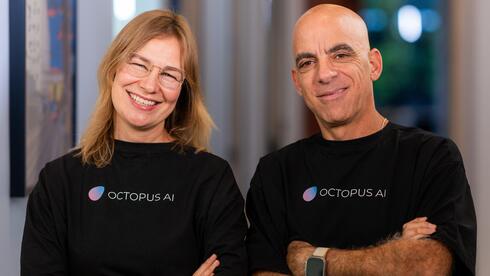
“This idea was born out of pain and frustration and a refusal to accept that finance is what it is,” said Lena Levin, founder and CEO of Octopus AI, a financial intelligence platform. “We realized that the problem was not data or dashboards, but that financial institutions had no active presence in the business and had little visibility into the anomalies.”
Founded in 2023 with co-CEO Eran Raichel, the Israeli fintech startup aims to transform enterprise environments and help companies achieve their financial goals with a platform that deploys proactive AI treasurers and automates financial planning tasks.
1 View gallery
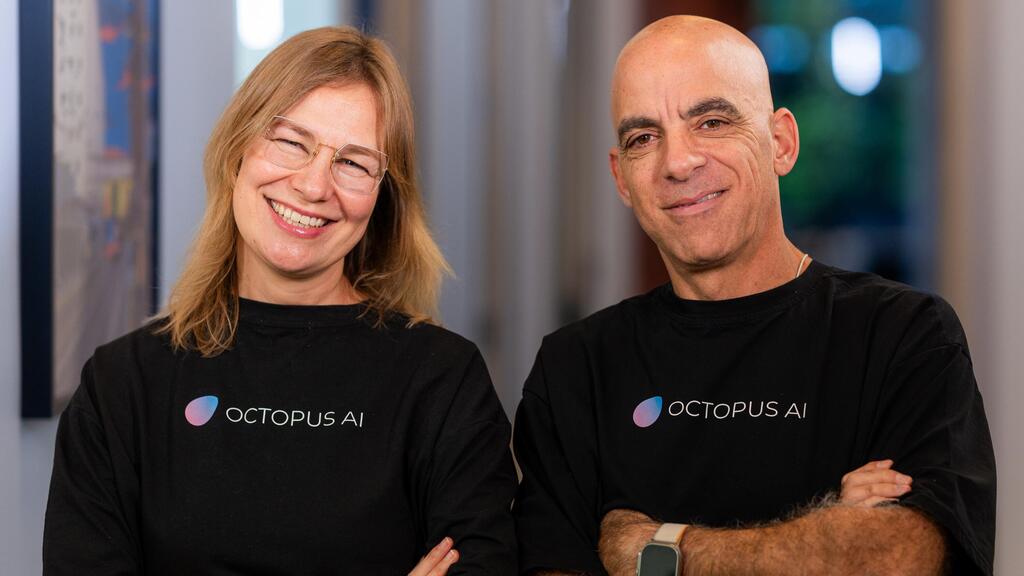
Lena Levin and Elan Reichel
(Photo: Octopus AI)
Learn more about the company below.
Product/Service Description:
We build financial digital workers who act as your colleagues and execute complex financial workflows.
Since our founding, our mission has been to help businesses use AI to maximize their profitability potential. We build digital financial workers that perform “impersonal” workflows.
Lena Levin is CEO and co-founder of Octopus AI, a financial intelligence platform that develops AI-powered “financial angels” for large corporations and financial institutions. With a CPA and an MBA, Lena is a two-time successful serial entrepreneur who brings deep expertise in finance, enterprise software, and AI to her role as CEO. She is responsible for the company’s vision, market development and strategic partnerships.
Co-founder and CTO Eran Raichel has over 10 years of experience in advanced data engineering and AI development. Prior to co-founding Octopus AI, he was Vice President of Research and Development at Amplio, where he led teams building technology to process unstructured data, including innovative applications to support children with dyslexia.
Lena and Eran have worked together, combining complementary expertise in product innovation, enterprise technology, and applied AI.
Last investment round: $550,000
The final investment stage: pre-seed
Last investment date: 2025/12/01
Total investment to date: $550,000
Investor: HiCenter Ventures, Founder (Lena Levin)
Current number of employees: 3
Open position: AI Engineer, Full Stack Engineer, Early GTM/BD
Website: https://myoctopus.ai
Social media: linkedin
This idea was born out of pain, frustration, and a refusal to accept that finance is what it is.
Every company had the same pattern: world-class data, expensive tools, and smart people. Still, decisions were delayed, budgets were not kept, political coups occurred, and there was a disconnect from reality. Even though the business was already moving forward, the finance team was obsessed with analysis. Predictions were constructed after the decision, not before. And zero risk reduction.
We realized that the problem wasn’t with the data or dashboards, but rather that finance didn’t have an active presence in the business and had little visibility into anomalies. Everything was passive. you ask. Please wait. you interpret. And I’ll miss you again. So we turned that around.
Octopus was born from a simple but fundamental question. What if financial institutions had the ability to actively think, analyze, debate, and push back in real time? Instead of being co-pilots. It’s not a chatbot.
AI finance professionals own end-to-end workflows, live inside business conversations, and surface insights before humans know what to ask. Then Octopus clicked:
The financial industry doesn’t need any more software. Needs protection. And that’s what we built.
What is the need for the product?
The central problem is not that the data is bad. The illusion is that there is only one economic truth.
Multiple truths coexist in every company. The treasurer says we’re “over budget,” FP&A says we’re “under budget,” and the budget director says we’re “on target.”
And the unpleasant reality is that all of them may be right. Each department views the business through a different lens, including timing, accruals, allocations, commitments, cash and P&L, accountability and manageability. The problem is not a difference of opinion, but that these truths are not in dialogue with each other.
Today, companies are trying to “force alignment” through reports, meetings, and spreadsheets. It does not resolve the truth, it delays decisions and undermines trust.
What we really need is a system that holds multiple financial truths simultaneously, explains why they differ in real-world business conditions, transforms one truth into another in real time, and brings accounting, FP&A, and budget owners into a shared decision-making space.
Octopus was created for this very gap.
Our AI financial agents don’t just crunch numbers, they mediate reality. They surface differences, explain factors, and connect decisions to outcomes before, rather than after, the trade.
Because in modern companies, alignment cannot be achieved by enforcing one truth. It comes from understanding it all quickly enough to take action.
How is the market changing?
AI moves capital allocation from heuristic BI and static spreadsheets to dynamic, scenario-based models that respond to real-time operational and market data.
Therefore, the change is not theoretical, it is happening now. This is shifting the market from thinking “Will AI work here?” “How can you run finance without it?”
What is the market size of your product? Who are your main customers?
Grand View Research says the global AI market “could exceed $1.8 trillion by 2030.”
Does the product already exist? If not, at what stage and when will it be brought to market?
Octopus is already present in the market today, with two AI digital employees actively deployed within the corporate environment. These financial professionals work with real workflows, not demos, and support real-world decision-making across complex organizations. They are currently used by design partners and enterprise customers in production-like settings, handling end-to-end financial workflows rather than individual tasks. As such, Octopus has moved beyond the prototype and pilot stage and into early commercial scale, with digital workforce additions planned and broader market deployment as deployment expands from design partners to repeatable corporate adoption by 2026.
Who are your main competitors in this space and how big are they?
We don’t see large enterprise platforms as competitors, we see them as partners. Companies like IBM, SAP, and Oracle are fundamental systems of record, deeply embedded in global enterprises, operating at scale, with revenues in the tens of billions. They owned the data, processes, and infrastructure, but they weren’t designed to proactively operationalize financial decisions.
Most traditional SaaS tools solve narrow financial problems at the cost of adding layers of complexity. For example, Anaplan or Workday Adaptive Planning improve forecasting and budgeting, but introduce separate models, assumptions, and adjustment cycles. Datarails or Vena streamline Excel-based FP&A, but you still need a human to interpret, coordinate, and communicate results across your team. Each tool is valuable on its own, but when combined they strengthen systems, definitions, and conversations. Instead of reducing complexity, companies end up managing it. Octopus AI addresses this gap by working across these tools and using AI financial agents to connect insights, collate truth, and drive decision-making without adding more silos.
What added value does a founder bring to a company or product?
Octopus is powered by a “dual engine” founding team that uniquely bridges the gap between enterprise financial complexity and advanced AI architecture. Lena Levin, CPA, MBA, a serial entrepreneur with two outlets, provides domain authority. Her deep background with US corporate CFOs allows her to map “multiple financial truths” from first principles, ensuring products address structural deficiencies, not just symptoms. Eran Raichel provides the technical backbone with over a decade of AI expertise and has scaled high-stakes enterprise systems R&D from $0 to $7 million ARR.
Together, they built Octopus as a recursive AI-native organization. There, all internal efficiencies are encoded directly into Emily, the proactive digital finance agent. By combining Lena’s first-hand knowledge of where workflows break with Eran’s ability to build autonomous agents, the team enabled Emily to do more than just report data. She builds financial workflows on the fly, transforming Octopus AI from another static co-pilot to a self-evolving operational layer.
What will the funds from the round be used for?
Capital from this round has been funneled almost exclusively into computational density and algorithmic efficiency. We’re not building a “chatbot.” We are building a multi-tentacled neural architecture designed to interface with every layer of the digital stack.
85% of the funding will go toward securing the H100/B200 clusters needed to train the “Central Nervous System” model and hiring six of the smartest kernel engineers. If Octopus could automate 90% of a company’s cognitive load, the word-of-mouth factor would be infinite, so there would be no budget for “marketing.”
We are compressing the path to Level 5 autonomy for digital work and solving AI’s “hand-eye coordination” so that AI can actually act, not just talk. We are focusing every penny on improving the FLOP-to-value ratio and making Octopus AI the fundamental foundation of the new economy.


