
As President Donald Trump’s ‘AI-first’ Pentagon rushes to weaponize technology beyond China’s, Australian defense officials are taking a cautious approach to introducing artificial intelligence, mandating “layers of policies, processes, training and procedures” to prevent unintended consequences.
A new policy document seen by The Australian says the Department of Defense needs to expand its use of AI to make “faster, more informed decisions” and achieve “asymmetrical advantages” on the battlefield.
However, the company warns that the use of AI must be lawful and responsible, and “appropriately applied in conjunction with human judgment.”
“The Defense Force applies risk-based control measures to AI technologies depending on the possible and potential consequences, including unintended consequences,” the policy reads.
“These risk-based controls consist of layers of policies, processes, training, and procedures that include continuous assurance and after-the-fact assessments that defense uses to identify, assess, and mitigate risk. They must be in place at every stage of the technology lifecycle.”
The Responsible Use of Artificial Intelligence policy document warns that any move to incorporate AI into weapons systems must comply with the Geneva Conventions, and urges defense officials to “seek legal advice at the earliest opportunity” if the technology is used for lethal purposes.
It requires the appointment of a “responsible official” to oversee each use of AI, and declares that “humans will always be responsible for the use, decisions, and outcomes of AI technology in defense.”
This approach stands in stark contrast to that of President Donald Trump’s “Secretary of the Army” Pete Hegseth, who designated artificial intelligence giant Anthropic a “supply chain risk” after the company refused to allow the Pentagon to use its technology without built-in safety guardrails.
Anthropic, whose Claude AI model is one of the world’s most popular AI apps, has filed a lawsuit against the US government, claiming the move is “unprecedented and illegal.”
At the same time, the Chinese government has ordered the People’s Liberation Army to leverage AI in autonomous weapons, battlefield intelligence, cyber operations, and logistics to achieve military superiority over the United States.
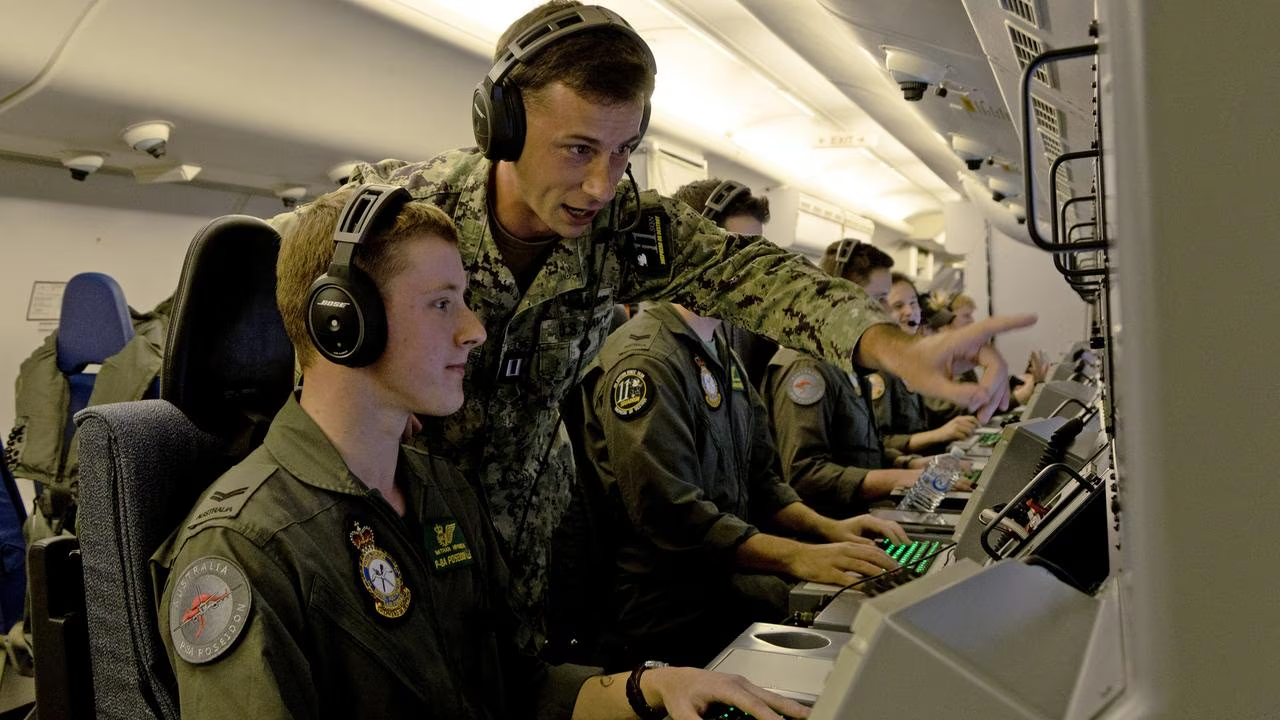
Australia’s Department of Defense did not say what AI applications were used for military purposes, but highlighted that the technology was integrated into a P-8A Poseidon aircraft during Australia’s largest military exercise, Talisman Saber.
In that case, AI supported faster decision-making by analyzing data feeds and providing quick insights to the aircraft crew.
“There is absolutely a recognition within Defense that the risks of not using AI are far greater than the risks of using AI,” said Emily Hughes, former director of Boeing’s Phantom Works and advisor on AI and autonomy.
He said the Ministry of Defense needs to reassure the public that the introduction of AI is being done in a safe and responsible manner to maximize its benefits.
“It’s no different than today when you have a commander commanding a brigade and making sure everyone has the proper training before taking command of tanks and other equipment,” Ms. Hughes said.
He said China’s push to develop AI-powered weapons was a challenge for Australia to address, but it should not undermine Australia’s ethical standing.
“It is important that we use technology in ways that are worthy and ethically consistent for us as a nation, and that we make the most of what is available to us,” Ms Hughes said.
David Law, head of the AI and security program at the Australian Strategic Policy Institute, said Defense’s AI policy was sensible but “quite cautious and conservative”.
“While the benefits of using AI have been explained, there has not been a proper sense of the need to take this technology seriously,” Lo said.
“This is a far cry from the Pentagon’s ‘AI first’ policy, which we rightly recognize we are in the competition for. Meanwhile, China has declared ‘intelligence’ to be the PLA’s top priority.”
He said Australia was unlikely to develop its own advanced AI models, but “that doesn’t mean we will stop focusing on AI adoption”.
“As the Department of Defense develops its approach, I hope there is a strong sense of urgency that we need to leverage AI from top to bottom. Of course, we need to make sure that we address the risks and the need for human accountability,” he said.
Hegseth announced an “AI first” policy in January, calling on the Pentagon to begin experimenting with AI and dominate the technology by “aggressively identifying and eliminating bureaucratic barriers” to its adoption.
He said AI-enabled warfare and weapons development, fueled by U.S. private sector innovators, will redefine the military landscape for the next decade.
“The U.S. military must continue to integrate this technology, established during President Trump’s first term, to further strengthen its advantage over adversaries and increase warfighter lethality and efficiency,” Hegseth said in a memo to Pentagon leaders.
He said the United States must “arm the speed of learning” to provide “the latest and best AI models deployed to our warfighters” and ensure that the technology is “free from usage policy constraints that may limit legitimate military applications.”


