
SK Hynix showcased its latest AI capabilities and leading memory solutions at Mobile World Congress 2026 (MWC 2026), held March 2-5 in Barcelona, Spain. During the exhibition, the company also engaged with major global partners in the mobile industry and discussed future collaborations.
MWC 2026 is the world’s largest exhibition focused on the mobile industry, organized by the Global System for Mobile Communications Association (GSMA). While previous MWCs have focused on connectivity through mobile technology, this year’s event adopted the theme “The Age of IQ,” reflecting the growing trend of connected devices that integrate AI to open up new possibilities. Reflecting this change, the exhibition expanded beyond mobile and network technologies to include AI and automotive, providing a broader view of the innovations shaping the future of connected technology.
In line with this direction, SK Hynix focused on placing leading memory solutions for AI and automotive applications throughout the exhibition space, presenting a clear vision as a full-stack AI memory creator at the forefront of future technologies. The company also sought to strengthen collaboration with its core partners by gaining insight into the latest technology developments and customer needs, while closely monitoring broader market conditions.
AI memory leadership exhibited at SK Hynix booth
Visitors touring the SK Hynix booth
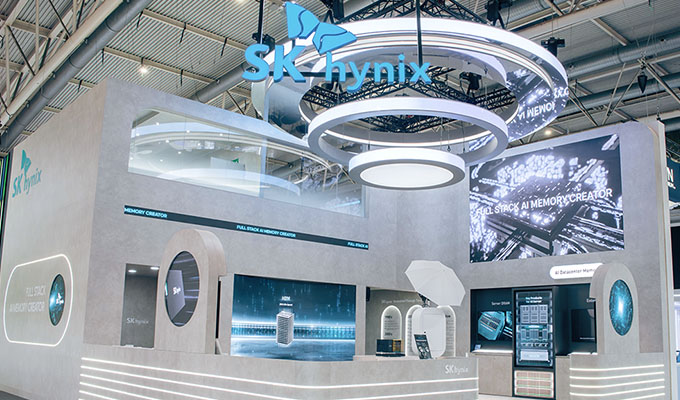
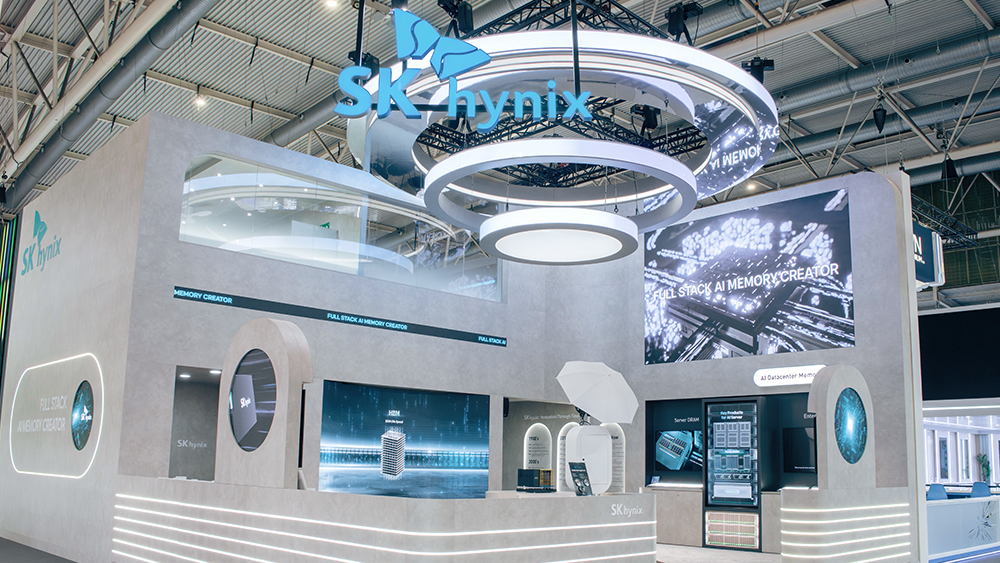
SK Hynix designed the exhibition space around the circular shape of the wafer, which is the origin of semiconductor manufacturing, and exhibited the world’s top-level memory semiconductor technology that will lead the AI era. The booth, which combines the solid feel of stone with flowing curves, created an immersive first impression, and the stacked circular lighting structure and large display attracted the attention of visitors.
SK Hynix exhibition space at MWC 2026
The main exhibition space on the first floor was organized into four zones dedicated to HBM.1AI Datacenter Memory, On-Device2 AI memory and cars. The second floor had a meeting room and lounge area.
1HBM (High Bandwidth Memory): A high-value, high-performance memory product that vertically interconnects multiple DRAM chips to significantly increase data processing speeds compared to traditional DRAM products. There are six generations of HBM, starting with the original HBM, followed by HBM2, HBM2E, HBM3, HBM3E, and HBM4.
2On-device AI: A technology that implements AI functions into the device itself, rather than having it computed by a physically separated server. The direct collection and calculation of information by smart devices enables quick reactions in AI performance and promises to improve customized AI services.
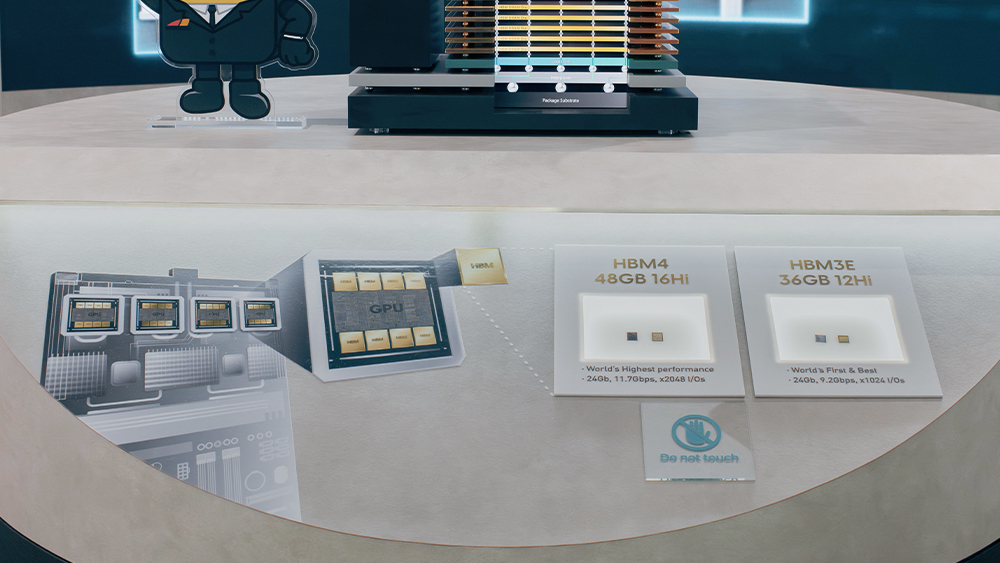
In the HBM zone, SK Hynix exhibited HBM4, which is adopted as a next-generation AI data center server platform. With 2,048 I/Os, HBM4 delivers 2.54x more bandwidth and more than 40% more power efficiency than the previous generation, making it ideal for ultra-high performance AI computing.
Additionally, the company announced its 12-layer HBM3E, which is used in the latest AI data center GPU modules by customers around the world, once again demonstrating its leadership in HBM technology.
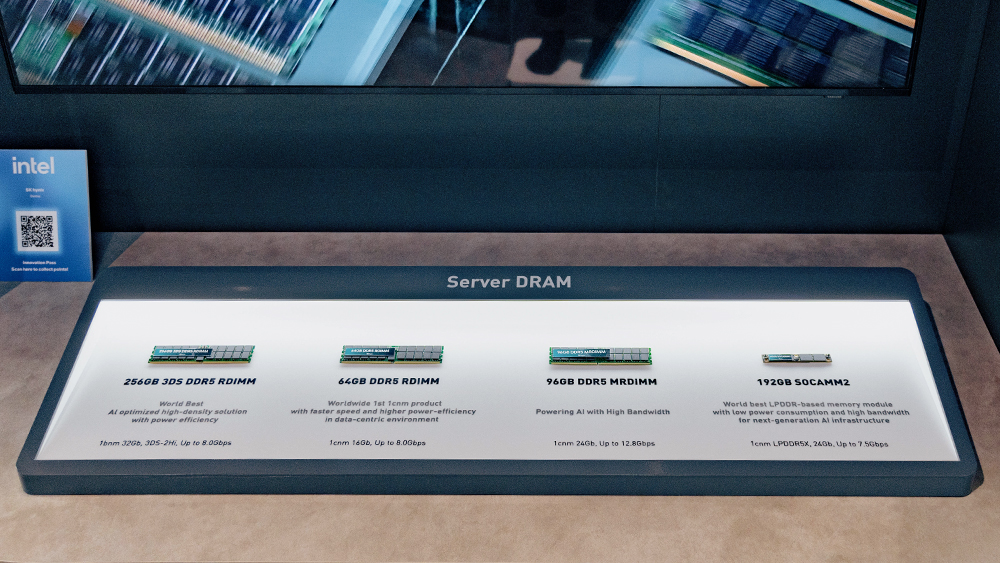
In the AI Data Center Memory Zone, SK Hynix introduced high-capacity, high-performance eSSD solutions as well as DDR5-based module products targeting the data center and server markets. DRAM lineup includes DDR5 RDIMM3(64GB), built on the world’s first 10 nanometer 6th generation (1c)4 Process technology enables faster speeds and improved power efficiency. 3DS5 DDR5 RDIMM (256GB), designed with increased density to meet the demands of AI environments. and DDR5 MRDIM6 (96GB), providing high capacity and high bandwidth for AI workloads. The company also announced SOCAMM27(192GB) is a next-generation memory module that combines the low power characteristics of LPDDR5X with a high-performance AI module to improve efficiency.
3RDIMM (Registered Dual Inline Memory Module): This is a memory module product for servers equipped with multiple DRAM chips.
41c: 10 nm process technology has evolved over six generations: 1x, 1y, 1z, 1a, 1b, and 1c..
53DS (3D stacked memory): High-performance memory with two or more DRAM chips interconnected using TSV technology.
6MRDIMM (Multiplexed Rank Dual Inline Memory Module): This is a product that increases speed by operating two ranks, which are the basic operating units of the module, at the same time.
7SOCAMM (Small Outline Compressed Connectivity Memory Module): A low-power DRAM-based memory module specialized for AI servers with a smaller form factor and better power efficiency compared to traditional server memory modules.
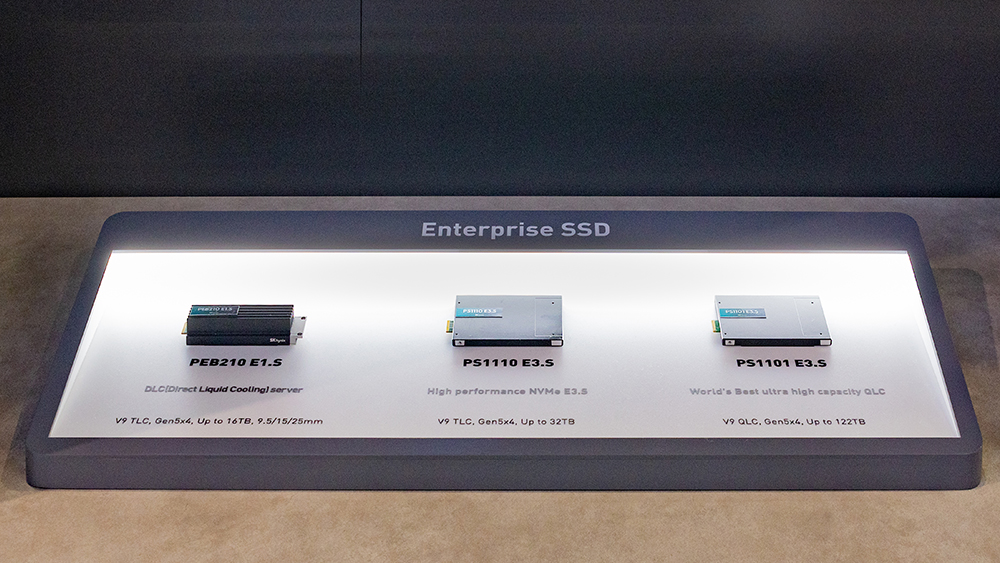
The eSSD portfolio targeted at the AI data center market included the PEB210 E1.S (9.5mm) with direct liquid cooling (DLC) support, and the PS1110 E3.S, which is optimized for high-performance specifications with NVMe compliance.8 E3.S standard, and PS1101 E3.S built on QLC9 Powered by NAND, it offers up to 122TB of capacity.
8NVMe (Non-Volatile Memory Express): A communication interface protocol for PCIe-based non-volatile memory, designed to enable faster and larger data processing than SATA.
9QLC (Quad Level Cell): NAND flash is classified based on how many bits of data can be stored in a single cell, the smallest unit of storage. NAND flash is classified as single-level cell (SLC), multi-level cell (MLC), triple-level cell (TLC), QLC, and pentalevel cell (PLC).
Expansion into mobile and self-driving applications
SK Hynix expanded its showcase beyond memory solutions for AI and AI data centers to on-device AI, autonomous driving, and connected car applications in the automotive sector, demonstrating its established technological capabilities as a full-stack AI memory creator.
SK Hynix’s on-device AI memory product lineup
In the on-device AI memory zone, SK Hynix turned heads with its latest offering in LPDDR, LPDDR6.10 line up. UFS was also on display11 4.1 (1TB), improved performance and power efficiency compared to previous generation. uMCP12 4.1, 16GB LPDDR5X combined with 512GB UFS. and ZUFS13 4.1 has a smaller package size compared to previous versions. These products represent the company’s latest offerings across each category.
10LPDDR (Low Power Double Data Rate): Mobile DRAM designed to operate with low power consumption. This standard includes the prefix “LP”, which stands for “low power”. LPDDR standards are developed in the following order: LPDDR1, 2, 3, 4, 4X, 5, 5X, 6.
11UFS (Universal Flash Storage): This is an innovative type of flash memory that can read and write data simultaneously. UFS is widely applied in mobile devices due to its low power consumption, high performance, and reliability.
12uMCP (Universal Multichip Package): A multi-chip package that combines DRAM and NAND flash into one product.
13ZUFS (Zoned Universal Flash Storage): This specification expands on UFS, a high-speed flash memory storage specification for mobile devices such as smartphones and tablets, and improves data management efficiency. It applies zone storage technology to store and manage similar data types within the same zone, optimizing data transfer between operating systems (OS) and storage devices.
SK Hynix automotive memory product lineup
At Auto Zone, SK Hynix introduced a range of memory solutions designed to support increasingly sophisticated autonomous driving capabilities. On the DRAM side, the company showcased two products: Automotive LPDDR6 and Auto/Robotics LPDDR5/5X. Both are built on 10-nanometer-class 6th generation (1c) process technology to improve data transfer speeds and overall performance. On the NAND side, the lineup includes Auto UFS 3.1, Auto eMMC 5.1, Auto SSD PA101, and Auto SSD PA201. These storage solutions are designed to meet the demands of self-driving technology. Autonomous driving technology requires high-speed processing of large amounts of data as the level of autonomous driving increases.
SK Hynix officials said, “At MWC 2026, we showcased a wide range of memory solutions spanning AI infrastructure, on-device applications, and in-vehicle systems, allowing visitors to directly experience our brand value and vision. We will continue to focus on technology development with a forward-looking approach in a rapidly changing environment and aim to strengthen our position as a leader in the global semiconductor market in the AI era.”

