(Updated: Added stats, links and video)
BEND, Ore. (KTVZ) — If you’ve called customer service lately, you’ve probably heard the increasingly frequent auto-response message to transfer you to an AI-powered support system.
From tech support lines to retail stores, artificial intelligence is rapidly reshaping the face and voice of customer service.
A new study from HostingAdvice.com found that 92% of business owners believe that AI will improve the overall customer experience and help them operate more efficiently.
Almost three-quarters (74%) of those surveyed said they have already integrated AI into their customer communication workflows. Most companies cite lower costs and faster response times as drivers.
But what about the customers themselves? They tell a different story.
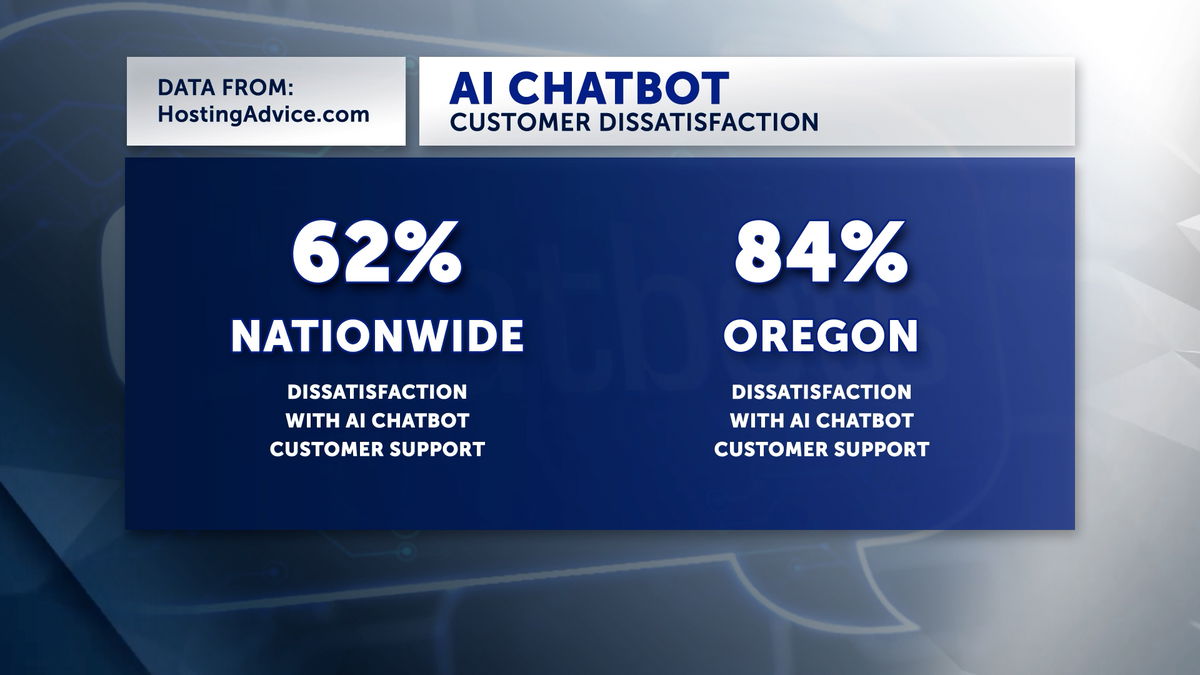
According to the same report, 62% of consumers nationwide say they’ve had at least one bad experience with a chatbot, and many are frustrated by not being able to easily contact a human.
Here in Oregon, that frustration is even higher, with 84% of respondents saying they have felt frustrated or confused after dealing with an automated system.
So why are companies doubling down on technology development despite widespread dissatisfaction? For many, that’s what ultimately matters.
Block, the parent company of popular brands CashApp and Square, recently replaced thousands of human employees with AI-based systems, citing efficiency and scalability as key benefits.
As reported by CNN’s Claire Duffy, the company claims that artificial intelligence can now handle more tasks than humans ever could, while reducing the cost of doing business.
Still, even the best bots have glitches. Portland’s KGW-TV recently spotlighted a high-profile call in which when a caller pressed “2” in Spanish, an AI voice spoke primarily English with a thick Spanish accent.
Maya Edwards, the wife of the first caller, played an automated message that read, “Estimated wait time is less than three minutes.”
The awkward combination of English and Spanish drew laughs online, but it also highlighted an important point: When AI stumbles, customers notice.
The agency responsible for the mistake later apologized and said it was working to resolve the issue.
Like Edwards, balance is the goal for many who support accessibility tools.
“If you’re going to use AI to cut costs or cut corners, have someone check it out,” she says.
Experts have a similar opinion. Joe Warnimont, senior analyst at HostingAdvice.com, writes: [the majority] customers say you’re alienating them, but that’s a design problem, not a user problem. ”
Still, most agree that the solution is not to eliminate AI completely. Instead, it’s important to maintain a “human safety net” to ensure that when technology hits a wall, a real human is just a click or phone call away.