
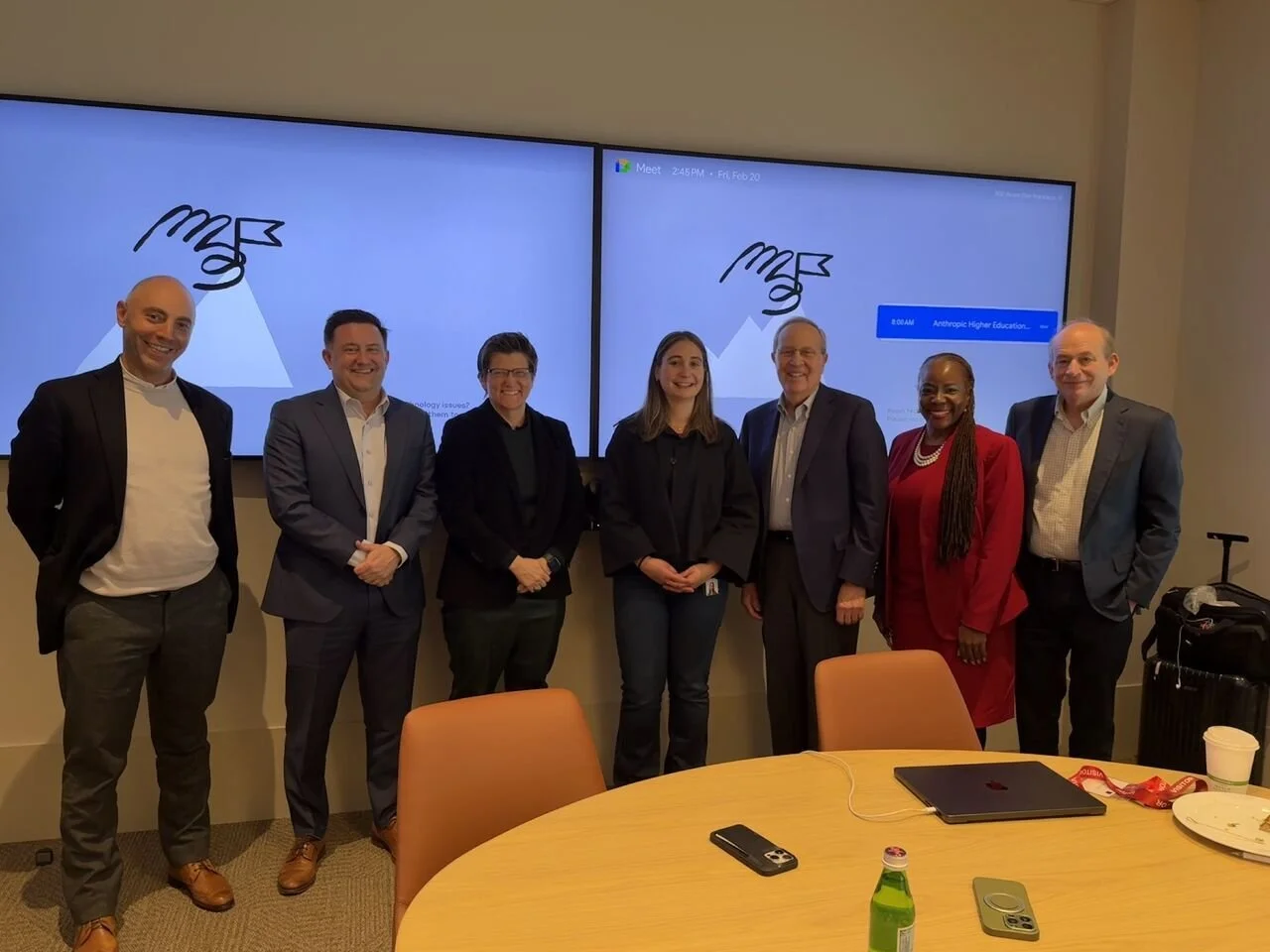
human held its Higher Education Advisory Board at its San Francisco headquarters last week, bringing together senior university leaders and EdTech strategists to explore how artificial intelligence is reshaping higher education.
The conference has been publicly referenced by multiple board members on LinkedIn, demonstrating deep engagement of AI model developers with academic governance, policy, and long-term learning outcomes.
This discussion comes at a time when universities are moving away from reactive AI policymaking to more structured governance and leadership strategies. As institutions decide how to integrate generative AI tools into the classroom, assessment, and research, these advisory boards are becoming an influential link between AI companies and higher education leaders.
James Devaney, associate professor of academic innovation and founding executive director of the Center for Academic Innovation at the University of Michigan, reflected on the two-day conference in a LinkedIn post. He writes: “We just wrapped up two great days for the Anthropic Higher Education Advisory Board meeting at Anthropic headquarters in San Francisco.”
Devaney said the timing is consequential: “We are at a pivotal moment in higher education. The decisions universities and policy leaders make now about AI will shape how an entire generation learns, discovers, and prepares for the world ahead. That’s no small thing.”
Balance optimism and risk
In his post, Devaney emphasized that the board’s discussions were not one-sided. “Our discussions were balanced,” he wrote. “While there are many reasons to be excited and optimistic, there are just as many risks that need to be carefully considered.”
He added that the structure of the advisory board allowed for criticism and open discussion. “I learned as much as I contributed and left with more questions than answers. That’s exactly how it should be in a boardroom environment, where the organization is open and advisors are given space to critique and generate new ideas.”
Devaney also referenced Anthropic co-founder Daniela Amodei’s leadership in the conversation, writing that she was “inspired by Daniela Amodei’s vision to elevate curiosity” and motivated by “the commitment of my colleagues on the board to ensure that AI serves students, educators, and institutions in meaningful, unbiased, and human-centered ways.”
Julie Shell, assistant vice president for academic technology and director of the Office of Academic Technology at the University of Texas at Austin, also posted about the conference, focusing on governance and learning outcomes. She writes: “How can we improve learning for all students everywhere, across subjects? What if…?”
Shell described the discussion as a “serious and considered discussion” and made it clear that the board’s focus goes beyond incremental change. “…rather than incremental learning or learning that misses opportunities to break through low self-efficacy, it is the voice that tells students, ‘Math or history is not for me.’ Learning that unlocks social good, strengthens students as leaders, and accelerates human flourishing across generations,” she wrote.
AI governance moves from theory to institutional practice
Schell’s post emphasized the urgency of decisions regarding AI integration within universities. “Today, AI is reshaping what we learn and what we learn. How can we, educational institutions, nonprofits, and organizations alike, manage that transformation in a way that students and educators deserve, so that AI doesn’t suddenly fall on them?”
She continued: “How can we be sure that AI will make us less cognitively competent, rather than making us more cognitively competent?”
Her compositions highlight the changing conversations within organizations. Early generative AI discussions centered around academic integrity and plagiarism. As reflected in these advisory discussions, the current stage appears to be more directly focused on learning design, cognitive development, and long-term student outcomes.
Schell also spoke about Anthropic’s internal approach, writing, “I’m so inspired by the team at Anthropic who have created a space to seriously interrogate these tensions. And I’m so inspired by the discipline at asking the toughest questions about learning from the educators who do this work every day.”
“I am deeply grateful to have spent two days at this table with my colleagues and friends, envisioning better learning as our North Star, and reinforcing the fact that AI must contribute to learning with balance and responsibility. I am committed to next,” she concluded her reflection.
In addition to Devaney and Shell, the advisory board includes senior figures such as Rick Levin, David Leebron, Matthew Rascoff and Yolanda Watson-Spiva. Their presence signals that the discussion of AI governance is moving to the highest levels of university leadership and strategy. As AI companies formalize advisory structures with university leaders, influence over policy, product development, and learning integration increasingly flows in both directions.
Anthropic’s involvement signals that AI developers are seeking a structured dialogue with institutions at a time when higher education leaders are considering not just classroom use cases but broader issues such as an institution’s mission, equity, and public trust. As universities are under pressure to modernize while protecting academic integrity and student development, advisory boards like this could shape how AI tools are evaluated, adopted, and managed across the sector.
ETIH Innovation Award 2026
The ETIH Innovation Awards 2026 is now open and recognizes education technology organizations that are driving measurable impact across K-12, higher education, and lifelong learning. The award welcomes applications from the UK, the Americas and overseas, and applications will be assessed on the basis of evidence of achievement and practical application.


