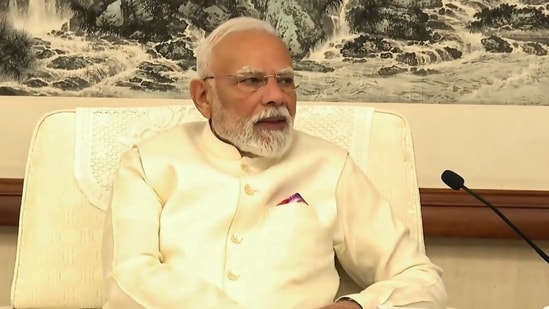
New Delhi: Prime Minister Narendra Modi on Sunday took to his monthly radio show Mann Ki Baat to present a comprehensive snapshot of a country in transition, confident in new-age technologies such as artificial intelligence, rooted in ancient knowledge systems, and increasingly shaped by daily acts of kindness, civic vigilance and cultural pride.

Prime Minister Modi began his speech by highlighting the recently concluded Global AI Impact Summit in Delhi, describing it as a moment that marked India’s growing role in shaping how the world adopts artificial intelligence. The summit at Bharat Mandapam brought together world leaders, technology executives and emerging innovators to project India as a bridge between cutting-edge innovation and social applications.
He drew particular attention to two exhibits that he said had “deeply impressed” world leaders. The Amul pavilion demonstrated how AI-powered tools are being used to monitor animal health and support dairy farmers with 24-hour digital assistance. The second focused on preserving India’s cultural heritage through technology and explained how ancient manuscripts are being digitally restored and made accessible to new generations.
As an example, Prime Minister Modi cited the digitization of the Sushruta Samhita and explained how the faded manuscript could be made more readable, converted into machine-readable text, interpreted through an AI avatar, and then translated into multiple Indian and foreign languages. He said this process demonstrated how India’s civilizational knowledge can be shared globally in a modern format. India also unveiled three indigenously developed AI models during the summit, reinforcing its ambition to become a creator rather than just a consumer of advanced technologies.
Shifting the topic from technology to sports, the Prime Minister spoke about Indian cricketers who are representing countries such as Canada, the US and Oman in the ongoing T20 World Cup. Named several players, he said their journeys reflect the essence of ‘Indianness’ – maintaining their cultural roots while fully contributing to the country they currently represent. Their success is an inspiration to young people across continents, he added.
Another part of the speech focused on organ donation, centering on the story of Aaryn Sherin Abraham, a 10-month-old girl from Kerala whose parents chose to donate her organs after her death. Prime Minister Modi said the decision was an extraordinary act of courage and compassion, noting that Aarin had become one of the youngest organ donors in the country. He also highlighted how a single act of generosity can change multiple lives, citing examples of transplant recipients who have since overcome difficult treks or returned to active sports.
The prime minister also spoke of shedding symbols of colonial heritage, announcing that a statue of C. Rajagopalachari, the first viceroy of independent India, would be installed at Rashtrapati Bhavan, replacing the statue of British architect Edwin Lutyens. The move, which will be highlighted during the upcoming Rajaji Utsav, was framed as part of a broader effort to honor Indian leaders who viewed power as a public service.
He also paid tribute to former Tamil Nadu Chief Minister J. Jayalalithaa ahead of her birth anniversary on February 24. Recalling her popularity and enduring association with the people of Tamil Nadu, she said Jayalalithaa’s concern for women’s welfare, firm response to law and order and pride in India’s cultural heritage defined her public life. Mr. Modi also shared personal memories of his interactions with her as a fellow prime minister, saying her thinking was “very clear” and her approach to governance was disciplined and focused. He recalled her affectionate invitation to Pongal lunch in Chennai, called it an unforgettable act and paid tribute to her contribution to the society.
Prime Minister Modi expressed concern over the rise in digital fraud and warned the public against “digital arrest” scams and financial scams that particularly target the elderly and small business owners. He urged people to follow KYC and re-KYC procedures only through authorized banking channels, never share OTP or personal information and update passwords regularly. He said the year-long financial literacy campaign being conducted by the Reserve Bank of India is aimed at strengthening public awareness and financial security.
Agriculture featured prominently as well, with PM Modi praising farmers who are integrating traditional practices with modern technology. He cited examples from Odisha and Kerala, including integrated farming models and preserving hundreds of varieties of rice in a single village. India’s emergence as the world’s largest rice producer, with over 150 million tonnes, was linked to improved quality, value addition, and expanded export markets.
Touching on culture and faith, PM Modi cited similarities between the Maha Kumbh in the north and the revival of the centuries-old Mamangam festival, or Kerala Kumbh, in Thirunavaya, saying these are expressions of a common civilizational memory that unites the country from north to south.
In his closing address, PM Modi urged exam-taking students not to measure their worth only by marks, extended greetings to Mr Ramzan and Mr Holi, and encouraged the people to opt for Swadeshi products during festivals. He said the speech reflected a simple message: India moves forward with confidence, blending innovation and tradition, individual responsibility and collective purpose.