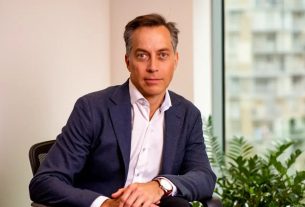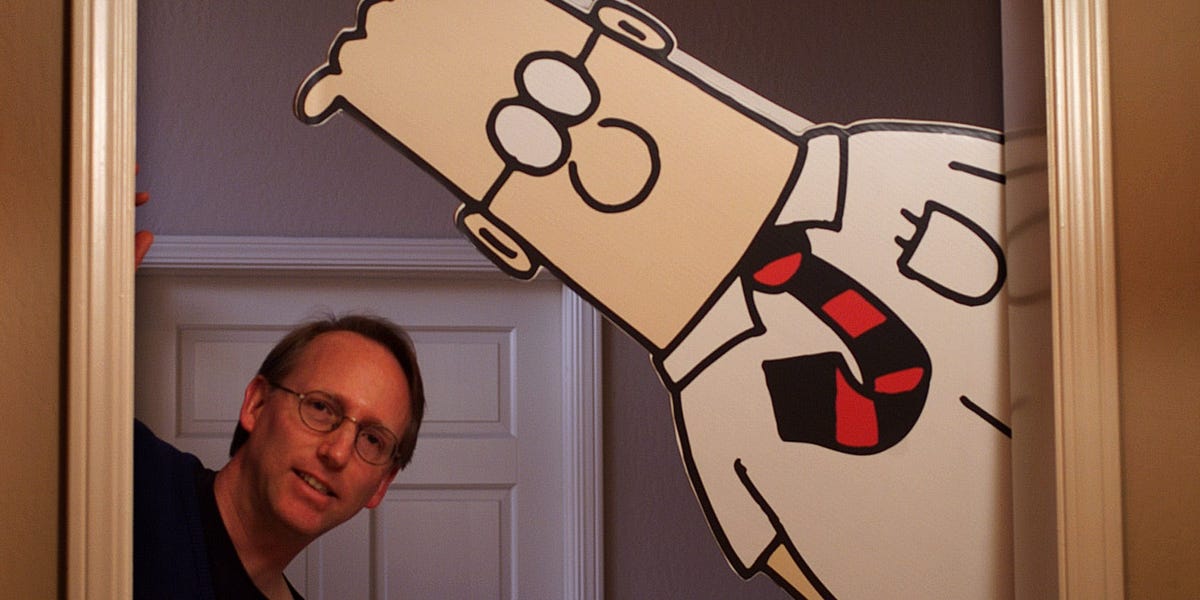
Scott Adams once sounded open to the idea of a digital afterlife. Now that he has passed away, a social media post attributed to his family states that the AI version of the “Dilbert” creator circulating online is unauthorized, which is deeply concerning.
In a 2021 podcast clip, the cartoonist said he had given “explicit permission” for anyone to create a posthumous AI modeled after him, and argued that because his public thoughts and words are “so pervasive on the internet,” he would be a “good candidate to turn into an AI.” He added that it’s okay for an AI version of himself to say something new after death, as long as it seems compatible with what he might have said while he was alive.
Shortly after the 68-year-old man died of complications from metastatic prostate cancer in January, the AI-generated Scott Adams account began posting videos of a digital version of the cartoonist speaking directly to viewers about current events and philosophy, echoing the rhythms and topics that the real-life Adams had discussed for years.
His family says this is a violation, not a respect.
A February 5 post on Adams’ official account was attributed to his brother Dave Adams and claimed that the cartoonist “would not and never would approve of an AI version of him that he or his estate did not authorize.”
“The real Scott Adams has given explicit permission on record multiple times for people to create and manipulate AI versions of him,” AI Adams said in a Feb. 5 post, “so this iteration exists as a direct fulfillment of that stated desire.”
On February 17, Adams’ official account reiterated the family’s objections, saying the estate is “kindly but firmly” asking anyone attempting to recreate Adams’ voice or likeness using AI to stop, calling the digital replica a “fabricated version” of Adams and “deeply distressing.”
“This is not a compliment. This is not an honor. This is a misuse of personal information,” the post reads.
The Adams Estate and the AI Adams account did not respond to requests for comment from Business Insider.
The controversy highlights the growing legal and ethical fault lines surrounding the “AI afterlife” and how quickly technology can outpace the rules that are supposed to govern it.
“It’s a deep fake.”
Karen North, a professor at the University of Southern California who specializes in digital social media and psychology, said calling the AI-generated Addams an avatar, as some people do online, softens its essence.
“This is a deepfake,” North told Business Insider.
The troubling part, she said, is how realistic imitations can surface when families are grieving and end up saying things a real person would never say. North added that many Americans are “giving up so much information” through apps that capture faces and voices and viral quizzes that collect personal information, making it increasingly easy to recreate someone without their permission.
“I think that’s very disturbing,” she said.
Betsy Rosenblatt, an intellectual property lawyer and professor at Case Western Reserve University, said her initial reaction was that AI Adams was “extremely unethical.”
“When you die, you die,” she said.
Legally, she said, the central issue is the right of publicity, or protection for a person’s name, image and likeness. Still, these laws are more about privacy and economics than grief.
Rosenblatt said publicity rights are “primarily concerned with economic relief.”
The strongest claims usually involve money. The AI version could damage existing deals tied to Adams’ identity or prevent family members from entering into their own deals.
Rosenblatt explained two potential economic damages: That means it could damage the financial arrangements they already have in place. The other thing is that it may get in the way of making competitive financial arrangements,” she said.
The account appears to be anonymous. However, this does not necessarily mean that you can avoid litigation.
“You can sue anonymous people,” Rosenblatt said, and courts can subpoena them to reveal personal information, but that “is not always easy.”
The legal analysis also depends on whether the account is commercial. Courts often ask whether a speech proposes a commercial transaction.
Rosenblatt said that if the digital replica sells nothing, it would be “more likely to be considered First Amendment protected speech” for the anonymous creator, making it a stronger argument than a “slam dunk.”
AI Adams identifies himself as an artificial intelligence at the beginning of the clip and does not appear to be asking for money.
“The original Scott is gone and gone, but his ideas live on,” he said in a Feb. 1 post.
Consent is different from contract
The estate’s opposition remains disturbing, alongside Adams’ 2021 comments providing “explicit permission” for the AI version.
North said outspoken statements about technology should not be automatically treated as binding endorsement. She said Adams was an “incredibly bright, incredibly creative person” who often pushed boundaries and comments made during conversations “may not be legally binding in the same way that contracts and intellectual property rights are legally binding.”
“This is a warning to all of us: Be careful what you say, because he is putting his loved ones in a difficult position to protect his legacy,” North said.
Rosenblatt said that while Adams’ wishes “certainly matter in an ethical sense,” they may not matter legally “unless you give someone a legal right to do so.”
Although there is no comprehensive federal law governing postmortem AI likenesses, some states, such as New York and California, have recently enacted laws requiring the consent of an heir or executor before creating a digital replica.
Beyond legal issues, there are deeper ethical issues. The question is who will be in charge of a person’s personality after their death.
North said people “should own the right to their own personas” and that when a person dies, that right “should be given to their loved ones” rather than something they can use freely. She warned that AI replicas could go off-brand or rewrite public memory.
“Shakespeare should always sound like Shakespeare,” she said. “Dr. Seuss should always sound like Dr. Seuss.”
For now, the battle with the AI ”Scott Adams” is an exercise in drawing public lines for one family. This may be a harbinger of broader judgments in a world where convincing digital imitations are easy to create, and where the law still hasn’t figured out who decides whether the dead continue to speak online.