
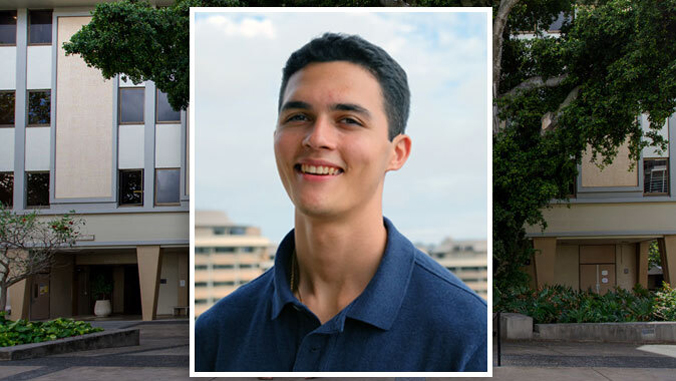

university of Hawaii in Manoa A student-led team has developed a new algorithm to help scientists determine orientation in complex two dimensions (2D) The data has potential applications ranging from particle physics to machine learning. The study was published on February 6th. AIP progress As a featured article.
The algorithm development, led by physics undergraduate Jeffrey G. Yepes, will help scientists figure out where tiny, nearly invisible particles called neutrinos come from. These particles can reveal information about nuclear reactors, the sun, and distant cosmic events. This method is based on a clever mathematical discovery. The team discovered a formula that allows them to match patterns in the data and pinpoint the direction of the source.
The students were guided by ah Manoa I studied and received additional guidance from Professor John G.. ah Alumnus and Lawrence Livermore National Laboratory staff scientist Viacheslav Li acknowledges funding from the Monitoring, Technology, and Verification Consortium. The project began with simulations of neutrino data to determine the location of the reactor, and further research is underway.
“What excites us most is that this approach provides researchers with a clearer mathematical foundation for extracting orientation from noisy real-world data,” said Yepes. “This is a tool that can scale with technological improvements in detectors, computing power, and data volumes, and has value far beyond its initial physical applications.”
This algorithm uses a mathematical tool called the Frobenius norm to measure the difference between grids of numbers, effectively acting as a “distance formula” for large data tables. By rotating the reference data set and comparing it to the measured data, the algorithm identifies the rotation that produces the smallest difference and reveals the most likely direction of the signal. Simulations show that this method works particularly well with high-resolution data and large datasets.
Although this approach is motivated by neutrino detection, it has potential applications in multiple fields. Potential applications include systems that rely on astronomy, medical image processing, weather mapping, and pattern recognition, providing scientists and engineers with versatile new tools.
other ah Manoa Authors of this paper include Jackson D. Seligman, Max AA Dornfest, and Brian C. Crowe. The Department of Physics and Astronomy is ah ManoaCollege of Natural Sciences.


