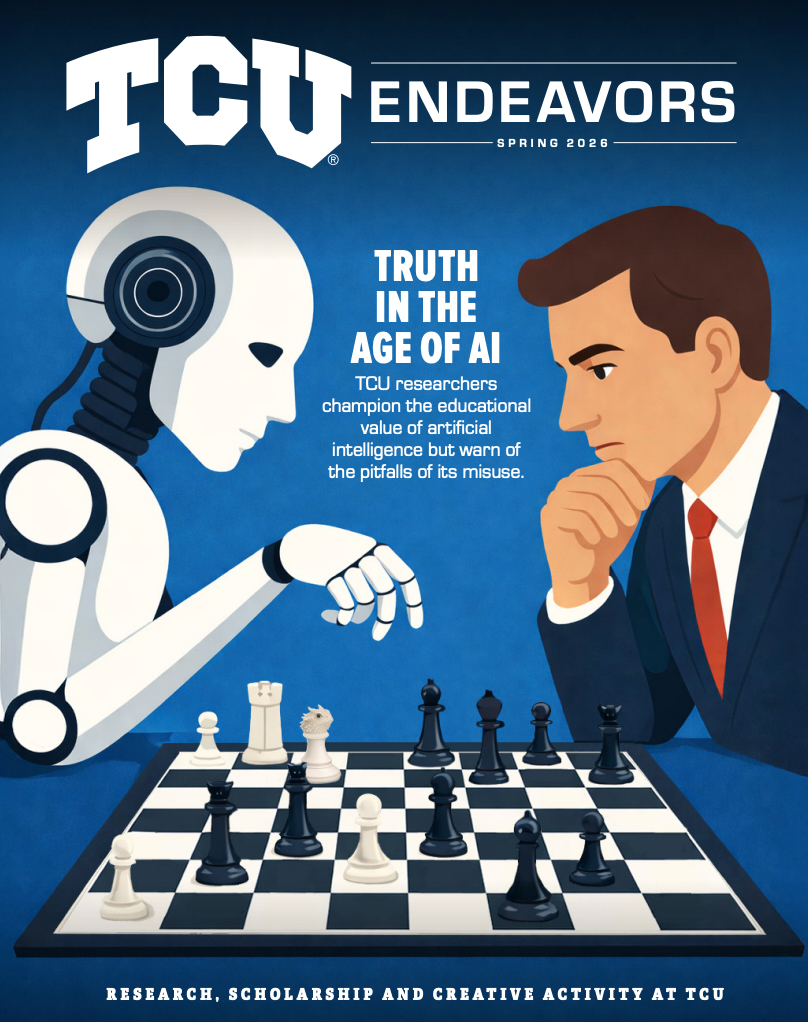
Spring 2026 issue efforta professional research journal at Texas Christian University, explores a question at the heart of this moment: What happens when the tools we build to solve problems begin to reshape us in return?
As artificial intelligence transforms political campaigns, disaster response, and medical research, TCU scholars are investigating not just what AI can do, but what it demands of the people who consume its work. Chip Stewart, a First Amendment expert, journalism professor, and assistant provost for research compliance, found that while laws regulating AI-generated deepfakes face constitutional hurdles, clear labeling can slow the spread of misinformation if people remain vigilant.
Jie “Jackie” Chuan, also an associate professor of communication studies at the Bob Schieffer College of Communication, examines how misinformation from AI can undermine trust in disaster response, highlighting the simple truth that technology is only as responsible as the humans who guide it.
This issue also marks an upgrade in TCU’s research strategy. As President Floyd L. Wormley, Jr. writes, the university is accelerating toward R1 status, building on a teacher-scholar model of “student-centered scholarship” that continues purposeful discovery.
He will introduce Reuben F. Birch V, TCU’s new vice president for research. His mission is clear: important research, successful partnerships, and students leading the way.
Across sectors, that vision is already taking shape. Adlan College of Liberal Arts Criminology and Criminal Justice faculty partner with local police departments to study leadership and accountability. Jessica Zeller, a dance professor at the College of Art, is rethinking ballet pedagogy through equity and collaboration. And at the School of Education’s Starpoint School, TCU’s experimental school for children with learning disabilities, graduate students sit next to elementary school readers and turn literacy research into living confidence, one chapter at a time.
Her research ranges from nursing research on restoring the sense of smell and taste in long-term COVID-19 patients, to marketing research on consumer trust after acts of ethical misconduct, to analysis of facial recognition technology and identity.
“The featured faculty in this issue do not offer simple solutions, because there are no simple solutions,” said editor Caroline Collier. “What they are offering is something even more valuable: a willingness to stay curious, to stay critical, to keep asking whether our innovations are actually making us better people.”
Read the full Spring 2026 edition effort.