


BENGALURU: Anthropic CEO Dario Amodei said that while artificial intelligence technology will create great value, it will also bring great economic disruption. It is therefore important to ensure that everyone shares the benefits, he said, calling on India, the world’s largest democracy, to leverage AI to make governance more efficient and people-centric. “This is a very valuable use of technology,” Amodei said at the inaugural edition of Anthropic’s Builders Summit in Bangalore on Monday.Anthropic, a company worth $380 billion and whose AI products are widely used in enterprises to improve coding efficiency, recently announced a slew of new tools for other corporate functions such as legal, sales and marketing, causing a collapse in the stock prices of software and IT services companies around the world.Amodei’s visit coincided with the AI company starting operations in Bengaluru. Speaking to about 250 developers and entrepreneurs, he noted that AI adoption tends to be more technologically intensive in India than in other countries. He said he had heard that the Ministry of Statistics was building an AI system to query economic data and statistics. “Government agencies in other countries generally don’t move this fast,” he says.He said Anthropic’s business run rate revenue in India has doubled in the past four months. “This is really incredible. It reflects the general advancement and explosion of Claude models and coding models. But in India, I think it’s even more extreme than we’ve seen in other parts of the world.”
“Technology creates great value, but it also creates disruption.”
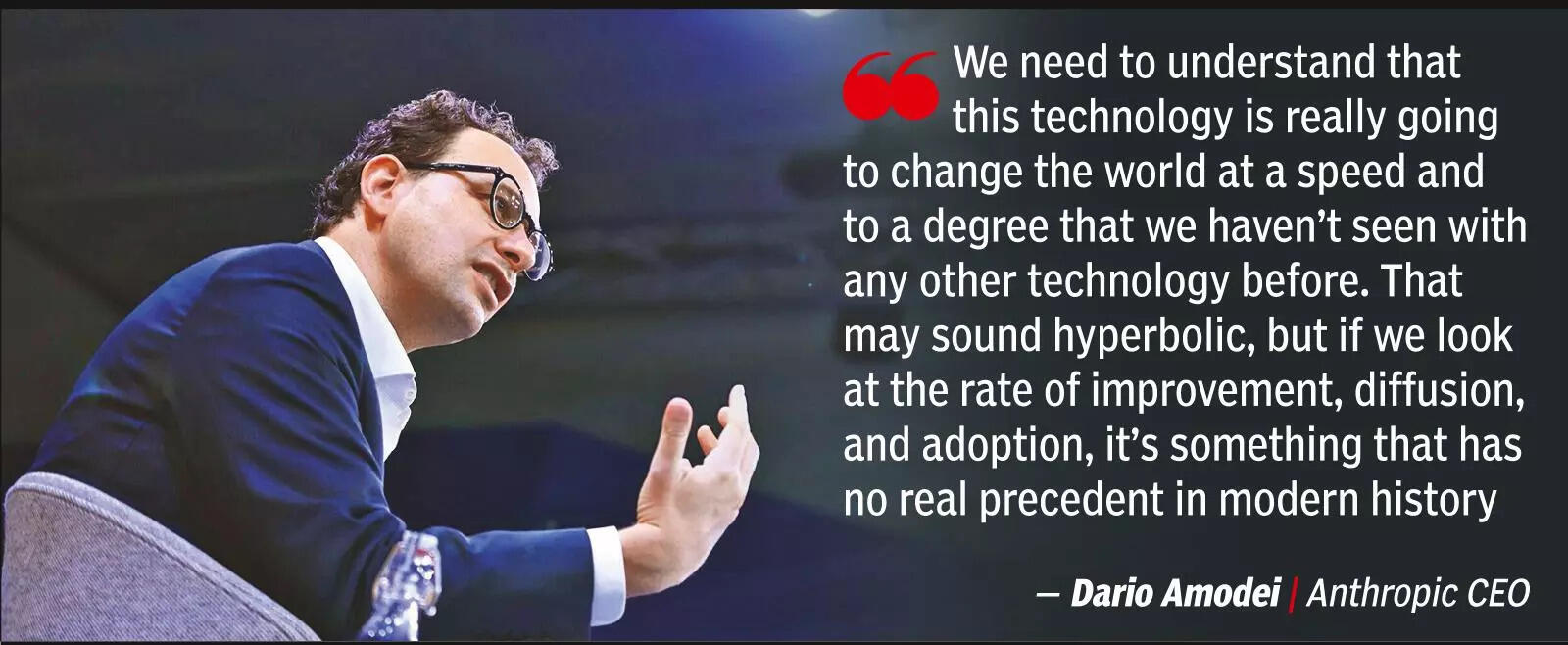
Mr. Amodei also pointed out that India’s extraordinary size is a catalyst for innovation. “We can experiment with hundreds of millions of people. This scale allows entrepreneurs and builders to pivot quickly and learn faster in ways that are not possible in smaller markets.”He said India’s linguistic diversity is a strong driver of AI innovation. This will allow construction tools to interoperate between languages, making translation easier and enabling true multilingual functionality, he said. Claude is working hard to support the long tail of languages, and “because India has so many regional languages, we’ve seen some great applications, including in the nonprofit and social services sectors,” he said.”Speaking about the philosophy of his 38-page essay, “Technology’s Adolescence,” Amodei said, “We need to understand that this technology is going to really change the world at a speed and degree that no other technology has seen before. That may sound hyperbolic, but when you look at the speed of improvement, proliferation, and adoption, this is actually unprecedented in modern history.” This essay highlights fundamental principles aimed at protecting against the worst risks posed by AI.Amodei highlighted the transformative potential of AI in specialized fields such as medicine and biology, noting that innovations rooted in the physical world are likely to create the most defensible businesses. “I really encourage people to build where AI intersects with fields like medicine and health. The biggest moats come from applications that are tied to the physical world, applications that are not easy to run and require specialized skills. Biology and medicine meet all of these criteria. It’s a complex and knowledge-intensive field that requires a regulatory system to navigate, but your efforts can lead to lasting business. Therefore, I strongly encourage builders to go in that direction. ”


