

Despite years of data investments, enterprises still struggle to coordinate governance, analytics, and AI. That’s because what enterprises really need is a structural reset of the data core itself, integrating data meshes, data fabrics, and modern composable architectures into a single integrated system.
Important points:
-
-
-
Traditional data architectures cannot keep up with modern demands — Traditional centralized data cores were designed for stable and predictable environments, but are now becoming bottlenecks under continuous regulatory change, rapid M&A, and AI-driven business needs.
-
AXTent aims to unify modern data principles for regulated enterprises — The modern AXTent framework integrates data mesh, data fabric, and composable architecture to create a data core built for distributed ownership, built-in governance, and adaptability.
-
Lasting success requires a shift in mindset : Organizations must move from project-based data initiatives to persistent data development, focusing on reusable data products and decision-aligned outcomes rather than one-off integrations and platform updates.
-
-
This article is the second in a three-part blog series exploring how organizations can reset and strengthen their data core.
For more than a decade, companies have invested heavily in data modernization: new platforms, cloud migrations, analytical tools, and now AI. However, for many organizations, especially in regulated industries, results remain underwhelming. Data integration remains slow as regulatory reporting still requires manual corrections, M&A still reveals hidden data debt, and AI efforts struggle to move beyond pilots as trust and reuse of the underlying data remains weak.
The problem isn’t the effort, it’s the architecture. Building around AI in 2022 and beyond will be like the stuff of science fiction. Self-learning, easy to install, replaces workers, autonomous, and even terminator-Like. Moreover, while AI certainly has the potential to revolutionize research, processes, and revenue, the fundamental challenge is not the advancement of technology, but rather the data used to train and interconnect these explosive capabilities.
Most data cores in use today are designed for early operational realities where data is centrally managed, reporting cycles are predictable, and governance can be applied after the fact. This model breaks down under modern pressures such as ongoing regulation, compressed trading schedules, ecosystem-based business models, and AI systems that consume data directly rather than waiting for curated output.
So why isn’t the AI hype delivering the expected benefits? Why can’t the data that has powered process systems for decades scale across interconnected AI solutions? Rather than updating the platform again, this solution requires resetting the structure of the data core itself.
This reset uses data mesh, data fabric, and modern composable architecture as a single integrated system, aligning with the AXTent architectural framework, which is explicitly designed for regulated data-intensive enterprises.
Why traditional data cores are no longer applicable
Traditional data cores were built to optimize control and consistency. Data flowed from operational systems into a central repository, where meaning, quality, and governance were imposed downstream. This approach assumed the existence of stable data producers, limited use cases, human-paced analysis, and regular regulatory reporting.
Unfortunately, none of these assumptions hold true today. Regulators now require traceability, lineage, and auditability at all times (not just at the end of the quarter). M&A activities require rapid integration without disrupting ongoing operations. AI also introduces probabilistic decision-making into an environment built for deterministic reporting, and business leaders expect insights in days rather than months.
The result is a growing mismatch between the structure and usage of the data. Centralized teams become bottlenecks, pipelines become brittle, and semantics drift. Compliance then becomes reactive, increasing the cost of change with each new initiative.
The AXTent framework starts from a different premise. This means that the data core must be designed from the beginning with continuous change, distributed ownership, and machine consumption in mind. In fact, AXTent is best understood not as a product or platform, but as an architectural framework for reinventing the data core. It integrates three design principles to create a consistent operating model:
-
-
- data mesh — Domain Owned Data Products
- data fabric — Policy and metadata-driven connectivity
- data foundry — Composable and evolvable data architecture
-
Taken individually, none of these ideas are new. What is different, and what is needed, is that they are treated as a single system rather than independent efforts, as shown conceptually below.
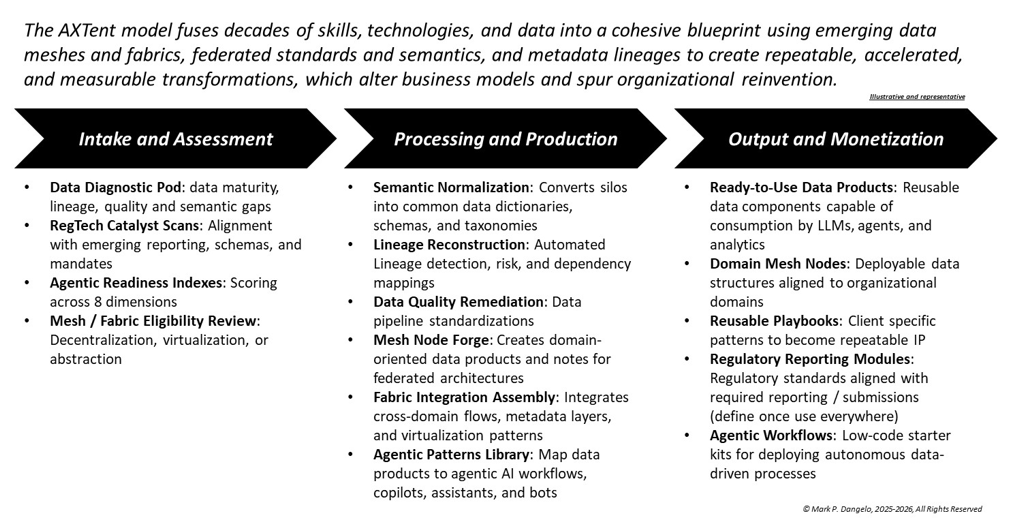
Figure 1: AXTent operating model
Three working principles of AXTent
Let’s look at each of these three design principles separately and see how they interact.
Datamesh: Reassigning responsibility
In regulated enterprises, data issues are rarely technical obstacles. Rather, they are a lack of accountability. When ownership of the meaning, quality, and timeliness of data is far removed from the realm that generates it, errors propagate silently until they surface in regulatory filings, audit results, integration failures, and more.
Structured frameworks apply data mesh principles to directly address this. The data is treated as follows: productowned by business-aligned domains and responsible for semantic clarity, quality thresholds, regulatory relevance, and consumer ease of use.
However, this is not decentralization without guardrails. AXTent enforces shared standards for interoperability, security, and governance, ensuring domain autonomy doesn’t fragment your enterprise. The practical benefits for management include faster integration, fewer semantic disputes, and clearer accountability when problems arise.
Data Fabric: Embedded control without recentralization
However, distributed ownership alone cannot solve the problem of enterprise scale. Without an integration layer, decentralization is simply rebuilding silos in new locations.
A good framework will address this through a data fabric that acts as a control plane across your data assets. Rather than moving data into a single repository, the fabric connects data products through shared metadata, lineage, and policy enforcement.
This allows organizations to continually answer important questions such as:
-
-
- Where does this data come from?
- Who owns it?
- How has it changed?
- Who can use it and for what purposes?
-
In this way, governance is no longer a downstream reporting activity. Rather, it is embedded in how data is produced, shared, and consumed. Compliance becomes an architectural feature rather than a routine remediation effort.
Additionally, in M&A scenarios, the fabric enables incremental integration, allowing acquired data domains to be adjusted incrementally and continue to operate, rather than forcing costly immediate integrations.
Composable architecture: Design for evolution, not stability
The third pillar of the AXTent model is a modern data architecture designed to absorb change, rather than resist it. Traditional architectures typically rely heavily on rigid pipelines and tightly coupled schemas. These work when requirements are stable, but can break down due to regulatory changes, demands for new analytics, or AI-driven consumption.
AXTent replaces pipeline-centric thinking with composable services such as event-driven ingestion and processing, API-first access patterns, versioned data contracts, and separation of storage, compute, and governance.
This approach supports both human analysis and machine users, including AI agents, who require direct and reliable access to data. The result is a data core that evolves without continuous re-engineering. This is critical for organizations operating under continuous regulatory oversight and frequent structural changes. AXTent allows you to plug captured entities into your enterprise architecture. domain Allows for gradual harmonization while preserving context.
architectural compass
This framework exists for one purpose. It’s about providing a practical, business-oriented methodology for building reusable, decision-aligned, and compliant data cores. It’s not the product or the platform. It’s a vocabulary backed by building blocks, patterns, and repeatable workflows that executives can use to organize their data. result instead of the system.
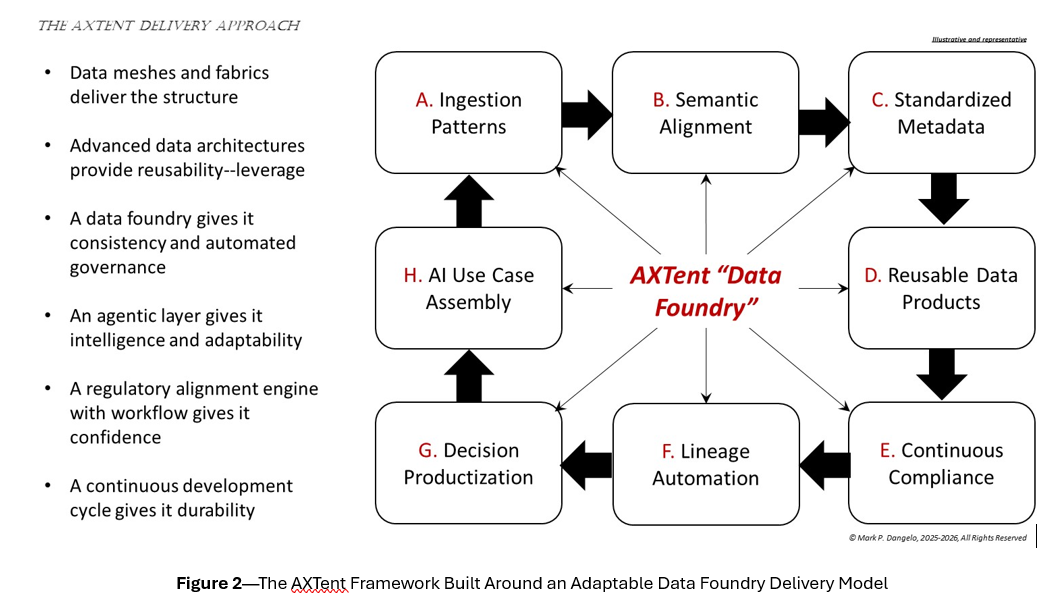
Overall, the AXTent model prioritizes data clarity over system modernization, decision alignment over model refinement, continuous compliance over intermittent remediation, reusable data products over disconnected pipelines, and enterprise knowledge organization over one-time integration efforts.
Essentially, organizations should stay away from things like: project thinking and towards persistent data development where every output contributes to a composite knowledge base. This is a mindset shift that has been missed by an industry that prioritizes AI engineering over business objectives.
In the final installment of this series, we’ll discuss how to move from “build and operate” to “build and evolve” through data foundries. You can find more blog posts by this author here


