

In February 1966, a metal ball the size of a beach ball bounced through the moon’s stormy waters, rolled to a stop, and bloomed like a flower. Peeling back the four petal-like covers revealed a camera that immediately began scanning the stark grayscale horizon. This was Luna 9, a triumph of Soviet technology and the first man-made object to achieve a soft landing on another world.
Over three days, it transmitted the first close-up images of the moon’s surface, proving it was not covered in the engulfing “quicksand” some scientists had feared. Then the battery died and there was silence for decades. The landing site is roughly known because the Soviet Union published the coordinates in newspapers, but pravdathe exact resting place of this historic robot remains unknown.

Sixty years later, a collision between modern artificial intelligence and old-fashioned obsessive human detective work has revived the hunt for Luna 9. Two separate research teams, each using very different methods, believe they have discovered the lander. The problem is that it was found in two different places.
It’s impossible for both to be right, and it’s entirely possible that both are wrong. But we may soon find out.
Algorithms and archaeologists

In a new study published this week, npj space explorationA team led by University College London and Birkbeck researcher Louis Pinault claims to have used a custom machine learning model to identify likely sites.
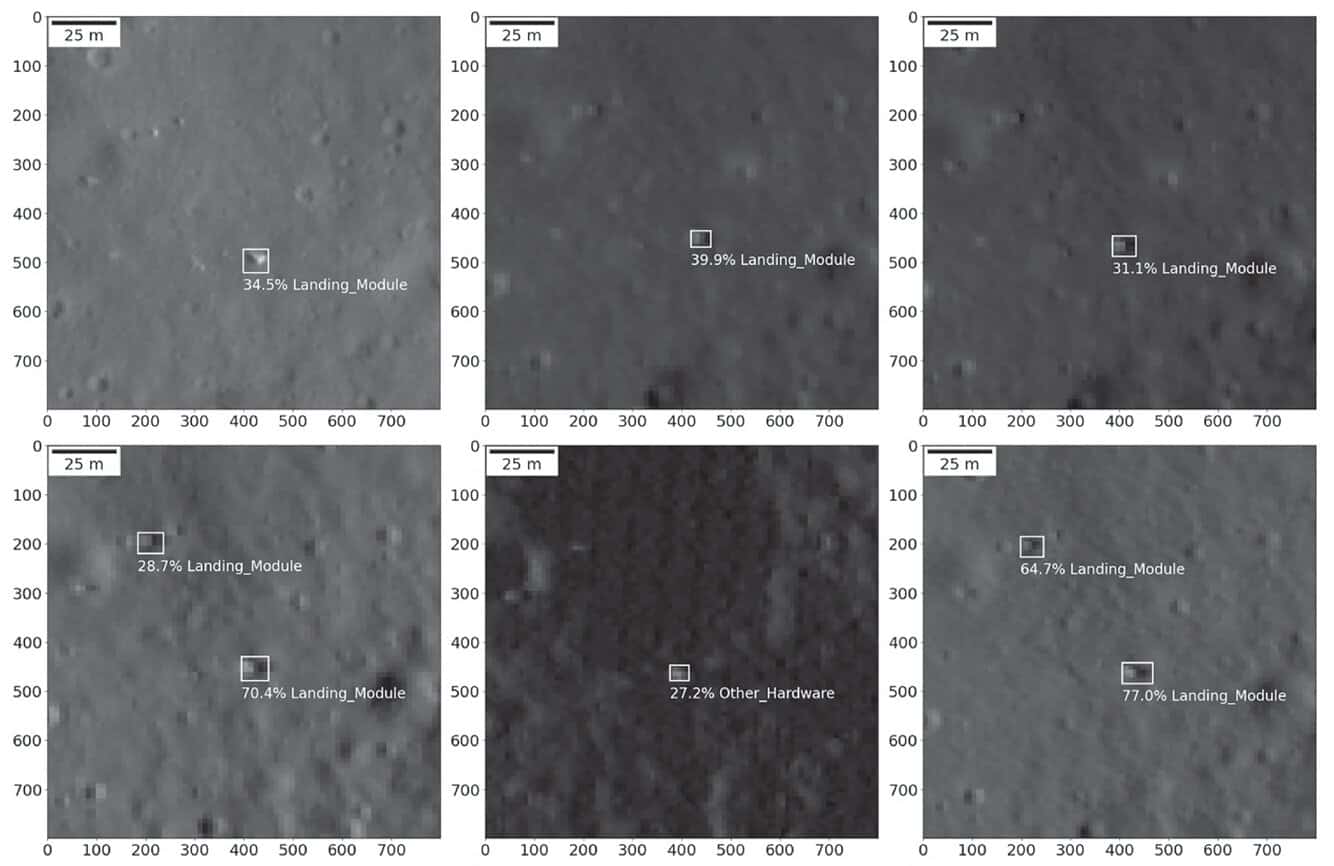
Dr. Pinault’s team developed a computer vision system called YOLO-ETA (You-Only-Look-Once — Extraterrestrial Artefact). Please ignore this fancy name for a moment. This is pretty powerful technology. This version was specifically “trained with data from the Apollo landing sites” to recognize the unique shadows and geometric features of human hardware on the moon.
The AI scanned a 5 x 5 kilometer area around the uncertain historical coordinates. It flagged a cluster of pixelated objects that looked like a landing site. The main object could be a flight module, with small features on either side of it that could be shells like the lander’s airbags.
“At least we detected an unknown artifact,” Dr. Pinault said. “I’m very optimistic that it will probably be Luna 9.”
The algorithm’s candidate site, located near 7.03 degrees north latitude and -64.33 degrees east longitude, has local topography consistent with the flat horizon seen in Luna 9’s original 1966 panorama.
But Dr. Pineau has competition.
human element

Russian space enthusiast and science communicator Vitaly Egorov has spent years searching for the same spacecraft using a radically different method: the human eye. Egorov, who fled Russia for Montenegro after the invasion of Ukraine, organized a massive crowdsourcing effort through his space website. Zeleny Kot to scrutinize images from NASA’s Lunar Reconnaissance Orbiter (LRO).
Rather than relying on neural networks, Egorov and his volunteers stared at thousands of pixels looking for anomalies. He also reconstructed the horizon seen in vintage photos of Luna 9 and tried to match the silhouette of the crater’s rim with modern orbital maps.
“One day, the landscape seemed familiar,” Egorov said. new york times. “I ‘looked around’ and realized this was the same place Luna 9 had seen.”
Egorov’s proposed location is miles away from Dr. Pineau’s location detected by the AI. The planned landing site of the long-vanished lander is about 25 kilometers away from the officially declared site.
“One of them is wrong,” said Anatoly Zak, a Russian space journalist who has been following Duel’s findings.
Needles in a gray haystack
The difficulty of this search cannot be overstated. Luna 9 is very small, about 2 feet in diameter. The best camera currently orbiting the Moon is the narrow-angle camera aboard NASA’s LRO, which has a resolution of about 0.25 meters (10 inches, or nearly 1 foot) per pixel. This means that the entire historical spacecraft appears as just a single bright spot or pixel smudge.
This pixel limitation is why Dr. Pinault turned to AI. The YOLO-ETA model was designed to discover “subtle and potentially previously overlooked surface artifacts” by analyzing contrast and shadow behavior that could be missed by the human eye. By the way, the main purpose of these models is to discover alien technology within our solar system, but that’s a story for another day. Previously, the model proved its worth by pinpointing the location of the Luna 16 lander in never-before-seen images, achieving a confidence score of nearly 77%.
But independent experts are wary of either interpretation. Philip Stork, a professor emeritus at the University of Western Ontario who specializes in lunar mapping, has considered both claims. He points out that crashes and landings typically disturb the bright lunar dust and leave obvious scars.
“Parts of the spacecraft’s landing system should be visible, and it consisted of five components. And typically the landing site also shows a bright area where the thrusters blow dust away during landing,” Dr. Stork said. new york times. “I’m not sure either of these sites have really good candidates for these things, but Egorov’s site is better.”
Preservation of space heritage
In the mid-1960s, the space race was at its peak. The United States and the Soviet Union were locked in a desperate battle for rights to the moon. Before Neil Armstrong could take his first step, scientists had to prevent the moon’s surface from swallowing the spacecraft whole.
“This was the first soft landing on another celestial body,” the European Space Agency said. “It dispels any doubts that the Earth’s surface is dangerous quicksand and paves the way for manned trips to the moon.”
Restoring the site will allow researchers to study how human material deteriorates during 60 years of exposure to the harsh lunar vacuum and radiation. It will also examine the utility of “compact, edge-deployable machine learning models” in future missions. Dr. Pinault envisions a future where similar AI models are built directly into spacecraft and can autonomously detect and catalog hazards and artifacts in real time.
“This is kind of an obsession of mine,” Dr. Pineau admitted. His ultimate goals extend even further than Soviet hardware. He hopes these techniques will eventually help search for “extraterrestrial artifacts” throughout the solar system.
You may not have to wait long for answers. The resolution of current NASA images is on the edge of what is physically resolvable. It will take a closer look to prove who is right.
Currently, expectations are high for India’s Chandrayaan-2 spacecraft. Chandrayaan-2 has a camera with slightly higher resolution than NASA’s LRO. Mission planners agreed to take images of Egorov’s target site in March 2026.
If that fails, a new wave of private and public lunar exploration missions is on the horizon. “It’s just a matter of getting a bigger, more powerful camera into orbit around the moon,” Zack said. “We’ll probably see those places in our lifetime.”


