How AI conversations will replace traditional search results in retail
It’s the day before my friend’s birthday. I need a gift under $50 that arrives tomorrow. Ask your AI assistant a question instead of opening a bunch of tabs. In one conversation, we understand your situation, assess your constraints, and recommend choices you feel confident and willing to make.
This moment is indicative of the changes underway in the retail industry. 1Bain & Company estimates that 30% to 45% of U.S. consumers are already using generative AI to research and compare products. Shopping is increasingly happening in AI-guided conversations, where agents go beyond listing options to interpreting intent, evaluating tradeoffs, and guiding decisions in real-time.
For CMOs, this is not just one channel to optimize. This represents a fundamental shift in how influence is gained and how brands compete for loyalty, margins, and growth.
What is agent commerce? How will it change the shopper experience?
For years, the front door to retail has been the homepage, search box, or category page. Growth comes from keyword acquisition, driving traffic, and funnel optimization, and is often measured through last-click attribution.
Agent Commerce changes that. The new gateway is conversation.
Instead of navigating through pages and filters, shoppers now express their intent using natural language. “I need a sustainable gift for my co-worker who loves to cook, under $50. It must arrive by Friday and feel upscale rather than generic.” The conversation itself can be a discovery, unexpected choices can emerge or new ideas can emerge. Through continuous dialogue, those possibilities are honed and decisions made with confidence.
It’s not just what you recommend that matters, but how that recommendation is shaped using context at the decision moment.
How AI shopping agents generate insights that drive business growth
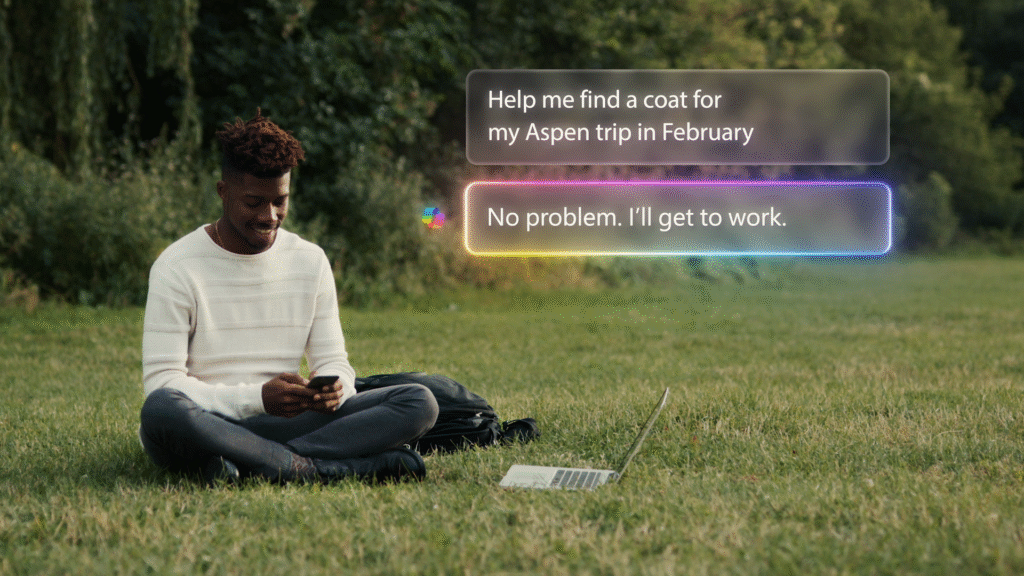
The following video shows agent commerce in action. This shows how a single request can create value for both shoppers and brands.
A shopper wants a coat for a trip to Aspen in February. Agents get to work right away, taking into account weather data, shoppers’ preferred styles, available inventory, prices, reviews, and more.
At the same time, the request also generates actionable insights for brands. Marketers look at intent signals combined with internal retail data and broader market trends. Patterns are emerging and we can see that the demand for winter clothing is increasing. AI agents recommend targeted promotions, marketers approve them, and offers are sent back to shoppers.
Shoppers receive hand-picked recommendations along with timely promotions, choose with confidence and head to the slopes in the right jacket.
This is real agent commerce. Conversations add value in the moment while generating learnings that inform future business decisions. This creates a feedback loop that is reinforced with each interaction.
What makes this different from previous changes in the industry is when influence occurs. This regulation no longer only applies before decisions are made through advertising or product sales. With real-time signals flowing between shoppers and brands, influence is now shaped within the decision itself.
What’s different about moving to agent commerce?
Retail has experienced major shifts from brick-and-mortar stores to websites, from desktop to mobile, and from first-party commerce to marketplaces. Each wave opened up new demand channels.
Agent commerce will continue to evolve. It changes the way decisions are made themselves. This introduces a decision-making layer between the shopper and the brand. Behind every interaction is a learning layer that sends signals back to the merchant to inform decisions that shape recommendations, promotions, assortments, and experiences.
The scale of this change is significant. 2McKinsey predicts that adjusted revenue from agency transactions will reach up to $1 trillion in the U.S. business-to-consumer retail market alone by 2030, with global projections of $3 trillion to $5 trillion. This is not incremental growth. It’s a reconfiguration of how products are discovered, evaluated, and purchased.
For CMOs, strategy is now focused on guiding decisions at the moment of choice and capturing the intelligence generated by those interactions. Brands that gain instant influence and build on what they learn over time are well-positioned to build lasting advantages in pricing, loyalty, and lifetime value.
How to build a competitive advantage with agent commerce
As agent commerce grows, two imperatives have emerged, and major brands are pursuing both.
Help shoppers find you wherever they ask
AI assistants such as Microsoft Copilot are becoming a popular starting point for product discovery. When a shopper asks, “What are the best running shoes for marathon training?” or “Find a sustainable laptop bag for under $200,” an AI agent interprets the intent and makes recommendations.
To compete in moments like these, brands must ensure that their products, attributes, and value propositions are accurately represented on AI platforms. Success depends on being found by consumers when they ask questions, not just when they type keywords into the search bar.
Build your own agent experience that captures learning
Being discovered on third-party platforms creates awareness. Unique conversational experience gives you an advantage. When brands deploy AI agents in their facilities, they understand the context behind each decision. That intelligence informs merchandising, pricing, inventory, content strategy, and personalization. Just as importantly, brands can use these insights to enrich their product catalogs with language, attributes, and use cases that improve discoverability on third-party AI platforms and enhance AEO and GEO performance over time.
Trust plays a key role here. According to Bain & Company, consumers are increasingly relying on AI for research and are now three times more trusting of a brand’s on-site agents than third-party agents. This trust benefit allows owned conversation experiences to more effectively drive conversions.
Why do winners do both?
The question for CMOs is not whether to participate in agent commerce. The shift has already begun. The real question is: Will your brand only appear in third-party recommendation engines, or will you also own the intelligence that turns interactions into lasting advantages in pricing, loyalty, product development, and lifetime value?
4 actions retail leaders can take now to prepare for agent commerce
Agent commerce is taking shape, and the path to preparation is clear.
- Optimize AI discoverability. Most product data is built for search filters, not AI conversations. Brands need structured attributes, descriptions that reflect real-world use cases and the brand voice, and accurate information about pricing, availability, fulfillment, and policies. This practice, often referred to as AI Engine Optimization (AEO) or Generative Engine Optimization (GEO), helps AI accurately represent your products when shoppers ask questions on search engines and conversational platforms.
- Launch your own conversation experience to help you learn faster. Bringing an AI shopping assistant to your own surfaces creates a feedback loop. Each interaction and conversion generates insights into customer intent, preferences, and friction points. Marketers can use these insights to continuously improve product catalog data and enhance AEO and GEO performance across all platforms.
- Designed for openness and portability. Agent commerce spans websites, apps, stores, partner channels, and third-party platforms. Product intelligence and brand logic must move across the surface so that brands can participate in new ecosystems without losing differentiation and having to reinvent the wheel each time the interface evolves.
- Manage measurement to connect learning to growth. As AI agents increasingly mediate shopper actions, brands risk losing visibility into how decisions are made. Clear expectations around signal sharing, experimentation, and insight ownership ensure that every interaction helps strengthen your business.
Trust and privacy run through all four movements. Transparent recommendations, responsible use of data, and alignment with brand values build long-term loyalty.
A new era of growth for retail CMOs
Agent Commerce is not meant to replace marketers and sellers. It enhances their role and brings intelligence, situation, and action closer to the moment of choice. For CMOs, this is a leadership moment. This is an opportunity to shape how customers discover and select products, transform data into conversational intelligence, and build trust as a source of lasting differentiation.
The people who define how shoppers discover, trust, and choose in an AI-mediated world will define the next era of growth in retail and consumer goods.
Prepare your brand for agent commerce
Optimize product data and brand content so that AI agents can accurately represent and recommend products across platforms. Access our guide to AEO and GEO to power your business with AI-driven shopping.

Accelerate your retail growth with Microsoft for Retail
Find AI use cases, customer stories, and other resources on the Microsoft for Retail page.
1Bain & Company estimates that 30% to 45% of U.S. consumers are already using generative AI to research and compare products.
2McKinsey forecasts that by 2030, adjusted revenue from agency transactions will reach up to $1 trillion in the U.S. B2C retail market alone, with global forecasts for $3 trillion to $5 trillion.

Hope Ashcraft is a Senior Product Marketing Manager at Microsoft, supporting the retail and consumer goods industries. Since joining Microsoft in 2017, she has helped brands leverage AI and emerging technologies to drive growth, increase customer engagement, and make smarter data-driven decisions. A strategic and results-driven leader, Hope is focused on turning complex technologies into practical solutions and keeping organizations at the forefront of industry innovation.
See more articles by this author