

🔊 Listen to the article
From science fiction to real-world laboratories, the humanoid robot market continues to advance.
Today, robots do more than just move. They work among us. They are making good progress walking, answering questions, and learning from humans. While big tech companies have focused on competence, one researcher has proposed a bold idea: robots with empathy.
Robots don’t just imitate humans. They will feel it with us. Although AI can imitate empathy, it cannot read human emotions, creating a rift between humans and robots. Researchers are trying to teach robots to interpret human emotions. It goes beyond scripted responses and focuses on reading facial expressions, body language, and real-time reactions.
Can robots really understand us?
Most conversation-based AI, such as chatbots and humanoid robots, work through pre-programmed empathy. Patterns and follow-up questions keep users engaged, but this empathy is notorious for its shallowness. They work through programming rather than true understanding. This tends to distort the user experience and can also lead to psychological distress. Scientists have been looking for something to add depth to the experience.
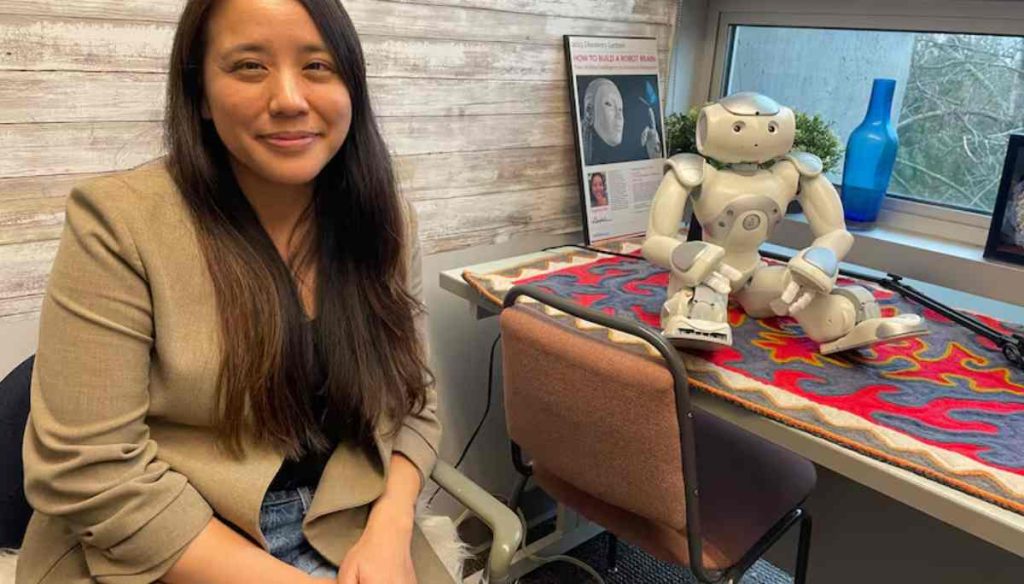
This is where American-Canadian AI roboticist Dr. Angelica Lim comes into the picture. Lim, an associate professor of computing science at Simon Fraser University and director of the SFU Rosie Institute, is leading research into socially intelligent and empathetic robots that can understand and express emotions through their faces, body language, and voice. Her lab builds machine learning models for human-robot and character interactions, focusing on behavioral adaptation rather than scripted responses.
Previously, Lim led the software team for the interactive humanoid robot Pepper at SoftBank Robotics in Paris and was a key contributor to the Pepper project with SoftBank and Aldebaran Robotics. With over 15 years of experience in robotics and artificial intelligence, her research spans signal processing, machine learning, developmental robotics, and specifically the study of emotions in intelligent systems. In a discussion with CBC, Lim explained that the goal is not emotional manipulation, but true, situational empathy. In one demonstration, a robot told a joke, detected a lack of laughter, and adjusted its response in real time. For Lim, trust comes not when robots rely on pre-conceived emotional cues, but when they can read nuances and respond accurately.
Lim holds a PhD and MSc in Intelligent Science from Kyoto University and a BS in Computational Science from Simon Fraser University. She has interned at Google, Honda Research Institute in Japan, and I3S-CNRS in France. She is a journalist for the IEEE Spectrum Automaton Robotics Blog and has also spoken at TEDx Kyoto and TED Kuala Lumpur. Her research has won multiple awards, including the IROS Best Paper Award. Angelica has also been featured on the BBC, Forbes, and SXSW.
Humans follow unwritten social rules. We know when to smile, when to adjust our tone, and when to be formal. Simon Fraser’s team has been working to formally map and integrate these rules into robots.
A broader perspective on robotics
AI platforms now offer mood settings and emotional tones, such as ChatGPT’s mood presets and virtual assistants designed to sound upbeat. However, these often don’t match the user’s current feelings. These systems focus on static definitions of assigned emotions rather than working through real-time interpretation.
Leading companies are investing heavily in humanoid robotics, physical AI, and perception systems that can interpret the world around them. In recent news, Mobileye decided to acquire Mentee Robotics for $900 million, expanding humanoid robotics into the commercial realm. Researchers and startups are also working on sensory functions.
Lyte has unveiled a virtual brain for robots that allows them to see and interpret their surroundings in a safe and efficient manner. Companies like Smart Eye and Beyond Verbal are powering facial analysis through AI systems that detect real-time behavior and voice recognition.

Why empathy is important in robotics
As robots become more prevalent in homes, schools, and hospitals, they will interact with humans, often vulnerable humans. By reading expressions and understanding tone, natural responses are essential to building trust.
Connectivity is a necessary feature of the future of robotics. Increased research and investment is blurring the line between machines as functional items and machines as empathic beings. A world where robots understand humans is closer than we expected.
stay tuned brand scenario For the latest news and updates


