The data science team I worked with last year spent six months building a machine learning model for a logistics company. Great work. Sophisticated algorithms. Beautiful prophecy. Everyone was excited to start production.
Then reality hit. The model needed to process real-time shipping data from 200 locations. Their office’s internet connection couldn’t handle the volume. Predictions that performed well on test data started timing out on the live feed. The entire system has crawled.
Six months of development almost derailed by something no one thought to check: whether the internet could actually support the AI they built.
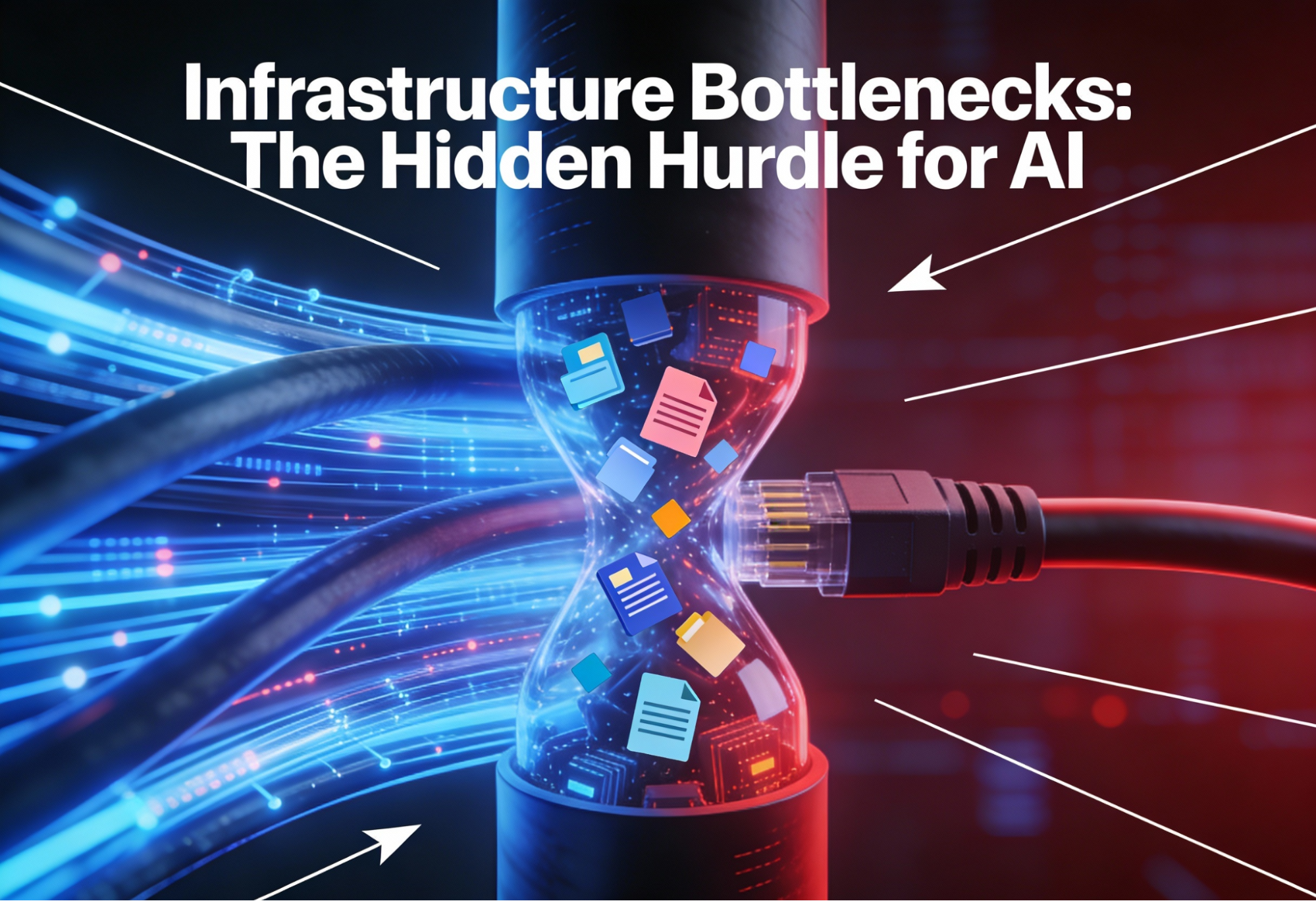
This keeps happening. Companies are pouring resources into AI talent, computing infrastructure, and high-performance tools. But they completely overlook the network connections that tie everything together. It’s like building an F1 car and filling it with regular gas.
Bandwidth issues no one talks about at AI conferences
Spend an afternoon at an AI or machine learning event. You’ll hear a lot about model architecture, training techniques, deployment strategies, and ethical considerations. Everything that’s important.
But no one is talking about bandwidth.
This is strange. Because bandwidth silently determines whether most AI implementations actually work in production. According to McKinsey research on AI adoptionorganizations are significantly increasing their investments in AI. However, infrastructure discussions rarely include network capacity alongside compute and storage.
Train models, move datasets, provide predictions, and sync across cloud environments. Every step requires moving data over a network connection. When these connections become bottlenecks, everything downstream is affected.
How AI actually uses networks
Most people think of AI workloads as purely about computing. GPU, TPU, processing power. Certainly that’s a big part. But data movement is just as important.
Transfer training data
Before you start training your model, you need to move your data from where it resides to where it will be trained. It could be an on-premises server to a GPU instance in the cloud. It could be a data lake to train your cluster on. Multiple sources may be combined into an integrated dataset.
We’re not talking about small files here. Training datasets for computer vision models typically reach hundreds of gigabytes. Training sets for large language models can exceed terabytes. Natural language processing corpora are growing every year.
On a standard 500 Mbps connection, transferring a 500 GB training dataset takes approximately 2.2 hours. Sounds manageable until you realize that data scientists are constantly iterating. New data arrives daily. Datasets are iteratively cleaned, enriched, and reformatted. This 2.2 hour journey is repeated many times.
At 10Gbps? The same transfer takes approximately 7 minutes. This fundamentally changes the way teams work.
Deploying and updating models
The trained model must reach production. Large models can be several gigabytes. Some enterprise deployments include dozens of models across multiple endpoints.
If you update your model frequently (which you should do to maintain accuracy), speed of deployment becomes important. Slow uploads result in longer gaps between model versions. A long gap means predictions are based on older data. Outdated forecasts result in poor business results.
real-time inference
Bandwidth becomes extremely important here. AI systems that make real-time predictions require data to flow in and results to continually flow out. Recommendation engines, fraud detection, dynamic pricing, and predictive maintenance. Both require a constant stream of data.
If the incoming data is delayed due to network congestion, the predictions will also arrive late. Delays in predicting fraud detection can result in fraudulent transactions being approved. Delays in forecasting in dynamic pricing result in missed revenue opportunities. Slow forecasting in manufacturing means quality issues go undetected.
distributed training
For large-scale AI training, work is increasingly distributed across multiple machines or cloud regions. These machines must constantly communicate during training, exchanging gradient updates, and synchronizing model parameters.
Network bottlenecks between training nodes slow down the entire process. Work that should have taken several hours now spans several days. GPU time is expensive. Wasting it because the network can’t keep up is literally wasting money.
Real-world AI workloads and their bandwidth demands
Let’s get specific about what different AI applications actually require from a network.
computer vision system
Analysis of surveillance cameras, quality inspection in manufacturing, and development of self-driving cars. These systems process large amounts of image and video data. One 4K camera generates approximately 25 Mbps of raw data. 10 cameras? 250 Mbps for video feed only, before processing or serving models.
In large manufacturing facilities, 50 to 100 cameras may be fed into the AI system simultaneously. That’s 1.25 to 2.5 Gbps for camera data alone. Adding model updates, results storage, and monitoring dashboards pushes standard connectivity to its limits.
natural language processing
Customer service chatbots, document analysis systems, and sentiment analysis platforms. These seem lightweight compared to computer vision, but scale makes all the difference.
A chatbot that handles 1,000 simultaneous conversations processes a lot of data. Document processing systems that ingest thousands of pages every day generate large amounts of network traffic. Enterprise NLP deployments that handle multiple languages and multiple document types in multiple locations will pay off quickly.
Generative AI applications
Companies that bring generative AI in-house face particular challenges around bandwidth. With large language models, API calls require large amounts of data transfer, especially with long context windows. The image generation model sends and receives large files for each request.
If you have a team of 50 people actively using a generative AI tool during work hours, your connections will have a constant stream of API traffic. Adding model fine-tuning with your own data significantly increases bandwidth requirements.
IoT and edge AI
Smart factories, connected logistics and environmental monitoring. IoT deployments generate continuous data streams from hundreds or thousands of sensors. Even if AI processes this data at the edge, the results must be synchronized with the central system.
A connected warehouse might have 500 sensors reporting every few seconds. This is a steady baseline traffic that never stops. With AI processing at the top, model updates flow downwards, insights flow upwards, and network demands rapidly increase.
Latency factors that slow down AI performance
Bandwidth measures the amount of data that can move over a connection. Latency measures the time it takes for data to start moving. Both are extremely important in AI applications.
Real-time AI systems are particularly sensitive to delays. Fraud detection systems must evaluate transactions in milliseconds. Autonomous navigation systems cannot wait 200 milliseconds for a prediction. A real-time recommendation engine is useless if the suggestion arrives after the customer has already left the page.
High latency doesn’t just slow things down; Fundamentally disrupts certain AI applications. There is a threshold at which AI cannot function as designed.
The combination of ultra-low latency connectivity (sub-milliseconds within local networks) and edge computing enables AI to respond fast enough for time-critical applications. Without this, businesses will have to accept reduced performance or give up on real-time AI altogether.
The true cost of inadequate infrastructure

When companies calculate budgets for AI projects, they typically include compute costs (cloud GPU instances), talent costs (data scientists, ML engineers), software costs (platforms, tools, licenses), and data costs (acquisition, labeling, storage).
Network infrastructure rarely appears on the list. That’s wrong.
Slow data transfer will extend your project timeline. Data scientists wait for datasets instead of working on them. Model deployment takes hours instead of minutes. Production systems cannot process data fast enough, resulting in poor performance.
I have seen AI projects run 30-40% over budget simply due to infrastructure bottlenecks that no one expected. No computational bottlenecks. It’s not a storage bottleneck. Network bottleneck.
cost to upgrade to 10Gbps business broadband This is just part of what companies often waste with extended timelines, idle computing resources, and underperforming AI systems.
What does an AI-enabled network infrastructure look like?
If you’re serious about AI, your network needs to match your ambitions. This is important.
Symmetrical high-speed connection
AI workloads push data massively in both directions. Download training data, upload models, send predictions, and receive sensor feeds. Asymmetric connections with slow upload speeds quickly become a bottleneck.
Symmetric 10 Gbps connectivity handles the bidirectional nature of AI workloads well. Data flows freely in both directions, without one interfering with the other.
Low and stable latency
Sudden, unpredictable delays cause more problems than consistent, moderate delays. AI systems require predictable network behavior to function reliably.
Look for a provider that offers sub-millisecond latency on the core network. Consistency is just as important as raw numbers.
Scalability for experimentation
AI projects are inherently unpredictable. A large amount of bandwidth may be required during model training for one week, and minimal bandwidth may be required during evaluation. Or perhaps you suddenly need to transfer a large dataset from a new source.
With a provider that offers on-demand bandwidth, you can temporarily expand without changing your contract permanently. This flexibility is consistent with how AI actually works.
Network resiliency
AI systems running in production cannot afford to lose connectivity. Serious problems occur if an autonomous system loses network access while it is operating. When fraud detection goes offline, your transactions are no longer protected.
A diverse network infrastructure with multiple paths keeps AI systems connected even if individual components fail.
Plan your AI infrastructure properly
If you’re considering implementing AI or expanding your existing AI operations, include network infrastructure in your plans from day one. It wasn’t a random idea.
Plan your data flow. Where does the training data come from? Where is the model deployed? How much data moves between locations? How much latency does the application require?
Calculate realistic bandwidth requirements based on actual data volume rather than theoretical minimums. Add room for growth and experimentation. AI projects tend to consume more bandwidth than originally estimated.
Consult your network provider for AI-specific requirements. Not all business internet connections are created equal, and the cheapest option is unlikely to adequately support serious AI workloads.
where things are heading
AI adoption is accelerating. The model is getting larger. Applications are becoming increasingly ambitious. The amount of data continues to grow exponentially.
Bandwidth requirements for AI workloads in 2027 will dwarf today’s needs. Companies that invest in high-capacity network infrastructure are better positioned to scale their AI operations later without hitting infrastructure walls.
Companies that recognize that their network infrastructure is a key enabler of AI will execute faster and deliver better results. Those who treat it as a consequentialist will continue to wonder why AI projects perform poorly, despite having great talent and powerful computing.
AI performance is determined by the infrastructure that supports it. This also includes network connections, which most people forget to think about.