
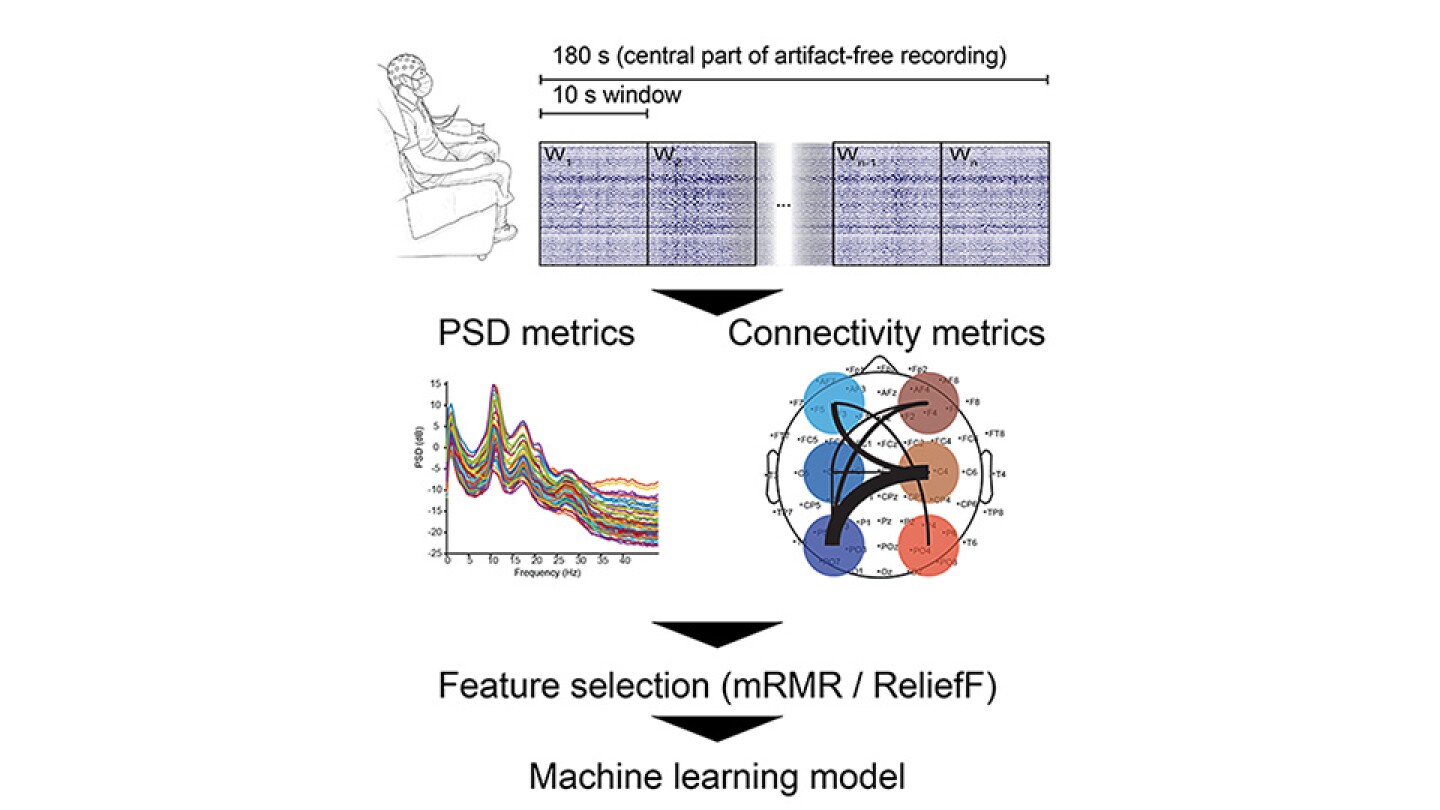
Machine learning models trained on brainwave data from patients recovering from stroke can help predict how new patients will regain mobility.
After a stroke, brain plasticity increases and can support recovery if patients stabilize quickly enough. To take advantage of this, doctors need to understand the patient’s ability to heal and whether they can regain motor control.
Lassi et al. created a neural network called StrokeRecovNet that uses electroencephalography (EEG) to predict a patient’s future motor recovery. This is displayed as a continuously updated score from the Fugl-Meyer Assessment scale, a competency-based impairment index for stroke patients.
StrokeRecovNet splits EEG data into short time windows and extracts quantitative features from the EEG data that correlate with different brain activities.
“Our main goal was to predict the fastest possible recovery after stroke, so we first tested our model on a dataset of acute stroke patients,” said author Michael Rassi.
However, using only data from acute stroke patients produced comparable results to previous models, so the researchers trained and tested the model on additional datasets from subacute stroke patients, that is, patients days or weeks after their stroke. This improved our results and demonstrated that these combined datasets can be used to refine acute-phase healing predictions.
In the future, the researchers hope to improve the model by incorporating kinematic and electromyographic data from upper limb movements into the predictive framework. Because these data contain important information that helps predict recovery.
“We hope to further develop this approach into a flexible and modular framework that can be easily adapted to different types of data, paving the way for more comprehensive and personalized predictive models in stroke rehabilitation,” said Rassi.
sauce: “Enhancing prediction of upper limb motor recovery after acute stroke using EEG and subacute data” by Michael Lassi, Stefania Dalise, Luigi Privitera, Nicola Giannini, Michelangelo Mancuso, Valentina Azzollini, Tommaso Ciapetti, Antonello Grippo, Silvestro Micera, Francesca Cecchi, Alberto Mazzoni, Carmelo Chisari, Andrea Bandini; APL bioengineering (2026). This article can be accessed from: https://doi.org/10.1063/5.0287165 .


