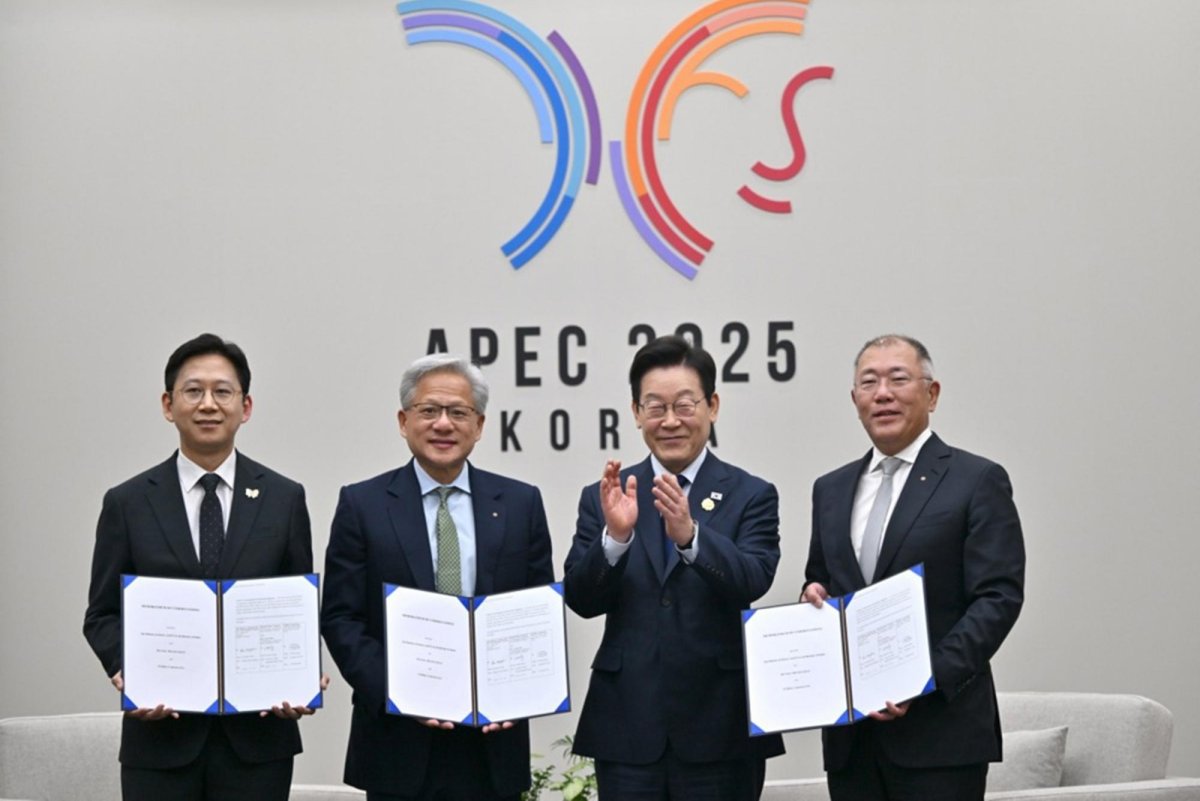
NVIDIA Founder and CEO ( South Korean President Lee Jae-Myung (2-right) poses with CEO Jensen Hwang (2-left), South Korean Minister of Science, Technology, Information and Communications Bae Kyung-hoon (left), and Hyundai Motor Group Chairman Chung Eui-sung (right). South Korea, October 31, 2025. file. Photo provided by: JUNG YEON-JE/EPA
January 27 (Asia Today) — The South Korean government has rolled out a “Manufacturing AI Transformation” strategy, pledging to combine data and artificial intelligence to increase productivity and support companies’ self-sustaining growth.
But even as many companies rush to buy Nvidia graphics processors and plan massive data centers, they still can’t answer the basic question of what they will actually do with AI.
The United States leads the world in large-scale language models such as ChatGPT. China has leveraged its capital base and market size to rapidly expand domestic AI services. The challenge for South Korea is to create demand while building infrastructure at the same time. One possible answer lies in an area often treated as obsolete: manufacturing.
The new concept is “physical AI,” or artificial intelligence embedded in machines such as robots and self-driving cars. Once a large-scale language model has learned from online text and images, the next step is to teach the machine how to perform real-world tasks. This requires a variety of data, including physical skills and movements.
The Internet is rich with decades of text and image data. Far fewer things matter on the factory floor, such as the manual skills of an experienced welder or the precise feel required to assemble semiconductor devices.
Even simple robotic tasks, such as picking up a water bottle, can be mathematically complex. Previous approaches have primarily attempted to solve such problems using mathematical formulas. Recent developments have moved towards learning by demonstration, where robots are trained by observing and imitating human movements.
An example cited in the industry is remote-style training in humanoid robotics. In this training, a human worker performs a task while wearing sensor equipment, allowing the robot to learn movement patterns through repetition. In this approach, the key input is “skilled behavioral data” rather than equations.
This is where South Korea may have an advantage. The country remains one of the world’s top manufacturing nations. While some global competitors convert the movements of ordinary workers into training data, South Korea could digitize the know-how of veteran skilled workers with decades of experience.
Industrial cities such as Ulsan and Changwon still have skilled workers whose tacit knowledge is difficult to explain on paper. If that expertise can be captured through remote control and translated into training data before retirement, it could become a national asset that would be difficult for competitors to quickly replicate.
South Korea has often treated its manufacturing-centered structure as a constraint, citing a lack of value-added software design capabilities. However, as AI begins to take physical form, factories can become “AI learning laboratories” and old strengths can turn into new strengths.
This argument is not that South Korea should abandon large-scale computing investments. The idea is that the country should pursue a form of “data sovereignty” based on skilled work, a national effort to convert industrial know-how into data, not just servers.
— Asia Today reported. Translation by UPI
© Asia Today. Unauthorized reproduction and redistribution is prohibited.
Korea original report: https://www.asiatoday.co.kr/kn/view.php?key=20260127010012632