
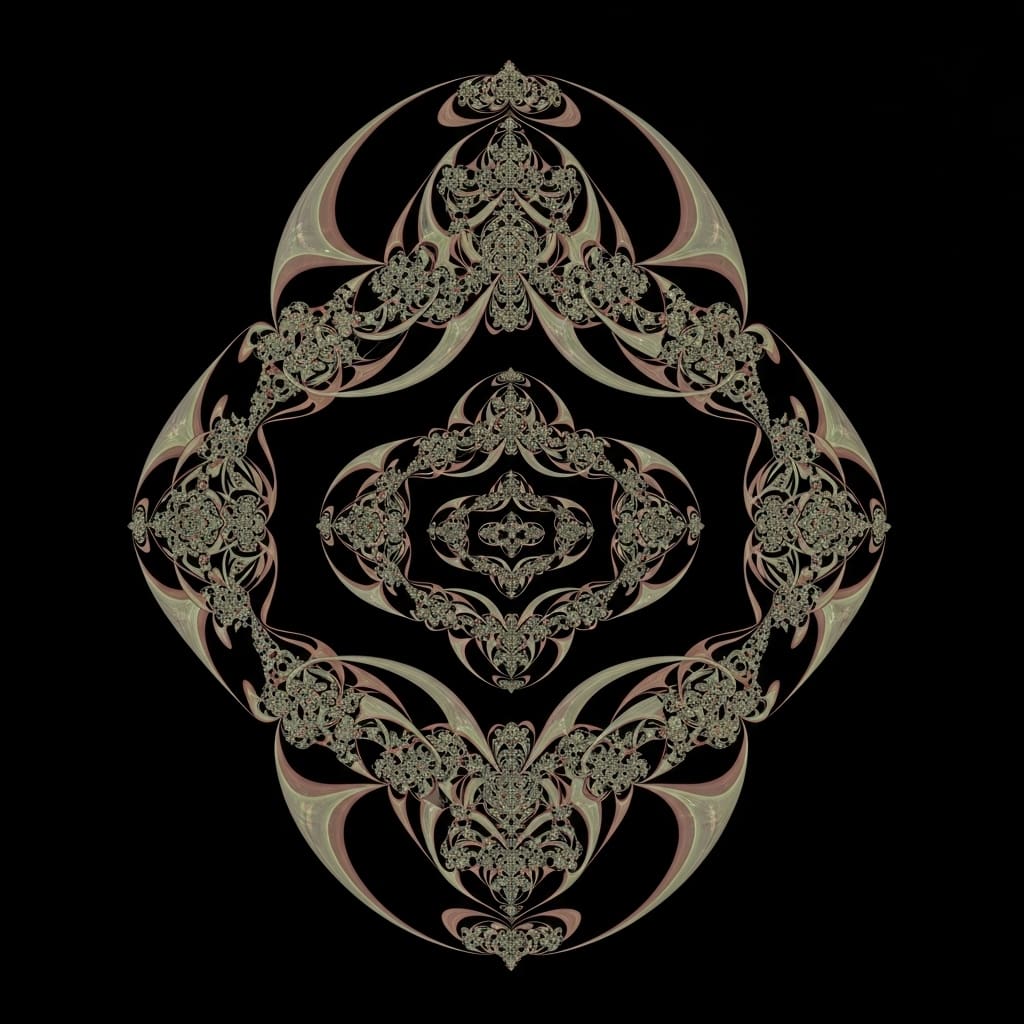
Researchers are increasingly investigating how artificial intelligence is reshaping artistic production, but a unifying framework for understanding these evolving practices remains elusive. Florentine Koch from École Polytechnique and HEC Paris, together with colleagues, introduces a new conceptual paradigm for analyzing self-transforming art: reflexivism. This paper formalizes recursion, a well-established principle in mathematics and computer science, as an aesthetic lens through which to view art that actively alters its own generative process, rather than simply changing its output. By establishing a five-level scale of analysis and three operational criteria (state memory, rule expandability, and recursive visibility), Koch et al. provide an important tool for distinguishing truly self-correcting art from related disciplines, providing a new perspective on art history, and prompting important discussions about the aesthetic, curatorial, and ethical challenges of AI-driven creativity.
This scale provides a rigorous way to understand the degree of self-transformation within an art system. This perspective suggests that the evolution of art is not just a linear progression, but a cyclical process of refinement and fundamental change. Researchers demonstrate that artificial intelligence can technically make this recursive logic explicit through learning loops, parameter updates, and code-level self-modification, literalizing structures that were previously implicit in the artistic process.
This research proves that AI can not only carry out artistic intentions, but also actively participate in the generative process, potentially leading to entirely new forms of artistic expression. These concepts provide a concrete methodology for identifying and analyzing reflexive art systems. To illustrate these criteria in practice, detailed case studies such as Refik Anadol’s immersive installations, Sougwen Chung’s human-machine collaborative drawing systems, Karl Sims’ Genetic Images, and Darwin, Gödel Machine were considered. The analysis of these diverse examples demonstrates the applicability and explanatory power of the reflexivist framework.
Experiments show that reflexivism provides a conceptual response to the automation of execution and the rise of recursive AI architectures, positioning it as an important framework for understanding the future of the arts. This study concludes by investigating the aesthetic, curatorial, and ethical implications of a self-correcting art system, opening new avenues for artistic exploration and critical discourse. This breakthrough reveals a deeper understanding of how art can evolve in the age of AI, moving beyond simple automation to true co-creation and self-transformation, a paradigm shift with profound implications for artists, curators, and audiences alike.
Five levels of reflexivity and operational criteria
These concepts were validated through a case study featuring Refik Anadol, Sougwen Chung, Karl Sims, and the Darwin-Godel Machine, providing a concrete example of recursive behavior. In this study, we adopted the comparative taxonomy detailed in Table 2 to contrast reflexivism and related fields such as generative art, cybernetics, process art, and evolutionary art, emphasizing the crucial difference in ontological evolution: the ability of systems to transform generative procedures. The experiment focused on analyzing the technical architecture of the art system to determine its recursive level and distinguishing between phenomenological experience and fundamental computational processes. For example, an analysis of Refik Anadol’s installation revealed that despite the evolutionary Level 1 appearance created by audiovisual montage and external data modulation, it is technically a Level 0 architecture, with pre-trained GAN models producing independent images without state memory or feedback.
This methodological approach allows for a nuanced understanding of how AI expresses recursion literally and scalably through iterative self-correcting loops, automating processes and revealing new patterns at scales beyond human perception. This work pioneered the use of μ, ρ, and R as a diagnostic lens for identifying recursive processes, a comparative tool for mapping system evolution, and a common vocabulary for linking human, machine, and hybrid reflexivist practices. Ultimately, this study shows how reflexivity reconfigures the landscape of dynamic systems, defining reflexivity not as mere observation or optimization, but as the ability of a system to act and transform based on its own generative procedures.
Five Levels of Reflexivist Artistic Self-Modification
Experiments revealed that each level specifies changes, states, parameters, rules, or meta-rules from one step to the next, following the principles of reflexivity, and marks a threshold at which the procedure moves from iteration to true self-correction. The team measured the artistic process, defining level 0 as a simple repetition of On+1 = f(On), indicating changes in inputs by fixed rules, such as repeating the same filter on each input. Level 1 of accumulation iterations is defined as On+1 = f(O0, ., On), indicating aggregated input and external memory through additive accumulation, such as layering the output without changing the rules. Level 2 parametric recursion is expressed as On+1 = f(On; pn) and pn+1 = g(On, pn), indicating parameter variation and adaptive feedback, similar to how an AI model updates weights.
The results show that recursion (level 3) is defined by On+1 = fn(On) and fn+1 = F(fn, On), indicating the evolution of production rules through structural self-adjustment in which the system modifies its own algorithm. Measurements confirm that meta-recursion, level 4, is expressed as (fn+1, On+1) = fn (fn, On), implying the evolution of generative principles and complete self-organization, redefining the logic governing its own evolution. This scale allows us to analyze precisely how the artistic process changes and moves beyond mere repetition to true self-correction. This work shows how major breaks such as Renaissance, Modernism, and Conceptualism each functioned as meta-recursive jumps, signifying changes in the underlying rules of artistic creation. This study posits that artificial intelligence acts as a catalyst for a new artistic paradigm, enabling the technological realization of a self-transforming reflexive process that reflects the historical changes observed with the emergence of photography and Impressionism. This breakthrough provides a framework for understanding how AI can facilitate conceptual authorship and move art from the creation to the construction process.


