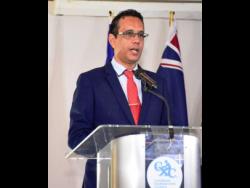
Dr. Eduardo Ali, a registration advocate and deputy CEO of the Caribbean Examinations Council (CXC), has called for greater involvement of parents and teachers as students report increasing use of artificial intelligence (AI) to aid learning.
AI is a branch of computer science that allows machines to simulate human cognitive functions such as learning, reasoning, problem solving, perception, and decision making.
CXC is now allowing the use of AI in external exams in school-based assessment (SBA) based on a new policy framework that emphasizes ethical use, appropriate referencing, and academic integrity. This framework allows AI to be used to devise and enhance ideas, but not to generate complete submissions. There are severe penalties for abuse and fraud. This policy applies to SBAs, projects, and assignments and is designed to help students leverage technology while maintaining original thinking.
This policy governs assessments under the Caribbean Secondary Education Certificate (CSEC), Caribbean Advanced Proficiency Examination (CAPE), and Caribbean Secondary Level Competency Certificate (CCSLC).
SBA is a flexible, continuous school-managed assessment process in which teachers assess students throughout the learning cycle, rather than relying solely on final exams.
Mr Ali made the remarks during a panel discussion on Thursday at the launch of the Teens and Technology Report 2025, a joint initiative of the University of Technology Jamaica (UTech) and the Jamaica Broadcasting Commission.
While recognizing the growing importance of AI, Mr. Ali emphasized the need for increased cooperation among key stakeholders.
“We are not looking at AI in terms of making it compulsory in the education system, because we recognize that while AI is being used, not everyone will be using it, for example to ask for an assessment, but some will be using it,” he said.
promote understanding
“Our general guidelines for the SBA are mainly what we have adopted. But we say that once a student uses AI, parents need to work primarily with the school, primarily teachers, and the dialogue between parents and teachers should be through the PTA and directly with the teachers. That needs to be done to facilitate understanding of how to use AI. There is a huge need for teacher training. Teachers will also be using AI, so Self-declaration of use must be managed in terms of “space,” he added.
This policy promotes the concept of “Responsible AI” and ensures that students remain the primary authors of their work and that AI is used solely as a support tool rather than determining the final outcome.
Meanwhile, Paul Golding, principal investigator and professor of information systems at UTech, presented important results of the study, noting that the study included blind and hearing-impaired students for the first time. According to the data, only 6 percent of able-bodied teens reported not using AI, compared to 30 percent of visually impaired teens and 20 percent of hearing impaired teens.
In line with national trends, ChatGPT has emerged as the most widely used platform. The study found that 69 percent of non-disabled teens reported using ChatGPT at least once a day, compared to 20 percent of blind teens and 54 percent of hearing-impaired teens.
Golding added that most teens believe that AI will not affect their creativity or critical thinking. This is a view that contradicts existing research suggesting that the use of AI can negatively impact both creativity and critical thinking skills.
karen.madden@gleanerjm.com