
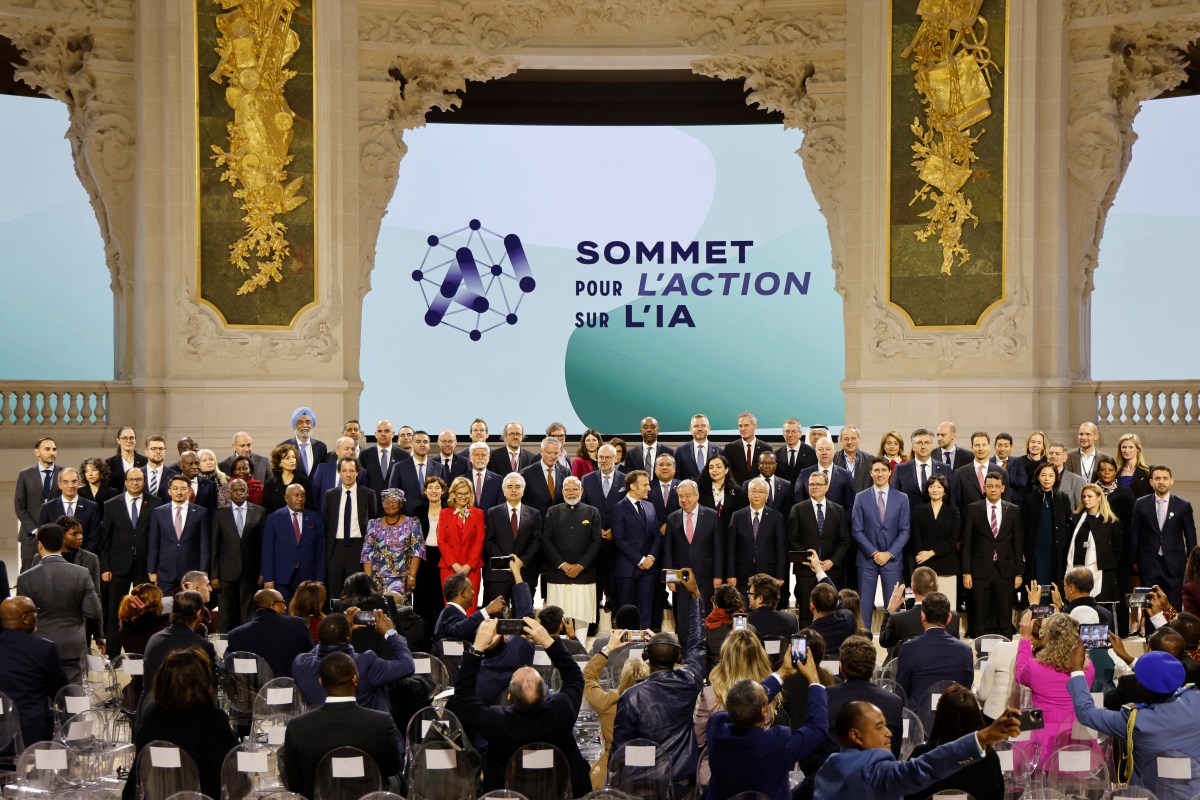
The Artificial Intelligence Action Summit in Paris was supposed to culminate in a joint declaration on artificial intelligence signed by dozens of world leaders. Although the statement is less ambitious than the Bletchley or Seoul Declarations, both the United States and the United Kingdom have refused to sign it.
The current (challenging) geopolitical situation once again proves that reaching consensus on artificial intelligence and other topics is difficult.
“We feel very strongly that AI should remain free of ideological bias and that American AI should not be co-opted into the tools of authoritarian censorship,” U.S. Vice President J.D. Vance said in a speech at the summit’s closing ceremony.
“The United States is the leader in AI, and our administration intends to keep it that way,” he added.
A total of 61 countries, including China, India, Japan, Australia, and Canada, have signed the declaration, which specifies a focus on “ensuring that AI is open, inclusive, transparent, ethical, safe, secure, and trustworthy.” It also calls for greater cooperation and fostering a “global dialogue” on AI governance.
Early reactions expressed disappointment at the lack of ambition. “This missed opportunity should not be repeated at the next international summit,” Anthropic’s Dario Amodei said in a statement. “Advances in AI are posing major new global challenges, and we must act faster and more clearly to meet them.”
More countries are likely to sign the declaration in the hours after the event.
tech crunch event
san francisco
|
October 13-15, 2026
Reducing regulations for AI was a common topic throughout the event. Earlier on Tuesday, EU President Ursula von der Leyen reminded senior officials that the EU’s AI safety regulations also aim to simplify interactions between member states.
“This is the purpose of the AI Act to provide a single safety rule for the entire European Union, or 450 million people,” von der Leyen stressed. “Instead of 27 different national regulations and safety for the benefit of business.”
“At the same time, I know we have to make it easier and we have to eliminate red tape. And we will do that,” she added.
On Monday, French President Emmanuel Macron called on Europe to simplify regulations to get back into the AI race. “It is clear that we need to be in sync with the rest of the world in terms of communicating, licensing and approving clinical trials – in all areas.”
In a separate speech on Tuesday, Macron added that government leaders should avoid the “dilemma of risk and opportunity” and the “urgent need for regulations that could hinder innovation.”
At the same time, the French president walked a fine line, defending the need for international governance regarding artificial intelligence. “Artificial intelligence needs these rules to move forward,” he argued.
“It’s not a question of rebellion, it’s not a question of stopping innovation, it’s a question of enabling innovation. [innovation] This must be achieved at the international level while avoiding division,” Macron added.
For the United States, not signing the AI Action Summit Declaration is a matter of diplomatic principles. Early in Donald Trump’s second term as president, the United States withdrew from several international organizations, including the World Health Organization and the Paris Climate Agreement. You can now add AI Summit consensus to that list.
Read the full story from the Artificial Intelligence Action Summit in Paris.
TechCrunch has a newsletter focused on AI. Please register here Delivered to your inbox every Wednesday.


