
Video is already everywhere these days. Billions of hours of everything from YouTube tutorials to lecture recordings are uploaded every year. It’s interesting and easy to watch, but there’s a problem. Finding exactly what you need in a long video can be frustrating. Learning through 90-minute lectures or long interviews takes time, and writing notes or copying by hand can feel like a daunting task.
That’s why many students, researchers, and creators are turning to AI transcription. Video to text tools make your job much easier by allowing you to search and scan hours of footage. These tools can turn overwhelming content into something you can actually use.
How AI transcription actually works
Before exploring how AI transcription can improve accessibility and learning, understand how AI actually works. AI transcription does more than just convert audio to text. Using advanced speech recognition combined with natural language processing, it can handle punctuation, identify what different people are saying, and even recognize context in some cases. Today’s AI is trained on vast amounts of data, allowing it to understand different accents, speaking speeds, and even terminology, making accurate recognition across all types of content.
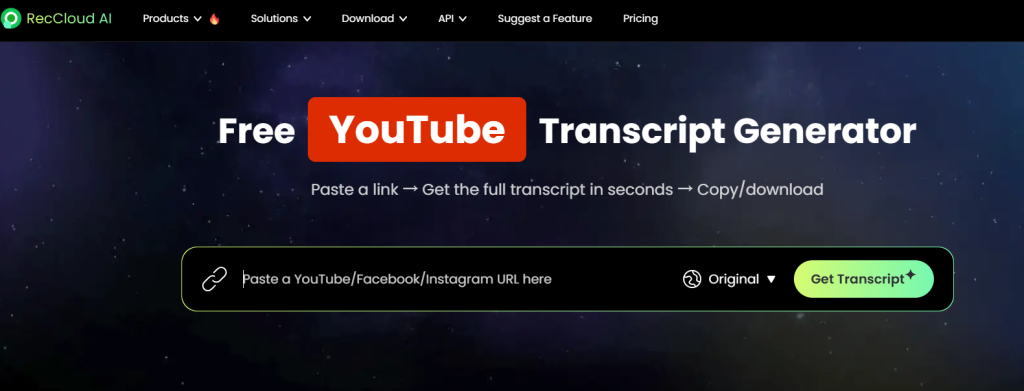
For example, a student reviewing a molecular biology lecture can simply search for “photosynthesis” rather than repeating the entire lesson all over again. Researchers analyzing discussions can extract quotes in minutes. Meanwhile, content creators can turn videos into blog posts, social media captions, or reports without manual transcription. tools like YouTube transcript generator This process is now even easier, making video content instantly searchable and easy to analyze.
AI transcription can handle noisy environments, multiple speakers, and specialized terminology. This functionality is part of what makes it an essential tool in today’s video-driven world.
Make your video content truly learnable
Videos are a great medium for gathering information, but just watching them doesn’t necessarily mean you can learn. Many students have a hard time remembering information from long lectures and tutorials, especially when important key information is buried in a few minutes of speech. AI transcription changes this by turning spoken content into organized, searchable, and easy-to-use text.
Transcripts allow students to jump directly to specific concepts, compare instructions from multiple videos, and create their own study notes. Meanwhile, researchers can quickly analyze interviews and identify trends in panel discussions. Content creators can also benefit by using transcripts to get quotes, outline screenplays, and plan new material. By converting videos into structured text, AI transcription makes knowledge more than just something to watch, it’s truly easy to understand and use.
The benefits of accessibility and inclusivity
AI transcription not only makes content learnable, it also makes video content accessible to everyone. Helpful for viewers who are hard of hearing or who are not native speakers. Transcripts can be read with screen readers, searched for keywords, and converted into captions for social platforms, ensuring your valuable content reaches all your audiences.
This kind of inclusivity is important in everyday learning and work. Students can move through the material at their own pace, experts can quickly return to specific points, and educators and researchers can tailor content to different audiences. For language learners, having written references along with audio makes the content easier to understand and turns videos into a more flexible and accessible learning format.
How to use AI transcription in practice
To help you better understand how AI transcription can enhance accessibility and learning, here are some real-world use cases that show how transcription can improve your workflow.
teaching and learning
AI transcription is changing the way students learn. Instead of replaying an hour-long lecture, you can quickly search for specific terms, create a summary, or take personal notes. Teachers can benefit as well by creating quizzes, summaries, and subtitles in multiple languages to reach a wider audience.
research and academics
Researchers working with interviews, panel discussions, or recorded experiments use AI transcription to save time. This allows you to extract important quotes, identify trends, and efficiently organize large amounts of data. Video-to-text technology also makes it easier to compare information across multiple sources, speeding up academic research and improving accuracy.
content marketing and media
Marketers and media professionals often need to quickly reuse video content. Transcripts make it easy to create blog posts, social media snippets, and SEO-friendly content. tools like YouTube transcript generator Your team can turn long videos into searchable text, making content easier to find and manage.
Challenges and considerations
AI transcription is powerful, but it also comes with challenges. Accuracy may vary based on accents, voice overlap, and background noise, and highly specialized topics or terminology may require human review to ensure accuracy.
Privacy is also an important consideration. When recording sensitive interviews or lectures, users must ensure that their transcription tools comply with data protection standards. In many professional or research environments, the best results are achieved by combining AI transcription with human editing.
It’s also important to set realistic expectations. AI transcription can save you hours of work, but it works best when combined with careful note-taking, editing, and organization. Understanding these limitations will help users get the most value from video-to-text technology without frustration.
conclusion
AI transcription is changing the way we interact with video content. Video-to-Text technology speeds learning, simplifies research, and makes content more accessible by converting spoken words into searchable text. Close the accessibility gap, improve discoverability, and support inclusive learning. As AI continues to evolve, these tools will become more accurate, multilingual, and seamlessly integrated, meaning transcription is no longer a luxury but an essential part of navigating a video-first world.



