
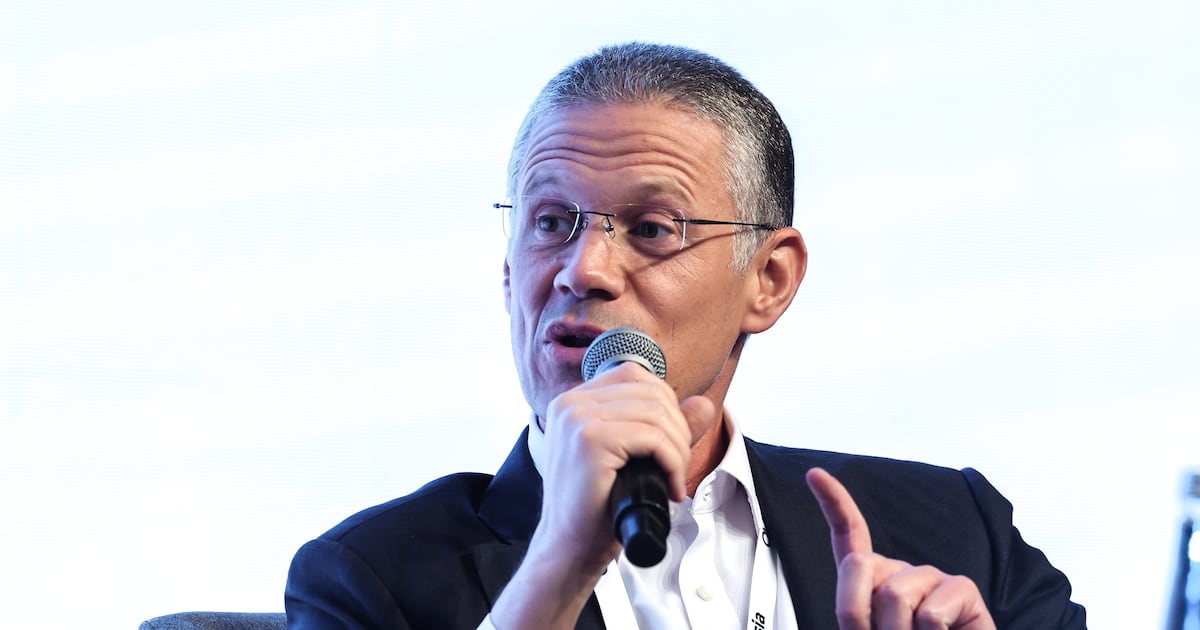
The UAE’s special envoy for business and philanthropy believes the time to talk about artificial intelligence is over and the goal now should be to tune it to work optimally.
In an interview with The National Speaking at the World Economic Forum’s annual meeting in Davos, Switzerland, Badr Jafar said the UAE is best placed to enable AI collaboration to make the most of this promising and sometimes controversial technology.
“The way I see it, the world doesn’t need more AI conversations. I think it needs AI coordination,” he said. “What the UAE brings to AI is similar to what the UAE brings to Davos. AI cuts across policy, capital and public trust, and what we offer in the UAE is the ability to bring governments, businesses, investors and, of course, charities on the same playing field.”
Jafar’s schedule at Davos is packed as he will meet with a range of officials, executives and thought leaders to advance the UAE’s vision of how AI can benefit society at various levels.
The country’s recognition of the potential of AI and its affinity for AI technology research has helped create startups, partnerships, and investments from industry leaders such as Microsoft, Nvidia, and OpenAI.
The UAE is also working with the US to develop an AI campus in Abu Dhabi with 5 GW of data center capacity.
Jafar said the UAE’s enthusiasm for AI is rooted in more than the promise of increased productivity and revenue.
“It’s all about how we can deploy AI responsibly to support jobs and inclusive growth,” he said. Government projects and philanthropy can also be enhanced with the help of AI, he added.
He said the UAE’s track record of “close partnerships with high-growth economies” makes it ideal for leading the way in the management and use of AI, as well as guardrails to protect users.
In Dubai, the AI Seal was introduced to recognize many companies promoting AI services and to help avoid tools that may not be up to date.
Last year, the country became the first in the Arab world to join the Hiroshima AI Process Friends Group, which was established during the G7 summit in Japan and aims to pursue advances in AI while curbing potential problems posed by rapidly evolving technology.
The UAE has also joined Pax Silica, a US-led bloc aimed at boosting innovation and supply chains as demand for AI soars.
“It’s often talked about as if it’s some kind of trade-off, but I strongly believe that innovation and governance are trade-offs and compliments,” he said.
Mr. Jafar highlighted several measures that show the UAE’s approach is working.
He referred to a recent Microsoft report that found the UAE is leading the way globally in terms of “AI adoption” (broadly defined, the adoption of technology and adaptation of its use).
“Public confidence in the adoption of AI in the UAE is significantly higher than in the United States and most European countries,” he said.
“The role of countries like the UAE and their ability to bridge divides and deliver is what helps make the UAE a valuable contributor to the world.”


