
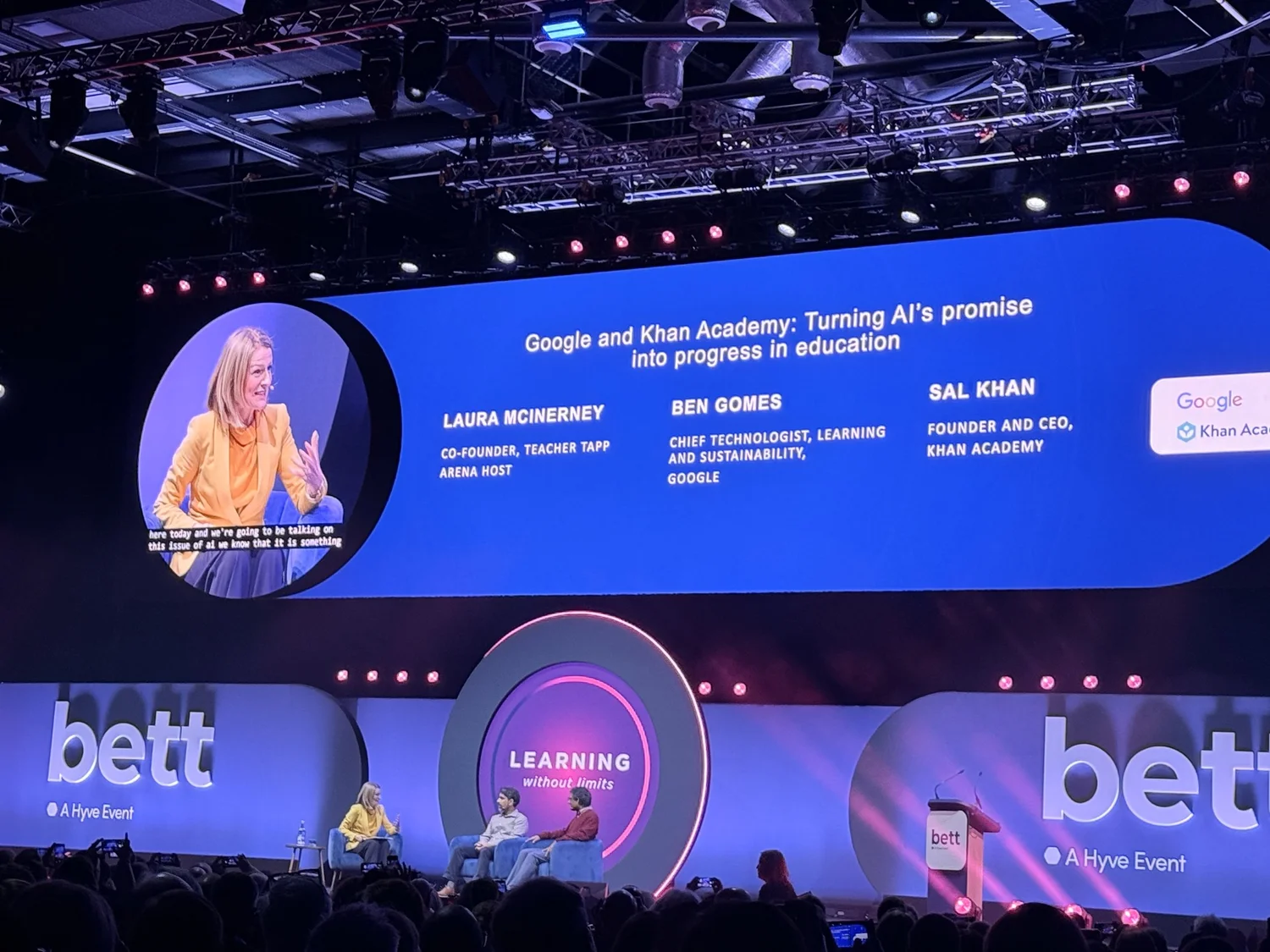
Fireside chat Bet UK 202The sixth meeting, held on the first morning at Excel London, provided one of the most detailed public explanations yet of how artificial intelligence is being designed for classroom use rather than automation.
The session was moderated by Laura McInerney and featured Sal Khan, founder and CEO of Khan Academy, in conversation with Ben Gomez, Google’s chief engineer for learning and sustainability.
They discussed the origins of the partnership, the development of AI teaching and writing tools, and why both organizations see AI as a way to support teachers rather than replace them.
Khan began by telling how Khan Academy began in 2004 as a series of informal tutoring sessions for a younger cousin who struggled with math. “I offered to tutor her remotely,” Khan explained. “Slowly but surely, she caught up with her classes. Then I became her so-called ‘tiger cousin’ and called her school and said, ‘I really think she should be able to retake the placement exam.'”
This experience, he said, revealed a pattern that would later shape Khan Academy’s approach. “The reason they were struggling wasn’t because they weren’t smart or didn’t have good teachers,” Khan said. “That’s because there was a gap in their knowledge.”
To deal with that, he started writing simple software to provide practice and feedback. He described this as “the core of learning.” What started as tutoring for a few families quickly expanded. “Before I knew it, I was coaching five or 10 cousins and family friends,” he said. “I was still working as a financial analyst, but I spent my afternoons writing code, making videos, and calling my cousin.”
Khan said the decision to upload the video to YouTube was initially reluctant. “I thought it was a terrible idea,” he laughed. “But my cousins have famously said they like me more on YouTube than in person,” he said, adding that what students value most is flexibility.
“They loved being able to watch it on demand. They loved being able to pause and repeat and not feel like they were being judged when they were reviewing content from three years ago.”
Google’s early role and long-term commitment
Khan noted that Google was involved early on and provided funding as Khan Academy transitioned to a nonprofit organization. “In 2010, Google was one of the first two major funders to support Khan Academy,” he said. “That support has allowed us to become a true organization.”
Gomez explained that his path to education naturally emerged from Google’s work on search and language. “A big part of what people use search for is to change themselves, to learn something,” Gomez said. “Education has always been part of that mission.”
He added that many Google tools currently used in schools were not originally designed for education, but evolved through practice. “We have YouTube, Docs, Sheets, Classroom, Search, and now Gemini,” he said. “We are an information-oriented company, so we ended up with a product that helps people learn.”
Gomez argued that recent advances in AI signal a major shift, as machines are now able to interact with language in a meaningful way. “Language is a way of transmitting information from one person to another,” he said. “That’s what makes our species special. Even if someone leaves, we don’t lose our knowledge.”
However, he stressed that this does not change the role of teachers. “At the heart of all this are still the teachers who bring learning to life,” Gomez said, citing her mother, who was a teacher, as an example.
Lighting still matters in the world of AI
The main topic of discussion was whether generative AI reduces the importance of writing. Mr. Khan was clear. “People ask, ‘Do kids need to learn to write anymore?'” he says. “We’ve heard this before,” he said, comparing the current debate to previous technological changes. “When calculators came out, people said we didn’t need arithmetic. When Google came out, people said content didn’t matter anymore,” he said. “But those who knew arithmetic benefited the most from calculators, and those who knew benefited most from search.”
Khan said the same pattern is emerging with AI. “The tools raise the floor, but not the ceiling,” he said. “Those who are strong thinkers and good writers can use these tools to get even further.”
Inside Khan Academy’s Writing Coach
This idea underpins Khan Academy’s Writing Coach, an AI-supported writing tool that was discussed in detail during the session. “We didn’t want this to be a chatbot that just spits out essays,” Khan says. “We wanted something structured.”
He described Writing Coach as a system that helps students outline ideas, create thesis statements, and revise drafts. “It’s similar to collaborating on a document with an editor,” he said. “AI can help, but it doesn’t do the work for students.”
Khan also addressed concerns about academic integrity. “Teachers are right to be concerned about cheating,” he says. “People who think they can only block AI are fooling themselves.” Instead, he argued, writing coaches increase transparency. “When a teacher receives an essay, they can ask the system, ‘Where did this come from?'” he explained. “You can see where students struggled, where they made corrections, and if anything seems inconsistent.”
AI specialized in Gemini and education
Gomes explained that the underlying AI capabilities are built on Gemini, but are specifically adapted for education. “One of the most important things is managing cognitive load,” he said. “You can fall down the rabbit hole when you realize you have so much information that you are not absorbing anything.”
He said Google has spent several years developing models that support guided learning rather than open-ended generation. “We have developed the best AI for education,” says Gomez. “Writing is especially important because writing is how we learn to think.”
Schoolhouse and AI-supported individual instruction
The discussion also featured Khan Academy’s tutoring platform, Schoolhouse. “When the pandemic hit, we saw kids sitting at home isolated,” Khan said. “I thought, what if we could connect people online and teach each other?”
Schoolhouse now connects learners with trained volunteer tutors, and is increasingly using AI to support those tutors. “AI can participate in sessions, view recordings, and give feedback,” Khan says. “They might say, ‘We didn’t invite this student,’ or ‘This concept seems confusing.'”
He emphasized that the goal is to strengthen relationships. “This is a very clear example of how technology facilitates connections between people,” Khan said.
Teacher remains in charge
McInerney questioned both speakers about whether AI risks causing teachers to quit their jobs. Mr Khan rejected that idea. “When the textbooks were published, teachers were worried they would lose their jobs,” he says. “Now we can’t imagine teaching without them,” he said, arguing that AI allows teachers to focus on higher-value activities.
“Instead of spending hours preparing, teachers can adapt their lessons on the fly,” he said. “They can spend more time on discussions, games, and simulations,” Gomez agreed, adding that AI can help teachers manage variation in the classroom. “Every classroom has students who are struggling and students who are bored,” he said. “AI can help teachers address that discrepancy.”
Khan cited evidence from districts that have used AI-assisted tools. “In some districts, teachers are saving five to 10 hours a week,” he said. “They use it as a recruitment and retention tool.”
Gomez acknowledged there will be challenges to implementation, but said language-based AI may be easier to learn than previous technologies. “This isn’t about learning complex interfaces,” he said. “It’s about conversation.”
From promise to progress
During the closing session, Mr. McInerney asked what is stopping the promise of AI from being realized. Khan cautioned against deploying tools without purpose.
“Technology should never be used for its own sake,” he said. “You have to start with the problem you are trying to solve.”
Gomez echoed that sentiment. “The risk is the noise,” he says. “Opportunity is thoughtful implementation.”


