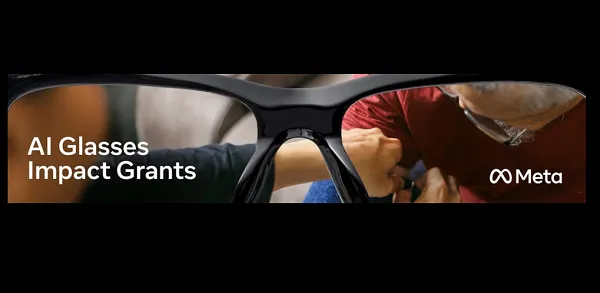
Meta has announced a new series of accelerator grants to fund research on expanding opportunities for AI glasses to drive improvements in a variety of areas.
This is a broader departure from the Metaverse, which is interesting given that Meta also provides similar grants and funding to projects looking to use AR, VR, and smart devices. But of course, Meta has its hands in many pies, and expanding research is part of the deal.
It is interesting to see the main focus shift to AI rather than how AR/VR will change digital connectivity.
Meta’s AI Glasses Impact Grants are awarded to organizations that are using AI glasses to “advance social and economic progress.”
According to Meta:
“There are two types of grants that U.S.-based organizations can apply for: Accelerator Grants for companies that are already leveraging our AI Glasses to scale their impact, and Catalyst Grants for organizations that are proposing new high-impact applications using our Device Access Toolkit. Depending on the size of your project, we are offering 15 Accelerator Grants of $25,000 and a grant of $50,000. We will also award 5 Catalyst Grants totaling nearly $2 million to more than 30 organizations and developers.
The project will focus on innovative uses of AI glasses such as:
“…gives farmers and agricultural workers hands-free, real-time AI capabilities to diagnose crop health, predict harvest readiness and yield, and capture spatial data to improve decision-making.”
Such practical use of Gen AI could drive significant improvements, but as always, as more and more AI projects are discovering, the real value of these tools is as a complementary element to existing human expertise.
Much of the initial hype around generational AI was that it would be smarter than humans and could replace many jobs. However, over time, the value of this modern set of AI tools (actually machine learning systems) is being reassessed, and their professional value is being reframed as supplementary rather than replacement.
As such, these grants could serve a valuable purpose in highlighting innovative uses of AI glasses to improve people’s lives both personally and professionally.
For example, it can translate audio into sign language in real time or highlight concerns in medical records.
Meta is keen to introduce these as part of our evolving AI push, which will also guide our efforts in key areas.
Because as the company continues to pour hundreds of billions of dollars into AI development, it will eventually need to find a way to get that money back, and that will require large-scale industrial investments and projects that pay for access to these capabilities.
Consumer devices just don’t bring in enough money to justify the spending, Meta’s advertising business remains strong, and while Meta has the money to invest, at some stage every AI project will have to offer a path to profiting from that big spend.
This could end up being a bigger challenge for OpenAI, which currently has about $1.4 trillion in data center contracts. OpenAI brought in $20 billion in revenue last year, primarily through ChatGPT subscriptions. That’s a lot of money, but at $20 billion a year, it would take OpenAI 70 years to even recoup its costs.
And since this is the current cost without considering growth, we can see that consumer interest alone will not change this point.
They are adding advertising to ChatGPT because it doesn’t have the same business infrastructure as Meta or Google. The same will be a challenge for xAI, even with Elon’s funding. The cost of scaling AI models is so significant that it is difficult to understand the full extent of what it will take to achieve profitability.
Meta is committed to AI beyond its investments in Metaverse Vision and VR, and will need to find practical and valuable use cases to justify its spending.
These grants are another step in solidifying that path.
According to Meta, applications for AI Glasses Impact Grants will close on March 9th. You can apply here.