
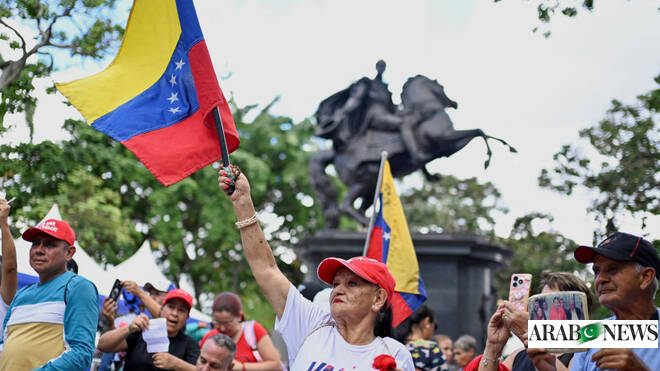
CARACAS: Since the United States detained Venezuelan leader Nicolás Maduro in early January, photos and videos documenting the incident have been filled with images generated by artificial intelligence, blurring the line between fiction and reality.
There’s an endless stream of content, from comedic memes to dramatic retellings.
In one, a courtroom illustration of President Maduro in a New York courthouse comes to life and declares, “I consider myself a prisoner.”
In another, an AI-generated Maduro attempts to escape from a US prison through an air duct, only to find himself in a courtroom with US President Donald Trump. There, they dance to a song by American rapper Ice Spice with judges and FBI agents.
On January 3, President Maduro was captured along with his wife, Cilia Flores, during a US military airstrike in Caracas, the capital of Venezuela.
They were then taken to a New York prison on drug trafficking charges.
While some have celebrated Mr. Maduro’s ouster, his Chavezmo movement (named after his predecessor Hugo Chávez) has been working to reframe what his ouster means for Venezuela’s future.
– “Chaos, Combat, and Silence” –
Leon Hernandez, a researcher at Andres Bello Catholic University, told AFP that the rapid creation of content by AI is leading to the development of “disinformation laboratories” flooding social media platforms.
“During[Maduro’s]detention, there were things that were not authentic, and there were things that were authentic that aroused suspicion,” Hernandez said.
“That was the idea: by distorting certain elements of reality, you create confusion and create skepticism at a fundamental level.”
The goal is for the content to overwhelm the viewer and prevent them from following it, he added.
Traditional media outlets are also participating, such as Venezuelan television station VTV, which is running an AI-animated video narrated by a child detailing Maduro’s capture.
“AI is a new tool of power for dictators to disrupt, combat and silence dissent,” said Elena Block, a professor of political communication and strategy at the University of Queensland in Australia.
– “The greatest threat to democracy” –
Block pointed out that the use of comics in particular has been used as a medium of propaganda in both authoritarian and democratic countries.
Long before his arrest, Mr. Maduro was portrayed as a “super bigot” or “super mustache”, an illustrated superhero who wears a Superman-like suit and fights monsters such as “extremists” and the “North American Empire.”
The cartoon’s popularity has led to toys that Maduro’s supporters carry around during rallies calling for his return.
And like his predecessor, Mr. Maduro maintained a “media domination” that prevented traditional media outlets from airing criticism of Chavismo.
“With censorship and the disappearance or weakening of news media, social media has emerged as one of the only information spaces,” Block said.
Maduro is not the only leader using AI propaganda. Trump frequently posts AI-generated photos and videos of himself with “hostile, offensive, and divisive language.”
“These digital tools and AI tools end up trivializing politics. Instead of explaining politics, they trivialize it,” Block said. “Today’s AI is the greatest threat to democracy.”


