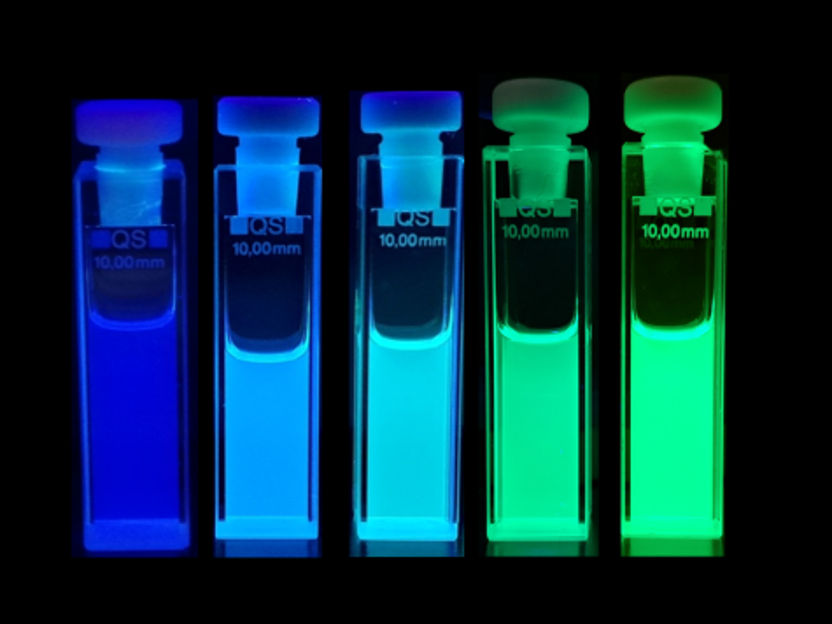
LMU researcher Professor Alexander Urban and his team have developed a tool that could revolutionize the design of new materials. Synthesizer is a platform that combines automated chemical synthesis, high-throughput characterization, and data-driven modeling. The goal is to control the growth of nanocrystals with unprecedented precision, thereby creating materials with tailored optical properties. The results of their research, which received funding from the e-conversion Excellence Cluster, were published by the LMU team as follows: advanced materials.
Unlike previous data-driven approaches, Synthesizer is the first platform to connect the entire chain from automated synthesis and optical high-throughput characterization to AI-supported derivation of specific design rules in an open, modular system. “Today, you can compose material properties note by note, parameter by parameter, almost like a melody,” says Alexander Urban. That’s exactly right synthesizer is possible. The platform allows you to automatically generate and characterize variants of halide perovskites, while AI models learn which chemical combinations lead to specific colors, brightness levels, or stability.
The optical properties of halide perovskites, such as color, brightness, and emission width, determine their applications in LEDs, solar cells, and sensors. “Even small differences in the size, shape, and structure of the nanocrystals can change the emission,” explains Nina Henke, lead author and postdoctoral researcher on the Urban research team. “Fine-tuning is therefore essential to develop materials that are precisely tailored to specific applications.”
Accelerating development of halide perovskites
what makes it so synthesizer What’s special is that the platform is open, flexible, and extensible. Although originally developed for halide perovskites, it is in principle suitable for other material classes as well. In the future, researchers will be able to automate synthesis, systematically vary parameters, and generate valuable datasets in a very short time. The AI model then converts this data into concrete design rules. In journal articles, researchers not only present a concept, but also announce a release. synthesizer As a freely available and modularly adaptable platform.
“Our goal is to accelerate materials research and enable accurate predictions,” says Alexander Urban. “This allows us to create crystals with specially tailored optical and physical properties, further advancing optoelectronics and photonics.” The synthesizer platform is compatible with existing systems for automated synthesis. The LMU team is currently working on integrating its development into the laboratory’s daily operations.
original publication
Nina A. Henke, Leo Luber, Ioannis Kurdis, Jonathan Paul, Alexander Schubeck, Lukas M. Rescher, Tizian Lorenzen, Veronica Mayer, Knut Müller-Caspary, Bert Nickell, Alessio Gagliardi, Alexander S. Urban. “Synthesizer: Chemistry-aware machine learning for precise control of nanocrystal growth”; Advanced Materials, 2025-11-5