
SAFA Conference Call for Ethical Use of AI
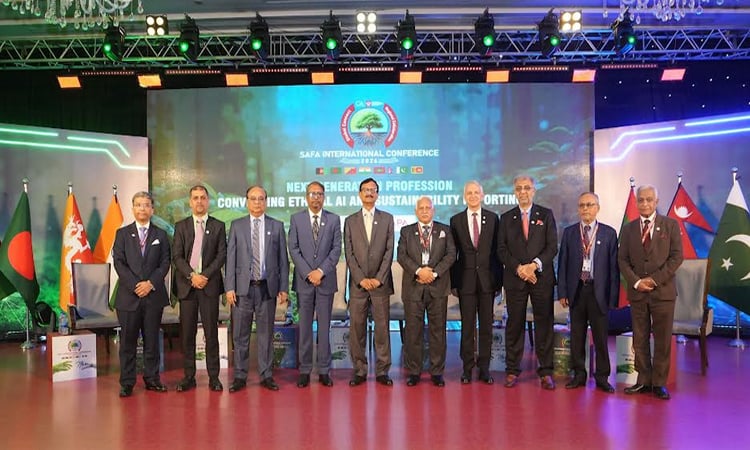
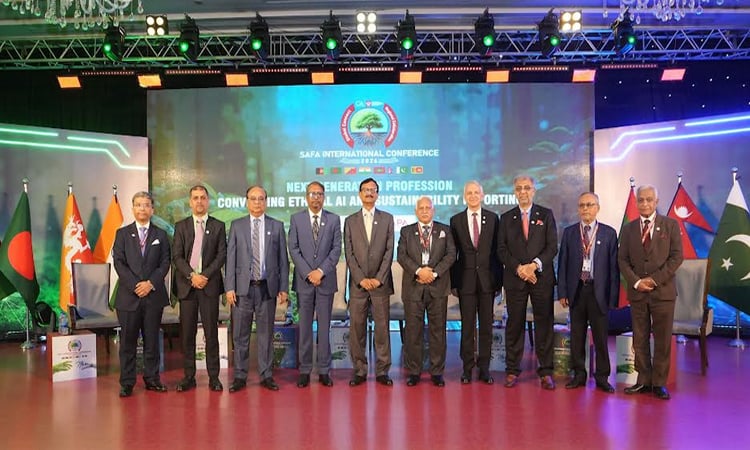
SAFA International Conference hosted by ICAB was held at a hotel in Dhaka city. Photo: BSS
DHAKA, 17 January 2026 (BSS) – The global accounting profession is entering a new phase as ethical artificial intelligence (AI) and sustainability reporting begin to converge, reshaping business risk, investor expectations and public trust.
Financial experts said this at the South Asian Federation of Accountants (SAFA) international conference held in Dhaka today.
The conference, organized by the Institute of Chartered Accountants of Bangladesh (ICAB) at a hotel in the city, was themed “Next Generation Profession: Combining Ethical AI and Sustainability Reporting”.
The keynote speech was delivered by Adeeb Hossain Khan, former president of ICAB and senior partner at leading CA firm Rahman Rahman Huq.
Khan emphasized that the introduction of AI in sustainability reporting is no longer a distant concept, but a structural change that is already impacting the way economic value is created, measured and disclosed.
The conference brought together national leaders and international experts from the financial sector and served as a platform for thought leadership, knowledge exchange and strategic dialogue on key issues to reshape regional and global professional collaboration, according to a press release.
Delegates from Afghanistan, Bhutan, India, Maldives, Nepal, Pakistan and Sri Lanka participated in the event, which featured three technical sessions and a valedictorian session.
Tuhid Hossain, Advisor to the Ministry of Foreign Affairs, opened the conference as the chief guest.
Mr. AHM Ahsan, Chairman, Bangladesh Competition Commission, and Dr. Md Sajjad Hossain Bhuiyan, Chairman, Bangladesh Financial Reporting Council (FRC) attended the meeting as special guests.
Tuhid Hossain emphasized the importance of combining technology and sustainability to shape a “new Bangladesh”.
The country’s aspirations for sustained economic growth and deeper global integration require professionals who are not only technically competent, but also ethically and socially responsible.
AHM Ahsan emphasized that technological advances bring both opportunities and challenges.
He observed that AI-driven systems can increase efficiency, strengthen compliance, and foster innovation. However, he noted that without a strong ethical framework, AI also poses risks such as algorithmic collusion, abuse of market power, opacity, and exclusionary practices.
He urged that AI adoption should be done carefully so that Bangladesh can fully and responsibly leverage its benefits.
Jean Boucot, President of the International Federation of Accountants (IFAC), the world’s highest body for the accounting profession, and Ashfaq Yusuf Thora, Advisor to the South Asian Federation of Accountants (SAFA) attended the conference as guests of honor.
Speaking at the conference, Buco emphasized the need for greater transparency in financial disclosures, while also stressing that the introduction of AI could have the added benefit of enabling professionals to provide services more efficiently.
He also highlighted the global relevance of the debate and its potential to shape the future of the profession, particularly in sustainability reporting, ethical AI and next generation professional practice.
Mr. NKA Mobin, Chairman of ICAB, gave a welcome address, and Mr. Muhammad Farhad Hussain, Past President of ICAB and Chairman of the Conference Organizing Committee, also gave a speech on the occasion.
The ICAB President said the world needs ethical, competent and forward-thinking accountants now more than ever.
Farhad Hussein said the conference theme reflects not only where the world is heading, but also where experts must lead it.
He said artificial intelligence and sustainability are no longer new concepts and are already reshaping the way organizations operate, generate information and build trust.
Keynote speaker Adeeb Hossein Khan noted that modern sustainability reporting has implications for capital allocation, regulatory compliance, and market credibility as climate and governance issues move into mainstream financial considerations.
He also emphasized that the scope of the profession extends far beyond traditional accounting to include risk modeling, valuation, assurance, research and policy engagement.
“AI can increase transparency and predictive insights, but it does not come with ethical accountability or fiduciary responsibilities,” Khan said. “These responsibilities essentially remain with humans, which is why ethical governance is essential.”
He called on experts, regulators and standard setters to work together to ensure AI-powered sustainability reporting is transparent, accountable and in line with global standards and investor trust.


