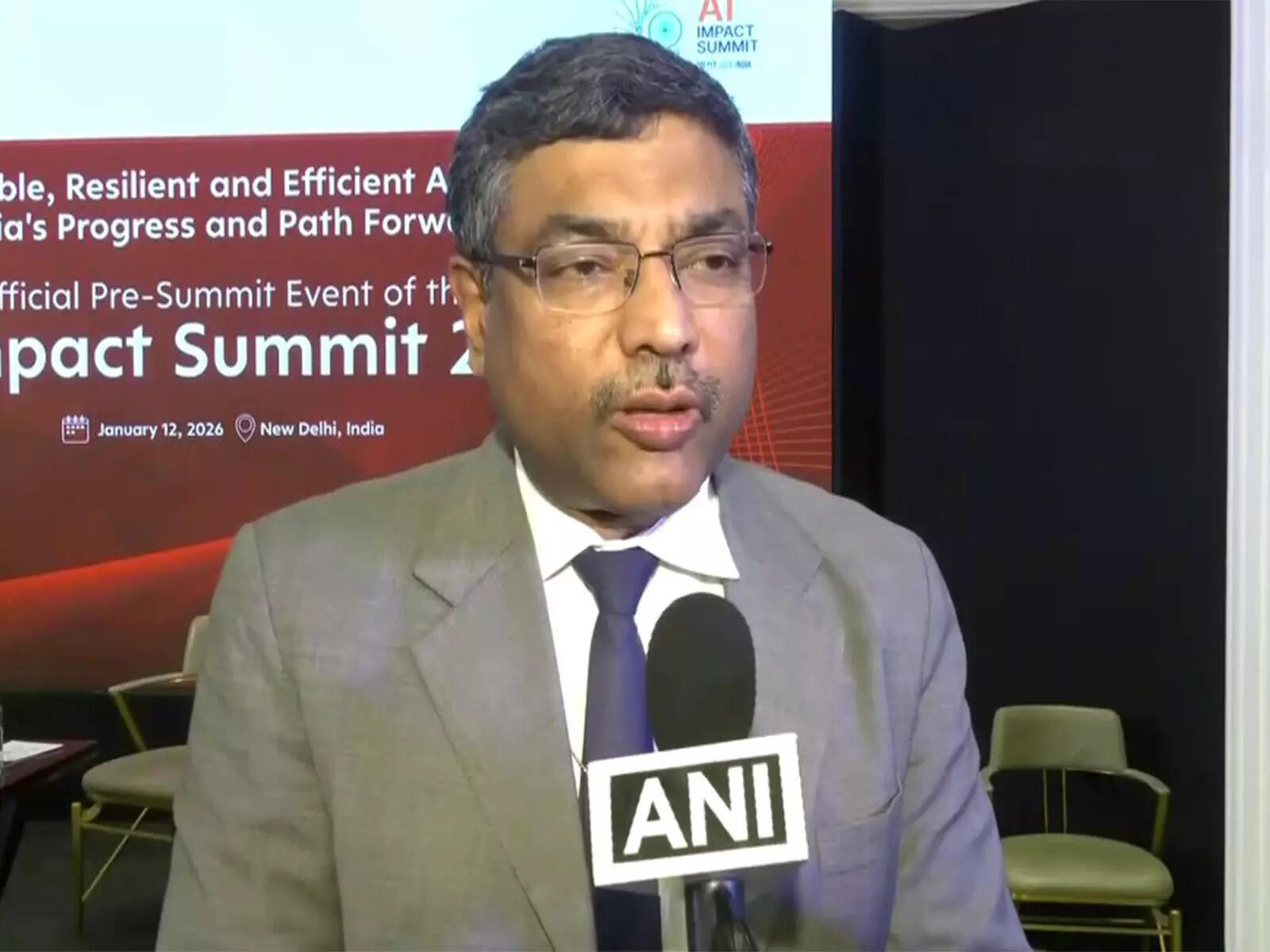
NEW DELHI: Ministry of Electronics and Information Technology Secretary S. Krishnan asserted that India's invitation to the US-led Pax Silica initiative signifies the country's global recognition as a reliable partner in critical technology supply chains.
He said IT Minister Ashwini Vaishnau was in Washington to attend a conference on critical minerals and asserted that India's engagement on such issues was of paramount importance.
“My minister is in Washington to attend a conference on critical minerals. So, from a strategic perspective, I think it's important that India is at the top of the table as far as all these important issues are concerned,” Krishnan said.
“Fundamentally, it's about addressing the critical mineral supply chain and I think it's important that a country like India is part of that and it's a recognition of trust,” he added.
US Ambassador to India Sergio Goh announced on Monday that New Delhi will be invited next month to participate in Pax Silica, a US-led strategic initiative aimed at securing critical supply chains across silicon, advanced manufacturing and AI.
Speaking at an event organized by industry body Nascom, he said the Indian government should pursue a balanced approach of building sovereign AI capabilities while maintaining openness to international players, and India should aim to become a global use case capital for artificial intelligence.
Krishnan outlined India's comprehensive AI strategy ahead of the IndiaAI Impact Summit, a multilateral gathering of world leaders scheduled to discuss global AI policy-making in the Indian capital next month.
Mr. Krishnan cited concerns about AI infrastructure being concentrated in a few companies, particularly in chip manufacturing, and emphasized India's technology-agnostic procurement strategy.
“We're not necessarily saying we're only going to buy NVIDIA GPUs. Our approach is who will produce the chips,” he said, explaining how the government is avoiding vendor lock-in.
He pointed out that recent developments like DeepSeek demonstrate that AI development does not have to be as expensive as previously thought. “DeepSeek was a game-changing moment, and we suddenly realized that it doesn't have to cost as much as people say it does. There are ways to do it cheaper,” he said.
The Prime Minister recently met 12 startups and institutions selected under the India AI Mission to prepare India's first infrastructure model, demonstrating the government's commitment to developing India's indigenous AI capabilities.
Mr. Krishnan emphasized that what differentiates India from other countries is its continued commitment to being an open system. “What is available? I think open systems are important in the technology world because people in India need to have access to whatever is latest in terms of technology,” he said.
“Some of it we will develop ourselves. Some of it we will develop over time, but why limit access to technology by saying it's not made in India so we won't use it?” He further pointed out that this approach has enabled the IT sector to grow.
He said it is in the larger global interest for India to develop sovereign capabilities in AI and become strategically autonomous.
“You are assuring the world that there is one more production line and one more option available to many countries in the world,” he said.
Krishnan emphasized that the democratization of AI extends beyond models and computing power to real-world applications where revenue is generated. He likened the occasion to a pivotal moment in the transformation of the Indian IT industry.
“India is right to aspire to become the world's AI use case hub. If active startups can do that, it will make a difference. It will make AI available to a wide range of users,” he said.
He noted that this is in line with the Prime Minister's message that India must enable AI in the same way it has achieved with digital public infrastructure.
Responding to a comparison with the $500 billion AI investment announced in the US, Krishnan clarified that such investments are primarily driven by the private sector and are not limited to a single region. He pointed out that recent announcements by Google, Microsoft and AWS in India have totaled around $70 billion in the past few months.
“If you have that investment, you have that compute, and you can take advantage of that and build more, that's really impactful,” he said.
The government is also working on sovereign cloud capacity for AI for government use and certain restricted categories of users, with several companies already offering such services.
Highlighting India's progress in semiconductors, Mr. Krishnan pointed out that 20 per cent of the world's semiconductor design workforce belongs to India. “Many of them are part of the Global Capability Center that has been set up here. Ultimately, this will become Indian intellectual property, designing chips and products that India can produce,” he said.
He said fabs and advanced packaging facilities under the India Semiconductor Mission have received orders and some are planning to export their entire output. “The biggest test of industrial policy is whether it is competitive and whether it can be exported,'' he said, pointing out that this policy has proven to be fundamentally sound.
The Prime Minister said in September that there is ISM 2.0, which is currently in the final stages of development.