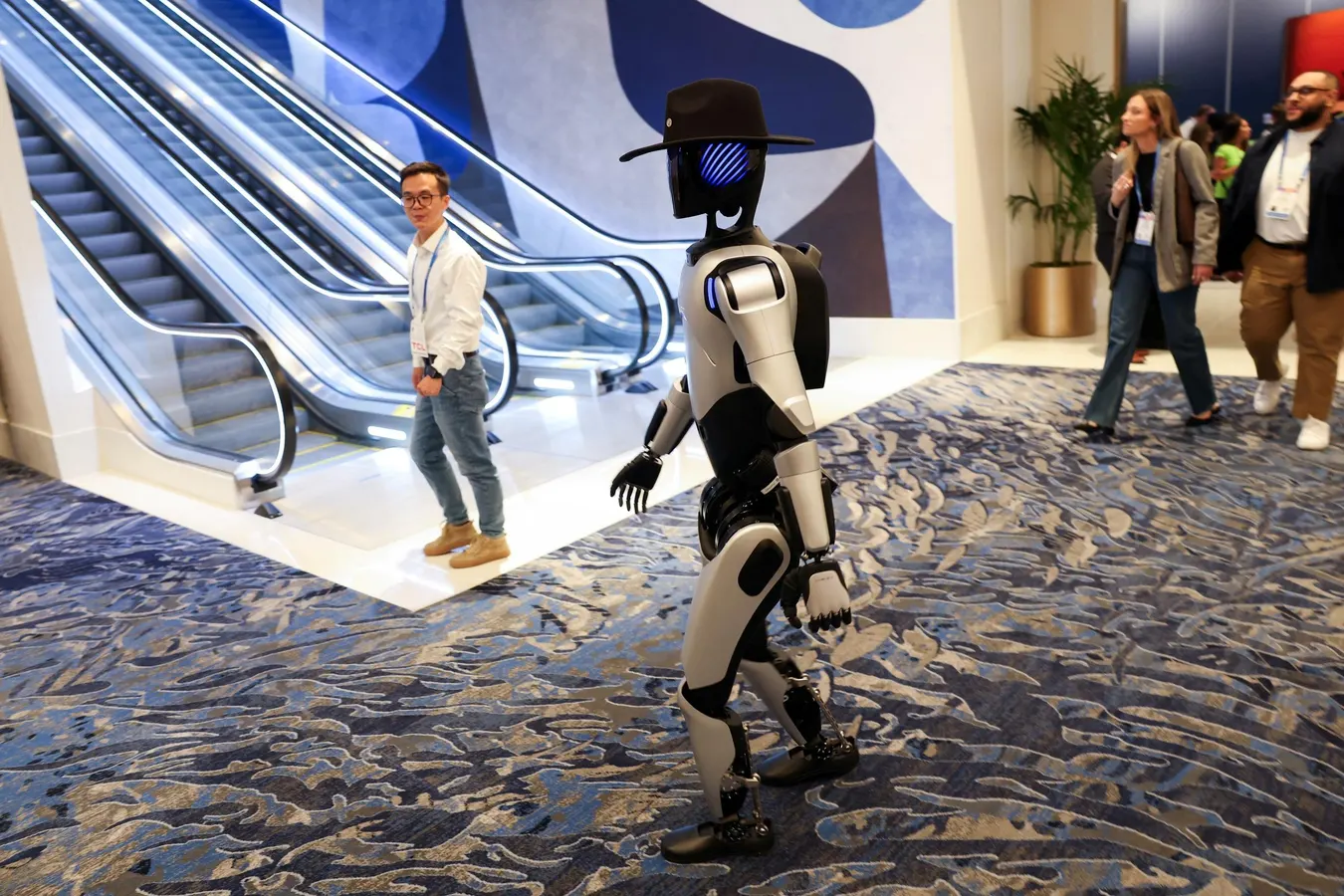

Agibot, a humanoid robot wearing a cowboy hat, walks past attendees at Fontainebleau Las Vegas during the annual Consumer Electronics Show (CES) in Las Vegas, Nevada on January 6, 2026. (Photo by Patrick T. Fallon/AFP via Getty Images)
AFP (via Getty Images)
One of the big stories coming out of CES 2026 this year is “Physical AI” and how it changes the AI landscape. Physical AI is the industry term for AI that not only generates content, but also perceives the real world, understands why, and acts on it through machines such as robots, vehicles, industrial equipment, and always-on consumer devices.
Physical AI can be thought of as an amalgamation of today's generative AI and other underlying models with sensors, actuators, and control systems, all operating within safety constraints and having some understanding of how the real world works. If the generative AI boom is about teaching machines to speak, physical AI is about teaching machines to behave.
If software AI can automate knowledge work, physical AI is expected to have the same impact on real-world jobs as it can automate tasks in factories, warehouses, hospitals, construction sites, and homes.
At CES this year, that change was clearly evident. A humanoid robot that folds laundry. A robot vacuum cleaner that moves up the stairs. Autonomous mobility stacks are gradually moving from pilots to production. All of this points to a near future where robots and other AI-enabled devices will coexist with us in our daily lives.
What does physics AI cover?
A useful way to define physics AI is determined by what needs to happen concurrently. First, there are perception tasks that require understanding camera, radar, lidar, IMU, microphone, and other signals and combining them into a coherent model to understand the environment.
By understanding the environment, these AI systems can model the world and predict what will happen. This allows the model to predict what will happen next. In robotics and driving, prediction is at the core of how these systems deliver beneficial outcomes and avoid negative outcomes.
The next requirement for a physical AI system is that it must be able to plan and control. This means that intentions and goals must be translated into safe actions under tight control, not just delay and power constraints. Finally, just as LLMs have built-in throttling and output controls to ensure that harmful outputs are not produced, physical AI systems have built-in reliability and safety controls that allow them to not only provide safe outputs but also deal with edge cases, unavoidable hardware failures, and the messy realities of the physical environment.
The biggest challenges for physical AI systems are that they have more limited computing power, need to make decisions and operations with very fast response times, and need to operate on edge devices that may have limited network connectivity. Latency requirements are stringent, connections are unreliable, and safety-critical systems require deterministic behavior.
At CES, computing technology company Arm summed up that whether the device is a robot, car, PC, wearable, or smart home product, physical AI “needs to be run locally, efficiently and reliably.”
This is a change for the AI ecosystem, which has traditionally been built on large data centers that grow in size and capacity and require large amounts of data for training needs. Cloud-based generative AI is centered around large-scale training runs and hyperscalar capital investments. In addition to large-scale edge inference, physical AI is shifting its focus to simulation, synthetic data, evaluation, and orchestration to make real-world behavior robust.
Physical AI announcements at CES 2026
The most important physical AI announcements for the AI market fall into three buckets: robotics stacks and models (edge computing modules and architectures, and institutional bets on where the physical AI market is headed).
NVIDIA used CES to claim that robotics is approaching a “ChatGPT moment,” aiding it with tools aimed at making robot development less custom and more reproducible. In a CES press release, NVIDIA announced new open models, frameworks, and infrastructure for physical AI, along with partner robots across industrial and humanoid form factors.
Key parts include the Cosmos model for synthetic data generation and simulation-based evaluation, positioned as a “world model” for physical AI, and in particular Cosmos Reason 2, described as an inferential vision language model that helps machines “see, understand, and act” in the physical world.
Other models released include the Isaac GR00T N1.6. This is positioned as a visual, linguistic, and behavioral model “exclusively for humanoid robots” that aims to improve whole-body control and situational understanding. Paired with this is Isaac Lab-Arena, an open-source framework for benchmarking and evaluating robot policies in simulation, aimed at standardizing pre-deployment testing.
Nvidia also released OSMO, an orchestration framework for running robotic workflows across workstations and cloud instances. This is called “Robotics MLOps.” NVIDIA also highlighted Hugging Face's integration work with the LeRobot ecosystem to accelerate open source robot development. The company also announced the Jetson T4000, a Blackwell-powered module focused on energy and efficiency for edge robotics needs.
Arm used this opportunity to reorganize itself to focus on Physical AI. Reuters reports that Arm has been reorganized into three major business lines, including a new physical AI division focused on robotics and automotive. Arm's CES announcement focuses on physical AI in robotics and “AI-defined vehicles.”
Even at CES2026 Exhibiting various humanoids and household robots These show how physical AI works in practice. Multiple robots were shown performing household chores such as folding laundry, making breakfast, and serving drinks. He also highlighted the latest Boston Dynamics Atlas, currently operated under the Hyundai Motor Group, and mentioned Hyundai's partnership with Google DeepMind in robot AI research, along with plans to introduce Atlas robots to manufacturing plants in the coming years.
Taken individually, these might be seen as AI gizmos touted at consumer-focused events. But taken together, they explain why physical AI is both lucrative and difficult. These devices still face many challenges to operate in even the harshest environments. But clearly we're seeing momentum building around how these physical AI systems work.
where things are heading
Physical AI will expand the AI market, but it will also reshape who captures value and which vendors come out on top. Generative AI has had a huge impact, but physical AI could have an even bigger impact. The next growth will likely come from bringing AI to billions of devices and systems, including vehicles, factory equipment, and consumer devices that run AI locally.
Physics AI doesn't just mean better models. It's about proving that the model works safely in difficult and challenging edge cases and conditions in the real world. This makes simulations and benchmarks disproportionately valuable. Chatbots can be wrong and annoying. Robots can be wrong or dangerous. It changes procurement, responsibility and regulation. It also raises the bar for entrants.
Once physical AI takes hold, the “platform” winners could start to resemble the cloud-era winners. They will own the toolchains that developers build, the benchmarks that customers trust, and the distribution channels for models and updates.
But while the market offers opportunities, it also comes with practical challenges. Physical AI customers value power, safety, and reliability, unlike consumer software. These constraints favor companies that can integrate hardware and software, certify systems, and support them over long product lifecycles.
This is why “physical AI” may end up becoming more like a systems integration race than a winner-take-all model race. Lasting benefits come from the ability to continually improve and update systems and ship updates without compromising safety and reliability. Companies that turn it into reliable, scalable systems will define the next stage of the AI economy.