
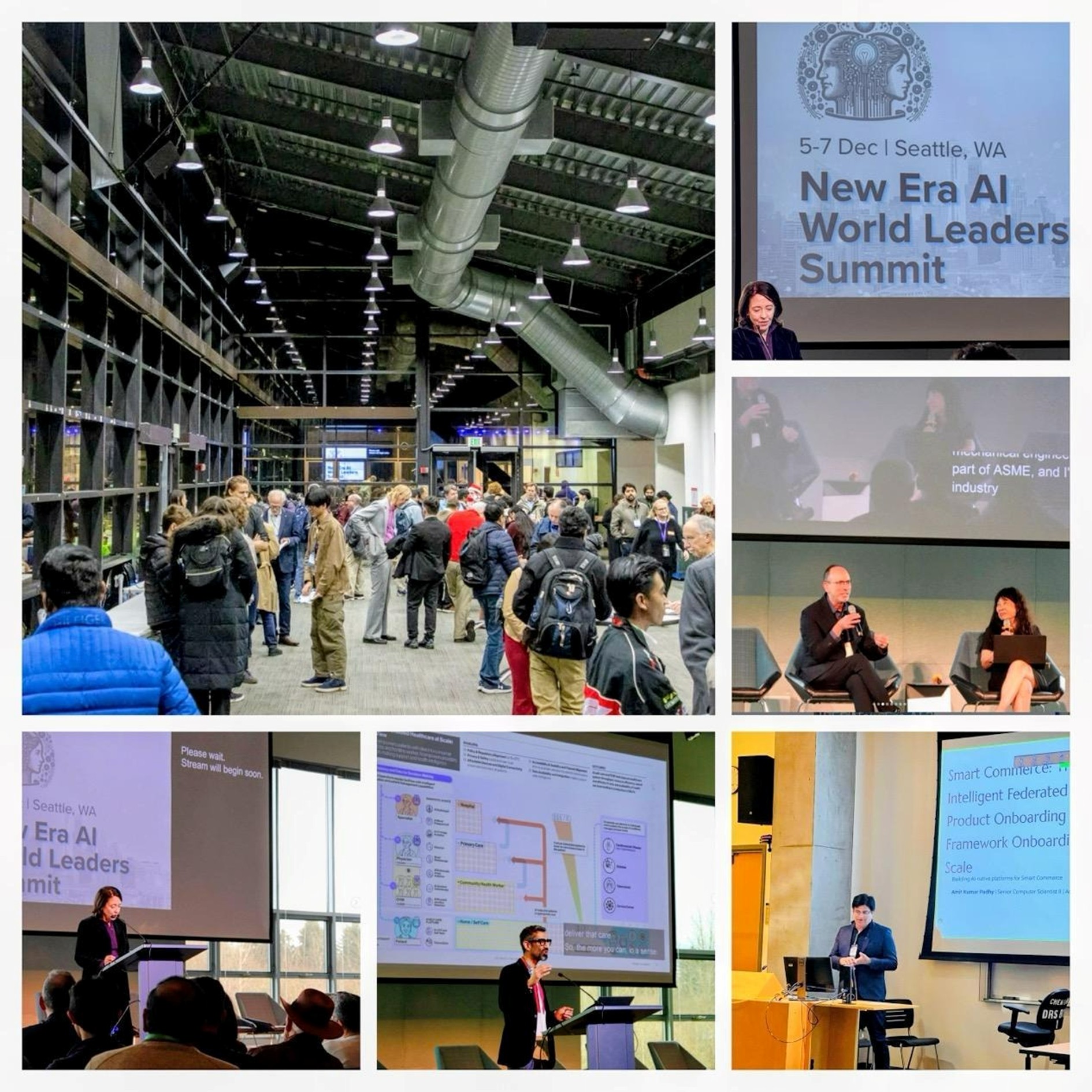
SEATTLE/BOTHELL, Wash. — The conversation around artificial intelligence is changing. The 2025 IEEE New Era AI World Leaders Summit, held at the University of Washington Bothell from December 5th to 7th, brought together technology leaders, policymakers, and engineers with a single focus: moving AI from the lab to working, real-world applications.
This three-day event was organized by New Era AI event chair Sheree Wen. “Working Forum” Rather than a showcase, representatives from tech giants including Google, Amazon, Microsoft, OpenAI, Meta, Boeing, LinkedIn, Salesforce, Zillow, and Zscaler came together to tackle the humble but important question of how to improve the reliability of large-scale AI systems.
Fusion of policy and practice
U.S. Senator Maria Cantwell, Ranking Member of the Senate Committee on Commerce, Science, and Transportation, set the tone early by emphasizing that responsible AI adoption is not just an ethical obligation, but a national priority. Her remarks centered on workforce readiness and the need for an innovation framework that protects both users and workers as AI adoption accelerates.
The technical foundation for that deployment was laid out by IEEE-USA President and Boeing Technical Fellow Tim Lee, who detailed the advances in microelectronics and semiconductors that will enable the next stage of AI. Without these hardware breakthroughs, especially in heterogeneous integration, the industry's ambitions for scalable AI will remain theoretical.
Real-world applications take center stage
Beyond infrastructure, speakers explored areas where AI is already having a tangible impact. Harold Tobin, director of the Pacific Northwest Earthquake Network, demonstrated how AI-powered data analysis is enhancing earthquake and tsunami early warning systems. This is literally a life-or-death application, highlighting the dangers of properly deploying it.
Sessions covered a wide range of topics, from trustworthy AI validation and privacy-preserving architectures to serverless computing, digital twins, and intelligent automation. Consistency: Move from proof-of-concept demos to production-grade systems that can handle complexity, failure, and regulatory oversight.
Amit Kumar Padhy, Senior Computer Scientist II at Adobe, provided an architectural-level perspective on agent AI systems designed to operate semi-autonomously within enterprise environments. His presentation focused on practical design patterns, event-driven orchestration, contract-first integration, and human-involved control that enables automation without sacrificing monitoring or reliability.
Prioritize deployment over disruption
By the summit's conclusion, consensus had been reached across policy, industry, and technology areas. The next era of AI will not be defined by increasingly large models or flashy demonstrations, but by systems that are robust enough to work reliably under real-world conditions, auditable, maintainable, and trustworthy.
In that sense, the Bothell Summit captured a tipping point in the transition of AI from a promised technology to one measured by deployment, performance, and accountability. The era of AI prototypes is coming to an end. Work towards practical application has begun.


