
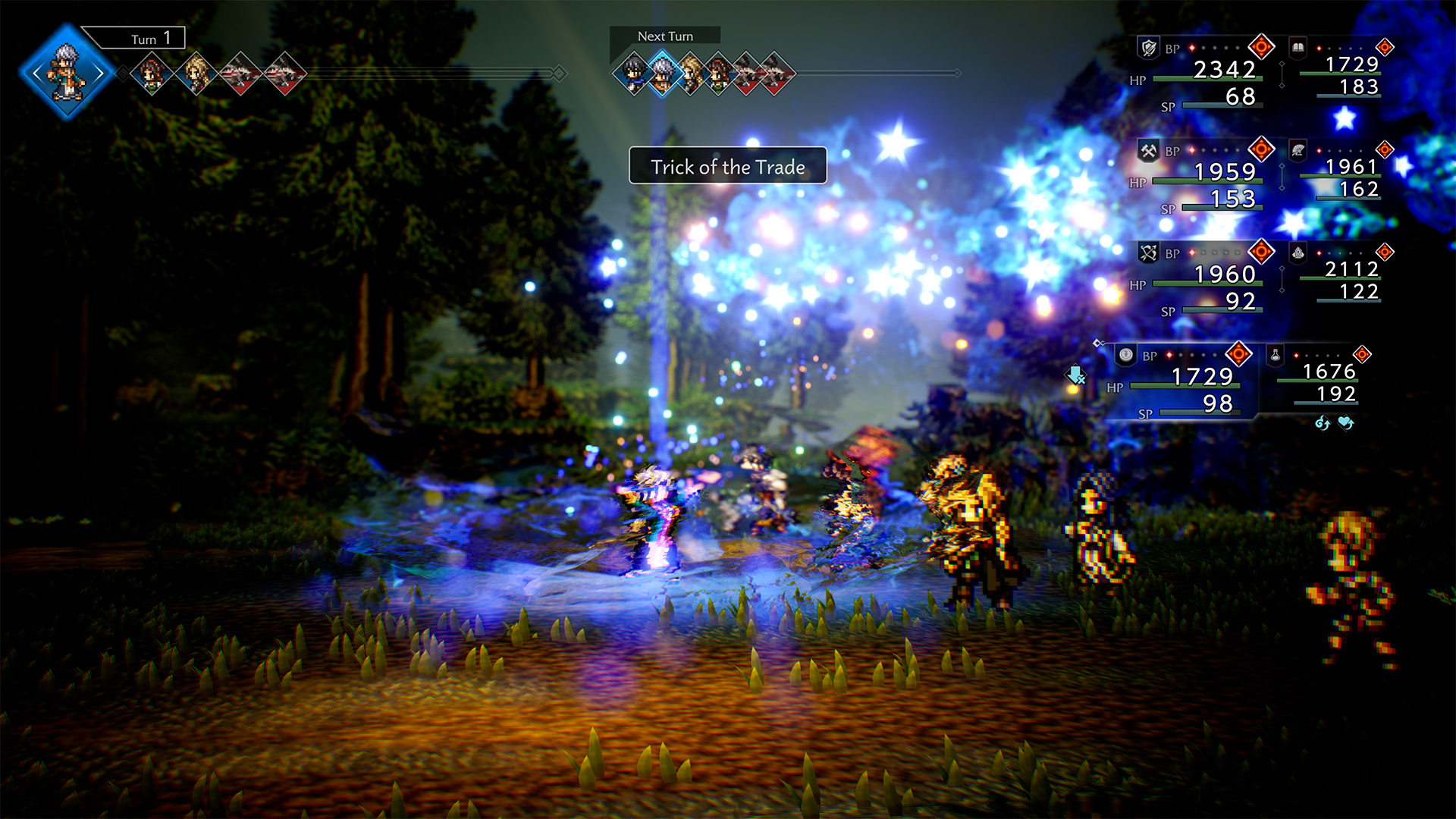
When I wrote a review of Octopath Traveler 0 last year, I bluntly commented that the game had “sprite art as a form of poetry.” I didn't really pay attention to it at the time, but since then several people have told me that they liked this comment. This is what got me thinking and I would like to elaborate further here. Because it explains why I prefer good sprite art over other video game aesthetics.
The reason sprite art is so beautiful when done well is that, like poetry, the approach to art is inherently limited. You should create an aesthetically appealing abstraction of a person, monster, or object using a mosaic of small squares in just a few colors. And even if you don't have the ability to express subtlety or depth within your animation, you still need to give those pieces personality and make them interesting to your audience. By definition, sprite work is a rare skill set, in the same way that theater acting is a different skill set than film acting. Sprite artists need to figure out how to project and articulate into the proverbial “back of the room” without relying on microphones or close-up shots to capture things that those at the back of the room can never see.
Kefka's laugh in Final Fantasy VI would have been considered disgustingly over-the-top if, say, Heath Ledger had adopted it for his performance as the Joker (if only to compare two forces of total evil that are completely nihilistic and unhinged). But Final Fantasy VI's art team could never have captured the subtly manic state and keen eye of Ledger's incredible performance. Kefka works because the team found an absolutely stunning and memorable way to convey the same level of intense sociopathy in a tiny mosaic of colored squares that violently quiver every time a character bursts into laughter.
The point here is that spritework is an exercise in working within extreme limits, and (going back to poetry) that's how the entire art form works. Whereas novels are creatively open, poetry has all sorts of rules. Rules can be tested and even broken, but they are the structural rules that bind an art form together. In some cases, such as Japanese haiku and Shakespeare's sonnets, these structures and restrictions are extreme.
Even so, within these limitations, Matsuo Basho was particular about paper and created words that were breathtakingly beautiful. Edgar Allan Poe's most famous work, The Raven, is quite a masterpiece because it uses poetic rhythm to create a dark, gothic atmosphere that is very thrilling to read. And, of course, the epic poems of Dante, Malory, and Beowulf had such exquisite depth that it would take many times as many words to create a novel.
Limitations unleash creativity. It's one of the “secrets” of art that artists understand well, but people outside the art world tend not to. One of the reasons I find generative AI so disgusting as a creative tool is that its entire premise is to remove limitations from creation. Unlimited access to actors, unlimited shot retakes, and unlimited words all included for a small fee.
This is an expression of a certain ideology. Modern Silicon Valley leans libertarian (so much so that it falls head over heels), and that philosophy shapes the way it approaches creative work. In this worldview, art is just another market inefficiency that must be destroyed. The constraints within which artists work, such as budget, time, and material limitations and the years spent developing their craft, are reframed as frictions, gatekeepers, and barriers between consumers and the content they desire. Generative AI is the logical endpoint of this idea. Anyone can create anything in an instant, and the tedious human labor that once got in the way has been optimized out of existence.
The political consequences of this frictionless generation are predictable and profound. The fascist movement has always understood that propaganda is a volume game, one that floods the zone and overwhelms discourse, making it impossible to distinguish between signal and noise. What they lacked was production capacity. AI has solved that problem. The same tools that allow hobbyists to create concept art for games allow villains to create endless amounts of disinformation, fake images, and fabricated outrages at virtually no cost. The designers of the technology may not have intended this, but certain examples, such as the son of a South African mining magnate, suggest it was entirely intentional. In any case, it's not an unforeseen accident for anyone other than Elon. If you build a system explicitly designed to remove all friction from content creation, you can't act surprised when the people most enthusiastic about creating unlimited content turn out to be the ones with the worst intentions.
What all these groups fail to understand (mainly because they don't respect the political dimension) is that even if you remove the political dimension, the creative problem remains. Without limits, the creative process has no meaning. Kefka's Laughter was definitely a deliberate solution created in a workshop, prototyped, tested, rejected, and then tested again. At each point in the process, the development team was looking for ways to work within the limits of the form. There has never been a more memorable or impactful moment generated by AI.
It turns out that the AI prompter doesn't just type the prompt and accept the initial output. They iterate on it (or keep hitting the “generate” button until they get something they like). The better ones combine, refine, and sometimes even incorporate real art into the process. But this is precisely the point at which the constraint argument is most serious. The iterations that occur in AI workflows are selections, not creations. Rather than solving the problem of how to represent something within strict limits, humans culminate from a field of machine-generated possibilities. thoughts occur rear Not a generation, through that. Practitioners may reject 100 outputs before finding one that works, but they didn't have to face the problems that the FFVI team faced. How can you express sociopathy in a 32-pixel figure when you can't show the player the strength of your eyes, you're limited in how you can animate your face, and you can't do any subtle manipulation with your body movements? Confronting constraints is where creative meaning comes from.
Sadly, as these movements become more and more mainstream, creating art that works within constraints is becoming counterculture.
Unlike poetry or sprite work, the AI also doesn't challenge the audience. These exist within strict constraints and are therefore highly abstracted, leaving us as viewers to fill in the gaps. We have to build a picture of what Kefka looks like, beyond the small dots that give us a hint of Kefka's color. When reading a poem, we need to visualize what the author is explaining with just a few key words. The gaps in these works of art are as important as what's there. Collaboration between author and audience is critical to the resonance of the work. AI generation, on the other hand, is literally a machine effort to recreate the prompt, and anything that isn't prompted is the product of random generation with no meaning behind it. There is no collaboration in this system. Produced by teleprompters and consumed by viewers.
There's no doubt that there will be people out there putting sprite “art” out there, and there will be games that will be produced in large numbers in these generations. But I think real people working on pixel games have an advantage here. Firstly, AI systems have a terrible understanding of working within limits, and secondly, the people creating the prompts don't either. Sprite art is abstract, like poetry, and requires a certain level of interpretation and literacy to fully interpret and understand its form, but for those who can, there is a depth of human creativity and emotion in this art that even the biggest and most expensive blockbusters (not even GTA VI itself) can match.


