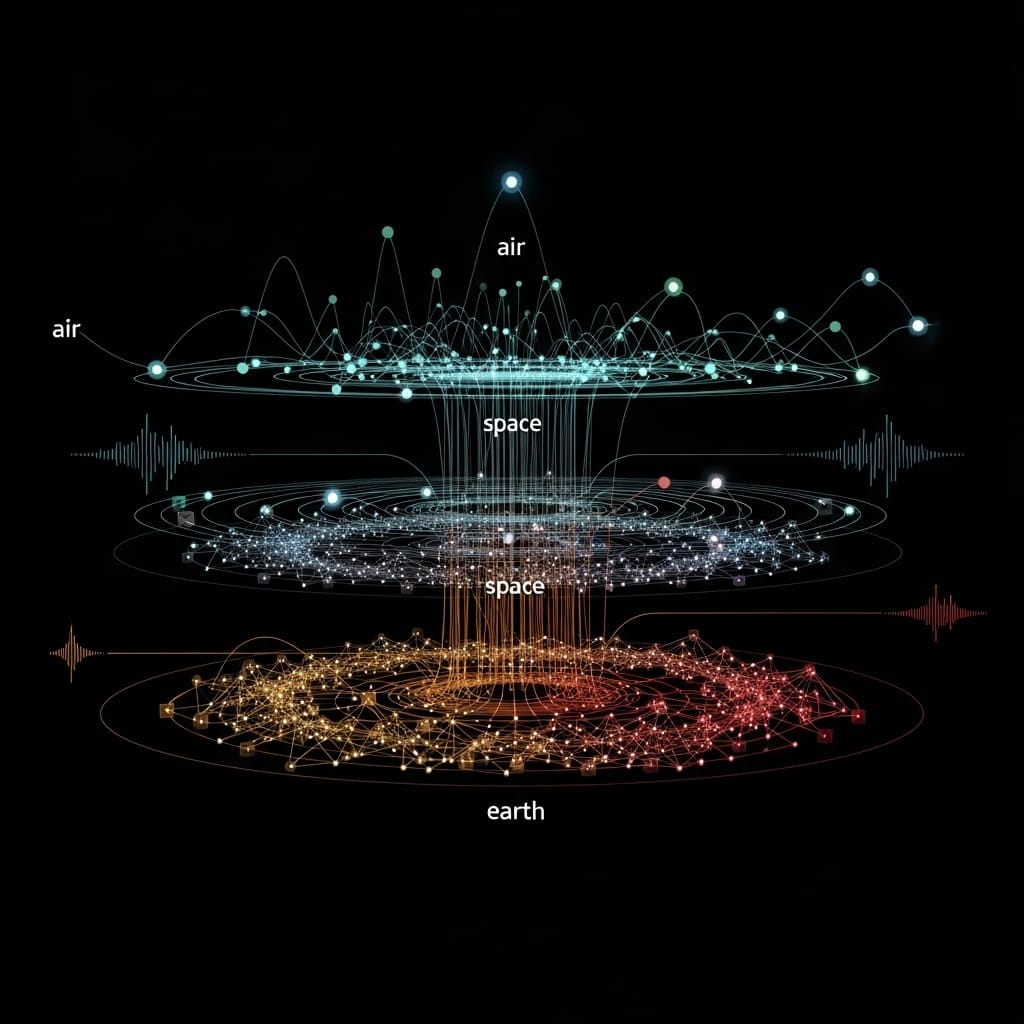
The growing demand for seamless connectivity is driving the development of integrated space, air, and ground networks, and multi-connectivity, the ability to utilize multiple network links simultaneously, is a key step toward next-generation network capabilities. Abd Ullah Khan of Kyung Hee University, Adnan Shahid and Hye-jun Jeong of Ghent University, along with Hyung-dong Shin and others, are investigating the current status and future possibilities of this technology. Their research addresses critical challenges arising from the complex interactions between terrestrial and non-terrestrial networks, where diverse communication links require sophisticated resource allocation strategies. The team will demonstrate how advanced artificial intelligence, and in particular agent reinforcement learning, can provide innovative solutions to significantly improve network performance in terms of speed and capacity, paving the way for more efficient and resilient communication systems.
Agent reinforcement learning for 6G networks
This study details the system of Space-Air-Ground Integrated Network (SAGIN) for 6G communications and proposes the use of agent reinforcement learning (RL) to intelligently manage resources across network layers. This study identifies challenges in integrating space, air, and ground networks, including technology heterogeneity, synchronization issues, and resource allocation complexity. Agenttic RL is introduced as a way to create intelligent and adaptive networks that can address these challenges. At the core of this work is an RL-based algorithm designed to jointly optimize link selection based on capacity, delay, and power.
Simulations demonstrate the effectiveness of our algorithm compared to baseline approaches and show that it is able to balance competing performance objectives. Future research directions include hierarchical control frameworks for synchronization, dynamic spectrum sharing for resource allocation, and co-design of baseband processing for energy efficiency. The paper concludes by summarizing its contributions and reiterating the potential of SAGIN and agentic RL, supported by funding from various sources.
SAGIN multi-connectivity for 6G networks
Researchers are exploring Space-Air-Ground Integrated Network (SAGIN) and Multi-Connectivity (MC) as key technologies for future 6G networks, aiming for terabits per second data rates, low latency, and high availability. This research focuses on integrating terrestrial and non-terrestrial networks, including air-to-air, air-to-space, and ground-to-ground communication links, to create a standardized architecture and address the complexity of resource allocation. To overcome these challenges, the team developed an agent reinforcement learning (RL) approach to optimize resource allocation within the SAGIN environment. This method uses an artificial intelligence agent that learns to adapt to changing channel conditions and network topology to intelligently select the best network links for multiple connections.
Experiments conducted in a heterogeneous network environment demonstrate that the system improves data rates through traffic aggregation and reliability through redundancy. The results show that the learning-based method effectively manages complex scenarios and significantly improves network performance in terms of latency and capacity. Although a modest increase in power consumption is observed, the team believes this is an acceptable trade-off for improved network efficiency and resiliency, paving the way for ubiquitous connectivity and support for demanding 6G services.
Reduce latency in integrated networks with multiple connections
Scientists are designing wireless networks based on Space-Air-Ground Integrated Network (SAGIN) and Multi-Connectivity (MC) to meet the demands of next-generation communication systems. This effort addresses the need for terabits per second data rates, sub-millisecond latency, and reliable connectivity for billions of devices, integrating terrestrial and non-terrestrial networks with global coverage. The team's research focuses on enabling devices to utilize multiple network links simultaneously, increasing data rates and improving reliability. Experiments demonstrate that multi-connection significantly reduces latency by employing optimal path selection and supports load balancing through dynamic bandwidth utilization.
Researchers have developed agent reinforcement learning (RL) algorithms to intelligently manage diverse communication links, allowing the system to adapt to changing conditions and optimize performance. The results show that the learning-based approach effectively handles complex scenarios and significantly improves network performance in terms of latency and capacity, with a modest increase in power consumption considered to be an acceptable trade-off. This breakthrough paves the way for ubiquitous connectivity and resilient service provisioning in dynamic environments.
Optimize SAGIN performance with agentic reinforcement learning
This study provides a comprehensive overview of Space-Air-Ground Integrated Networks (SAGIN) and multiplexed connections, addressing the complexities of combining diverse communication links. The research team demonstrates that intelligent resource allocation is critical to realizing the potential of these networks, given the heterogeneity of available links and technologies. Through a detailed case study, we successfully implement and evaluate an agent reinforcement learning algorithm designed to jointly optimize link selection based on capacity, delay, and power consumption. The results show that the learning-based method can effectively manage complex network scenarios and achieve significant improvements in both latency and capacity, with a modest increase in power usage, which is a valuable trade-off. Future research will focus on addressing open issues to enable scalable, resilient, and high-performance SAGIN-enabled multi-connectivity, and will build on these findings to pave the way for more efficient network architectures. This research was supported by grants from the National Research Foundation of Korea and the Ministry of Science, Information and Communications of Korea.
👉 More information
🗞 SAGIN Multi-Connectivity: Current Trends, Challenges, AI-Driven Solutions, and Opportunities
🧠ArXiv: https://arxiv.org/abs/2512.21717