Designing nanoscale materials that control light, known as photonic metasurfaces, is a major challenge for scientists, requiring both precision and creativity. Now, David Dang, Stuart Love, and Meena Salib, along with their colleagues, are pioneering a new approach that combines artificial intelligence with fundamental physics. Their work introduces METASTRINGS, a symbolic language that describes these complex nanostructures as simple text, on which they build Meta-GPT, a powerful AI model trained to understand and generate metasurface designs. The research team demonstrated that Meta-GPT can accurately predict how metasurfaces will interact with light, achieving exceptional accuracy and producing new prototypes with responses that closely match desired properties. This is a key step towards automating the discovery of advanced photonic materials and ultimately unlocking the 'meta-surface genome project'.
Machine learning accelerates metamaterial design exploration
Researchers have pioneered a new approach to designing metamaterials, artificial materials engineered to have properties not found in nature, by combining machine learning and reinforcement learning. To address the time-consuming, trial-and-error nature of traditional metamaterial design, the team developed METASTRINGS, a string-based language that allows models to generate designs in a compact and manageable manner. At the core of this new method is Meta-GPT, a generative model trained to create METASTRINGS representing metamaterial designs. The model learns to generate a design and uses reinforcement learning to refine the design and optimize it for specific performance criteria, such as light absorption.
A technique called chain-of-thought prompting improves a model's reasoning ability and allows it to explain its design choices. The team used computer simulations to create a dataset of metamaterial designs and their electromagnetic properties, and trained and tested Meta-GPT on this data. Results show that this framework successfully automates the design of metamaterials with desirable properties and, in some cases, the generated designs outperform traditional designs. The model also shows the ability to generalize to new design spaces and optimize for different performance criteria. Experimental validation shows that the fabricated structures are in good agreement with simulation results, confirming the accuracy of the framework. This research highlights the potential of artificial intelligence to revolutionize metamaterial design, providing materials scientists and engineers with powerful new tools.
Photonic metasurface design using generative AI
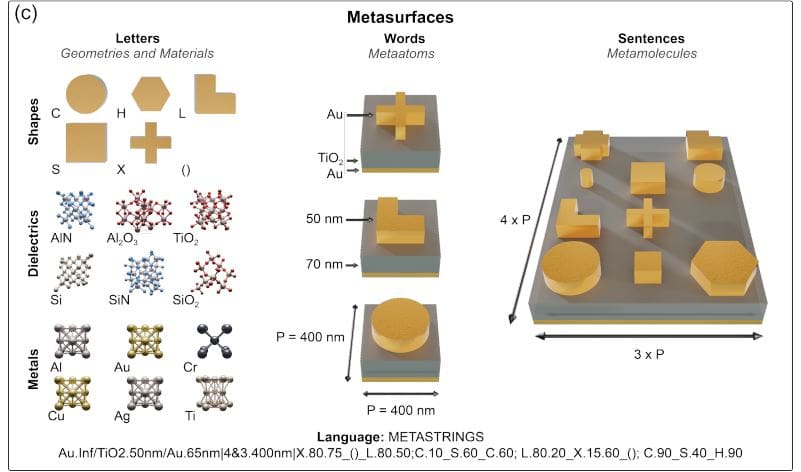
Scientists have developed a new method for designing photonic metasurfaces, nanoscale structures that control light, by harnessing the power of generative artificial intelligence. The team introduced METASTRINGS, a symbolic language that represents these complex structures as text sequences, mirroring the way molecules are represented in chemistry. This language encodes critical information about materials, geometry, and lattice configurations and establishes a framework that connects human understanding with automated design principles. Based on this foundation, researchers developed Meta-GPT, a generative model trained on the large dataset of METASTRINGS.
The model was further refined using supervised learning, reinforcement learning, and chain-of-thought strategies to incorporate intermediate inference steps to improve design accuracy and performance. Unlike previous approaches, Meta-GPT leverages the unique structure of METASTRINGS and enables more efficient inference about photonic structures while maintaining human readability. The experiments included generating various metasurface prototypes using Meta-GPT and fabricating these structures for experimental validation. The resulting design achieved high accuracy with mean squared spectral error less than 3% and construct validity greater than 98%. Importantly, the experimentally measured responses closely match the target spectrum, validating the effectiveness of the language-driven design paradigm and establishing a new approach to scalable and interpretable metasurface design. This achievement is a breakthrough in AI-driven photonics and paves the way for similar linguistic expressions in other physical sciences.
Design of high-fidelity photonic nanostructures with Meta-GPT
Researchers have developed a new approach to designing photonic nanostructures, nanoscale structures that control light, by combining a new symbolic language with powerful artificial intelligence models. The team introduced METASTRINGS, a language that expresses these structures as text sequences, mirroring the way molecules are represented in chemistry. This language encodes materials, shapes, and lattice configurations and establishes a framework for capturing the structural hierarchy of metasurfaces, enabling new approaches to AI-driven photonics. This study introduces Meta-GPT, a foundational model trained on METASTRINGS and refined using supervised learning, reinforcement learning, and thought chain reasoning.
Experiments demonstrate that Meta-GPT achieves high accuracy with a mean squared spectral error of less than 3% across a variety of design tasks while maintaining syntactic validity of more than 98%. This means that this model generates a variety of metasurface prototypes whose experimentally measured optical responses closely match the spectra of the target, confirming the model's ability to accurately predict and design optical behavior. The generated designs are not only accurate, but also interpretable, as the textual representation allows humans to understand the underlying structure and functionality. This approach goes beyond previous methods relying on natural language processing and simple parameter lists and takes advantage of a language specifically designed for photonic structures. This allows Meta-GPT to more efficiently reason about photonic designs while remaining easily understandable to human researchers. This breakthrough provides a rigorous foundation for the “Metasurface Genome Project”, enables scalable and interpretable design of photonic structures, and represents an important step towards automated discovery in the field.
Metasurface design using language model training
In this study, we introduce METASTRINGS, a new textual language for representing photonic metasurfaces, and demonstrate its effectiveness when integrated with a large-scale language model called Meta-GPT. METASTRINGS provides a framework that couples human interpretability with automated design by encoding materials, shapes, and lattice configurations as symbolic sequences, mirroring approaches used in molecular chemistry. The researchers then trained Meta-GPT on this language and further honed its capabilities with physics-based learning techniques. The resulting model achieves high accuracy in generating metasurface designs and consistently matches the target spectral response with a mean squared error of less than 3% while maintaining a high degree of construct validity.
Different training approaches, such as reinforcement learning and thought-chain reasoning, have developed complementary strengths, with reinforcement learning prioritizing optimization and consistency, and thought-chaining increasing design diversity and interpretability. These results demonstrate that Meta-GPT can learn the fundamental rules governing light-matter interactions through the METASTRINGS framework and move beyond simple pattern recognition to physics-aware design. Future work aims to extend the framework to encompass a wider range of photonic systems, including beam steering and holographic devices, by incorporating additional layers and polarization descriptors into the language. This scalable approach offers a promising path towards fully automated language-based design in photonics and could pave the way for a comprehensive “metasurface genome project.”