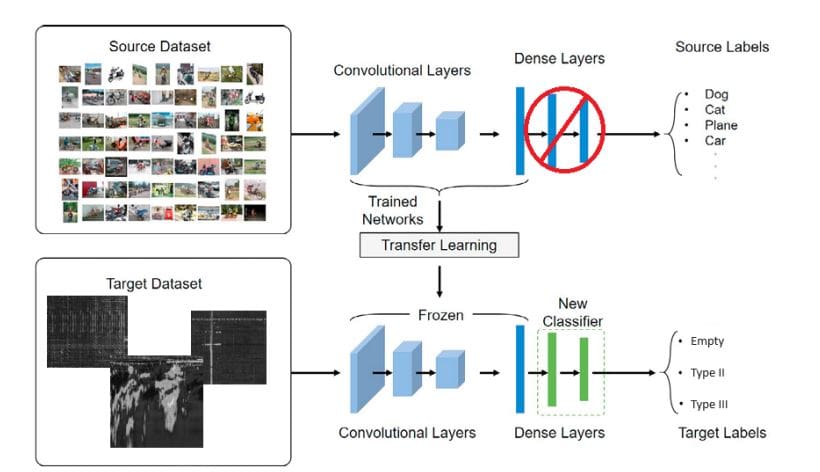
Powerful radio emissions from the Sun, known as solar radio bursts, can pose a danger to radio communications and signal destructive space weather events. Herman le Roux, Ruhann Steyn, and colleagues at research institutions such as the Dublin Institute of Advanced Study and Shannon University of Technology have published a new automated method for classifying these bursts. The research team applied transfer learning, a technique that leverages pre-trained deep learning models, to successfully distinguish between Type II and Type III solar radio bursts using images of the radio spectrum. Their work, which evaluated models such as VGGnet-19 and YOLOv8, achieved high classification accuracy with F1 scores ranging from 87% to 92%, demonstrating a practical solution for classifying these events even with limited data, and significantly advancing the potential for real-time monitoring and improved space weather forecasting.
Investigating solar radio burst data sources
This study provides an overview of a set of datasets and data sources relevant to the classification of solar radio bursts, including both established repositories and repositories compiled for recent research efforts. Key resources include CALLISTO Quicklook Solar Spectrogram Plots, data from the Rosse Solar-Terrestrial Observatory, and links provided through the International Space Weather Initiative (ISWI). Additional observations from the NenuFAR facility and the Deimos Solar Radio Spectrometer (DSRT) further enrich the available dataset.
The researchers also provide datasets derived from studies by Le Roux et al., Scully et al., Wang et al., Wang and Yuan, Zhang et al., and Zhao et al. The main data format consists of solar spectrograms, which visually represent radio frequency intensity over time and are characterized by parameters such as duration, frequency range, and morphological features. Some datasets, such as CALLISTO, are readily accessible, while others may require you to contact each researcher directly for access.
Classifying types of solar radio bursts using deep learning
Scientists have developed a method to automatically classify solar radio bursts (SRBs) using deep learning and transfer learning. Recognizing the limited availability of data, particularly Type II bursts, the researchers adopted a stratified sampling strategy to create a balanced training dataset. This includes fine-tuning five pre-trained convolutional neural network (CNN) architectures: VGGnet-19, MobileNet, ResNet-152, DenseNet-201, and YOLOv8 using the constructed dataset.
This transfer learning approach leverages knowledge from models previously trained on large image datasets to accelerate learning and improve performance with limited SRB data. The researchers froze most of the layers in each pre-trained network to preserve the learned feature extraction and retrained only the last layer to adapt the model specifically for SRB classification. Test results showed that YOLOv8 achieved the best performance with F1 scores ranging from 87% to 92%, demonstrating the effectiveness of transfer learning in automating SRB classification and overcoming data limitations.
Automatic solar radio burst classification using transfer learning
This research represents a breakthrough in the automated classification of solar radio bursts (SRBs), powerful radio emissions from the Sun that can disrupt communications and indicate significant space weather events. The team adopted a stratified sampling strategy to overcome the limited availability of Type II SRB data and constructed a balanced training dataset using spectrogram images from the e-Callisto network. The core of this work lies in the application of transfer learning to fine-tune five established CNN architectures: VGGnet-19, MobileNet, ResNet-152, DenseNet-201, and YOLOv8 to classify SRBs. It leverages knowledge from pre-trained models and effectively addresses the challenges of limited data and observational variability. Testing results showed consistently high performance for all models with F1 scores ranging from 87% to 92%, with YOLOv8 showing the best performance and establishing it as the most effective model for automatic SRB classification.
Automate solar burst classification with deep learning
Researchers developed and tested a series of automated methods to classify solar radio bursts, powerful radiation from the sun that can disrupt radio communications and indicate larger space weather phenomena. Test results showed excellent performance for all models with F1 scores ranging from 87% to 92%, demonstrating the potential of deep learning in automatic event classification. In particular, the YOLOv8 model consistently performed better than other models, achieving an overall accuracy of 92%. Future studies will consider ensemble methods and automatic parameter extraction to enable large-scale statistical studies of these solar phenomena.