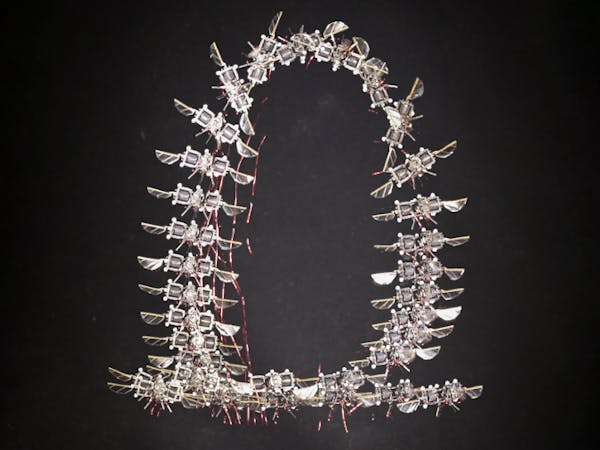
Researchers at the Massachusetts Institute of Technology (MIT) have designed a small flying robot that is as fast and agile as a bumblebee. The robot could one day be useful in search and rescue missions.
“We want to be able to use these robots in scenarios where traditional quadcopter robots are difficult to fly, but insects can navigate,” co-senior author Kevin Chen, associate professor and director of the Soft and Microrobotics Laboratory at MIT’s Institute of Electronics, explains of the project. “Now, with a biologically inspired control framework, the flight performance of robots is comparable to insects in terms of speed, acceleration, and pitching angle. This is a very exciting step toward future goals.”
Researchers say a computationally efficient machine learning model has enabled robot control to be as agile as a bee. (📹:Xiao et al.)
The robot itself is based on earlier research on small aerial robots, modified to have large flapping wings like bee wings for improved agility, and to be powered by soft artificial muscle actuators. However, the potential performance of the robot itself exceeded the capabilities of its “brain,” forcing the team to develop a two-stage artificial intelligence (AI) control system that could handle high-speed maneuvers without requiring excessive computational resources.
“Advances in hardware have led to advances in controllers, so you can do more on the software side, but at the same time, as controllers have evolved, you can do more with hardware,” explains co-lead author Jonathan P. How. “As Kevin [Chen]The team will demonstrate new functionality and demonstrate that we can take advantage of it. ”
The system is a model prediction system that has trained a computationally efficient deep learning policy model through imitation learning to provide real-time control, and has proven its capabilities in tests. The tiny robot was able to fly 447 percent faster than under the control of a manually tuned model, increasing its acceleration by 255 percent, completing 10 somersaults in 11 seconds, and never straying more than a few inches from its planned trajectory. This system was also used to implement saccadic movements, rapid flights used by some insects for localization.
The AI control system has proven capable of accelerating the robot to more than three times its original acceleration and five times its speed, as well as better handling impulsive movements and disturbances. (📷:Xiao et al.)
“This biomimetic flight behavior could be useful in the future when we start equipping robots with cameras and sensors,” Chen said. “For the microrobotics community, we hope this paper signals a paradigm shift by showing that it is possible to develop new control architectures that are both high-performance and efficient at the same time.”
The team’s results were published in a magazine scientific progress Under open access conditions.