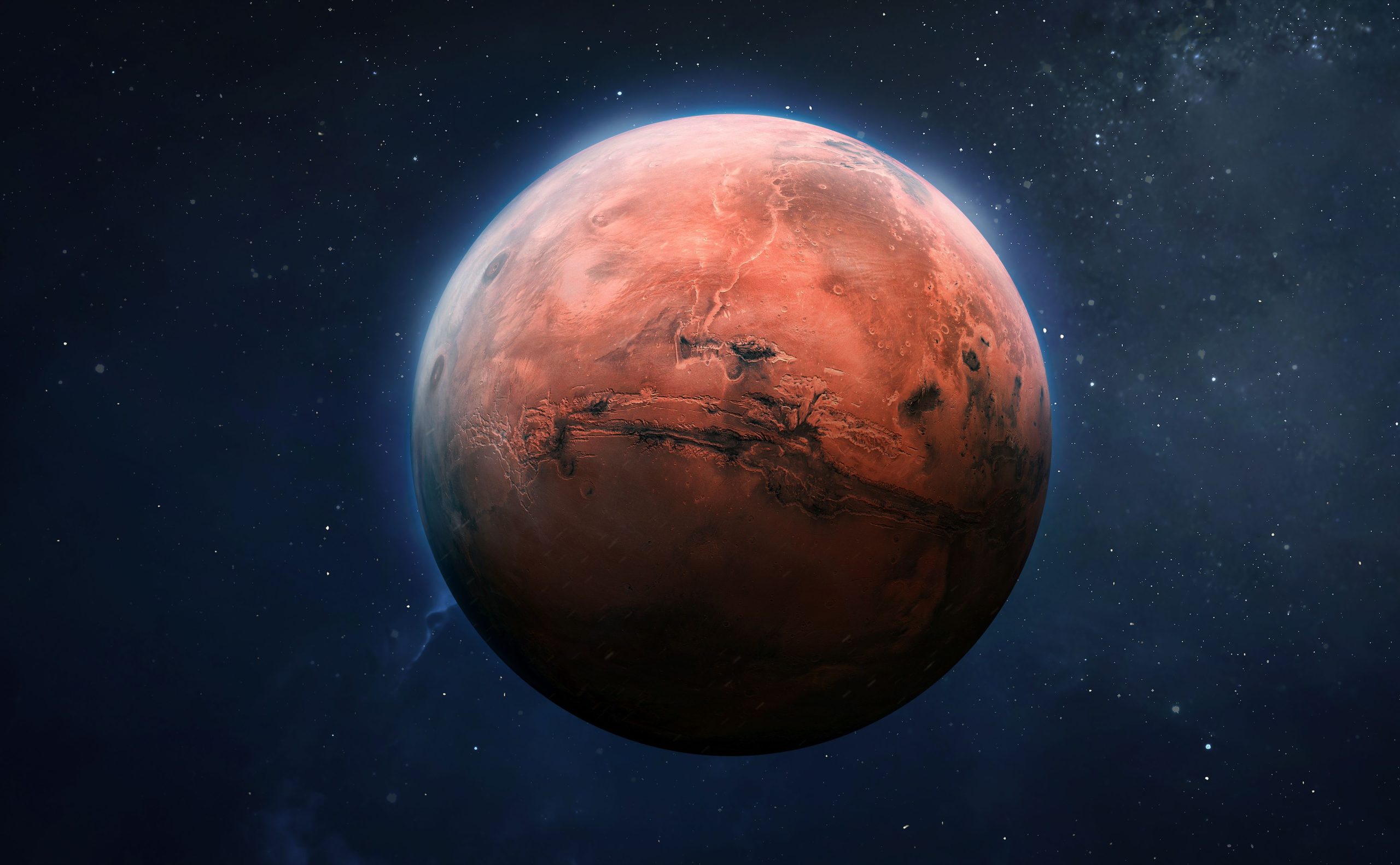
A collaboration between the Georgia Institute of Technology (Atlanta, Georgia) and NASA Goddard Space Flight Center (Greenbelt, Maryland) used 2D gas chromatography coupled with high-resolution time-of-flight mass spectrometry (GC x GC-HR-TOF-MS) to analyze a series of meteorite and terrestrial samples and systematically compare the molecular distribution of their organic components. This work led to a paper published in PNAS Nexus, hypothesizing that meteorite samples can be distinguished from terrestrial rocks by differences in the distribution of organic compounds (1).
Future sample return missions, such as NASA’s Mars Sample Return (MSR) and JAXA’s Mars Moon Exploration (MMX), aim to bring back samples from the Mars system containing material from environments that may once have supported life. To answer questions about the origin of life, these missions will require the development of unbiased tactics to assess where samples containing abiotically synthesized organic compounds are separated from samples containing biological remains of past or present life (2-4). These samples include carbonaceous chondrites. Carbonaceous chondrites are a class of primitive, organic-rich meteorites that represent the oldest solid material in the Solar System available for scientific analysis. The soluble organic compounds in these meteorites provide evidence of abiotic chemical reactions that predate the beginning of life as we know it (5-7).
“Determining whether organic molecules in planetary samples originate from biological or non-biological processes is central to the search for extraterrestrial life. However, distinguishing between these origins is difficult due to overlapping chemical signatures and limited access to extraterrestrial materials,” the authors write in the paper. (1)
To deconvolve the large data sets resulting from the analysis, the team developed LifeTracer, a computational framework for mass spectrometry data processing and downstream machine learning (ML) analysis. LifeTracer leveraged analyte metrics from GC x GC-HR-TOF-MS to identify predictive molecular signatures that distinguish abiotic from abiotic sources, enabling robust classification of meteorites from Earth samples based on their non-polar soluble organic matter composition (1).
“In contrast to traditional biomarker-based approaches, LifeTracer analyzes untargeted chemical signatures to infer molecular origins with high accuracy. This enables scalable and unbiased biosignature detection, providing a powerful tool for interpreting complex organic mixtures returned by current and future planetary missions” (1).
LifeTracer identified an unbiased set of discriminating characteristics across sample types. This enabled classification based on their organic distribution, without relying on the presence or absence of known biosignatures. However, scientists cannot rely on a single organic molecule to determine whether extraterrestrial organic matter is of living or nonliving origin, as many of these compounds are present on both sides. Therefore, the overall molecular patterns that serve as biosignatures are compared. Because Mars samples already contain complex mixtures from multiple sources, advanced multivariate tools like LifeTracer, supported by machine learning and expert analysis, will be important to assess whether patterns resemble known biological or abiotic signatures, especially as Mars sample return missions progress (1).
Read more on similar topics:
Check out our sister publications on similar topics here. spectroscopy:
References
- Saidi, D. Buckner, D. Walton, TA et al. Identification of abiotic and biological organic matter in meteorites and terrestrial samples using machine learning of mass spectrometry data. PNAS Nexus 2025, 4 (11), pgaf334. Doi:
10.1093/pnasnexus/pgaf334 - MM Grady explores Mars with returned samples Space science. pastor 2020, 216, 51.DOI:
10.1007/s11214-020-00676-9 - Saidi, D. Buckner, D. Aponte, JC et al. Astroagents: Multi-agent AI for generating hypotheses from mass spectrometry data [preprint]. arXiv 2025, 2503.23170. Doi:
10.48550/arXiv.2503.23170 - Tetsuya Usui et al. The importance of Phobos sample returns for understanding the Mars-Moon system. Space science. pastor 2020, 216, 49. Doi:
10.1007/s11214-020-00668-9 – citeas - Aponte, J.C. MacLaine, Halloween. Saeedi, D. et al. Challenges and opportunities in using amino acids to decipher parent processes in carbonaceous chondrites and asteroids. astrobiology 2025, twenty five (6), 437-449. Doi:
10.1089/ast.2025.0017 - Glavin, D.P. et al. Origin and evolution of organic matter in carbonaceous chondrites and their connections with their parent bodies. in: Primitive meteorites and asteroids: physical, chemical, and spectroscopic observations paving the way for exploration. Elsevier, 2018. p. 205-271.
- Pizzarello, S. Schock, E. Carbonaceous chondrite meteorites: chronicling a potential evolutionary pathway between stars and life. original. life. evolution. Biosph. 2017,47 (3), 249-260. Doi:
10.1007/s11084-016-9530-1